
The pattern has gone live for the
Woven Elephant that I designed for Lion Brand on the Martha Stewart loom
HERE’S THE LINK TO IT
She’s a cutie!
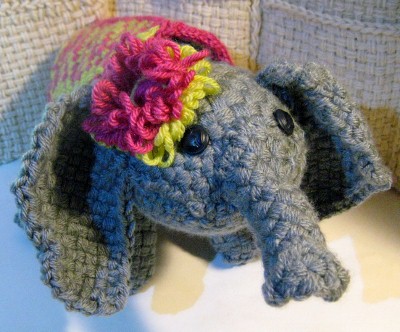
copyright Noreen Crone-Findlay
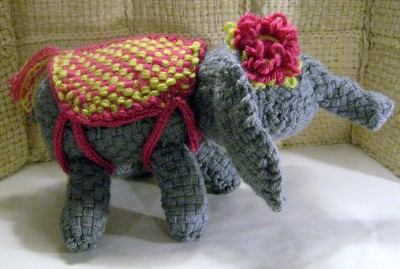
copyright Noreen Crone-Findlay
I love elephants…..
happy weaving! 😀

The pattern has gone live for the
Woven Elephant that I designed for Lion Brand on the Martha Stewart loom
HERE’S THE LINK TO IT
She’s a cutie!
copyright Noreen Crone-Findlay
copyright Noreen Crone-Findlay
I love elephants…..
happy weaving! 😀
If you are teaching a child to weave, or just want an impromptu, no cost small loom for sampling yarns and colorways, this little loom is very handy.

copyright Noreen Crone-Findlay
The project on the foam food tray loom is a bookmark, but you can weave amulet bags, rug mugs, small dolls and toys, doll house rugs or squares that you stitch together to make larger projects.
It’s great for traveling, as it’s light, and if you use a plastic darning needle for weaving, it’s fine to take through airport security.
Yesterday, I posted part one of the recycled and upcycled looms: Here’s the link: PART ONE
I think that one of the most accessible looms for beginning weavers is the weaving stick loom.
I am doing a lot of designing for it – here’s my post about the mermaid to weave on the stick weaving loom: LINK
Happy Weaving!!!!
Yesterday, I posted about teaching children to weave Link
One of the pleasures of weaving is that it can be done with tremendously complex machines, but, can also be done with small bits of this and that from around the house.
Today and tomorrow, I am going to be posting little how to’s on making recycled and upcycled looms that are great for teaching kids how to weave, or just for noodling about with sampling yarns and weaving little bags, or hacky sacks or bookmarks….
So, here’s today’s installment:

copyright Noreen Crone-Findlay
If you make each grid square 1/4 inch, then the loom is business card size, which is a charming size to work with, and to pop into a pocket or bag.
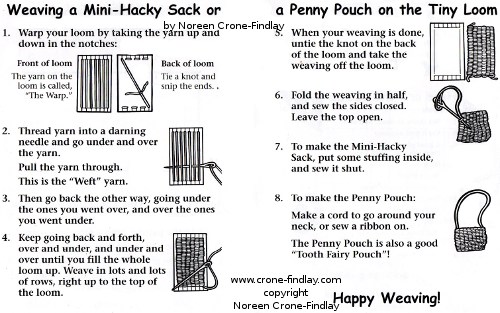
copyright Noreen Crone-Findlay
If you weave 2 tiny rectangles on the loom, and stitch them together, then add a beaded fringe, it makes a very pleasing little amulet bag.
I think that one of the most accessible looms for beginning weavers is the weaving stick loom.
I am doing a lot of designing for it – here’s my post about the mermaid to weave on the stick weaving loom: LINK
Happy weaving!
It’s never too early, (or too late!) for a child to start learning how to weave.
I bought my daughter her first loom when she was 6 weeks old. It was a little Spears loom #2 from England.
And, when my daughter and son were little, I had several looms set up for them to weave on, whenever they felt inspired to weave.
And, now, my grandson weaves with me:
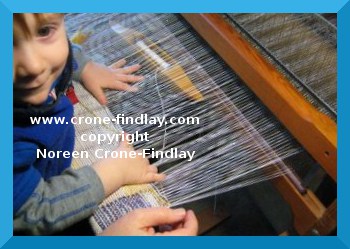
copyright Noreen Crone-Findlay
He’s been sitting in my lap at the loom since he was born, and he really gets what weaving is all about.
He’s helping me weave his Grampa’s Saori shirt:

copyright Noreen Crone-Findlay
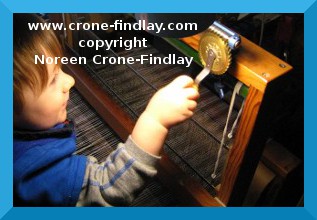
He’s two now, and he KNOWS about the shuttle!
He demanded the shuttle, and put it into the shed, and helped it across with his beautiful little chubby hands….
He LOVES the bobbin winder:
copyright Noreen Crone-Findlay
His grampa will certainly feel the love that has been woven into this shirt!

copyright Noreen Crone-Findlay
What do I recommend about teaching children to weave?
You don’t need a loom to start teaching a child to weave- cardboard looms and foam meat trays are great.
(I’ll post some patterns and instructions for them)
Child friendly looms are great- the Cricket is wonderful, as are a whole slew of small looms- ESPECIALLY,
the wonderful potholder loom!
BUT- I DO NOT recommend trying to teach a child to weave with loopers on the potholder loom.
Loops are actually rather challenging to work with.
Yarn is much more user friendly, and I have all kinds of YouTube videos to help you get children weaving.
When you click on my Potholder loom weaving page on my webiste: LINKIE
and scan down to the bottom of the page, you will find all kinds of YouTube links for my video tutorials.
I recommend the book: 1,2,3 Easy as Can Be Critters to weave on the potholder loom
and Weavagarumi for beginning weavers.
So, go ahead, and get those kidlets weaving!
It’ll be the gift that keeps on giving, as they will be embarking on a magnificent voyage of discovery that will last their lifetime!
Happy Weaving! 😀
I took time away from blogging over the Christmas holidays, but I have been a busy bunny making video tutorials.
Here’s a video tutorial on how to stitch spool knitted cords to woven or other finished edges:
And, another how to on stitching things together- this time, it’s how to stitch potholder loom squares and motifs together
Here’s a video tutorial on how to spool knit with the Martha Stewart loom:
https://www.youtube.com/watch?v=TWoYAs-L3yM
How to spool knit on your fingers:
https://www.youtube.com/watch?v=r-nEfmge_Ygvi
And, there are lots more spool knitting video tutorials on my youtube channel: LINK
So there you have it Lotsa video tutorials…. hope they are helpful!
I have been designing for and experimenting with the Martha Stewart loom, and just love it.
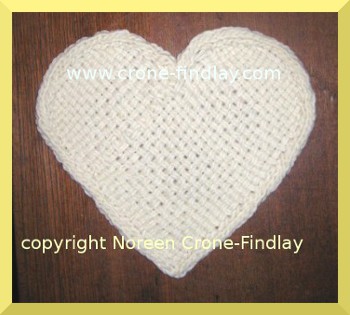
woven-heart-by-noreen-crone-findlay
One of the things that I have figured out how to do with the Martha Stewart Loom, is how to weave a heart shape motif on it.
It’s a little tricky, so I have made a video on how to do it.
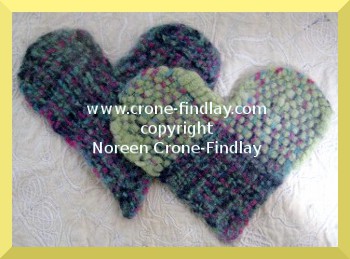
I felted some of the woven hearts, and they are really neat…. the do get smaller as you felt them!
woven-heart-by-noreen-crone-findlay-5 (c)
What can you do with a woven heart?
They can be used as placemats on their own, (especially if they have spool knitted cord stitched to the outside), or they can be stitched to bags, scarves, stoles, shawls, pillows, throws, wraps, afghans, blankets, jackets, vests, stitch 2 together as a toy….
Hearts are the symbol of love, so perhaps, you can just weave one for the love of it! 😀
For this last year and a half, I have been designing up a storm, but not getting the designs out into the world.
I made a promise to myself that I am going to get as many of the new designs up and released as possible before this year ends.
On that note, I am happy to announce that I have finished another pattern- Whee, whew and yay!!!!
copyright Noreen Crone-Findlay
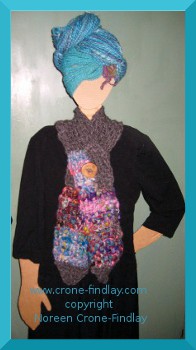
The Viva ‘V’ and “U’ shaped scarves are so comfortable to wear!
The clever shaping means that the scarf stays in place without a lot of extra yardage.
It can be made in several different ways. It can be a ‘V’ shaped scarf or cowl, or a ‘U’ shaped scarf or cowl.
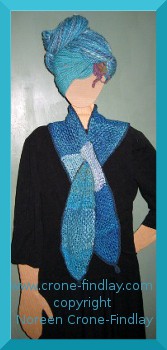
copyright Noreen Crone-Findlay
It’s a wonderful way to showcase art yarn, and other special hand spun yarns.
Instructions are given for how to weave all the different shapes using regular weaving with yarn techniques on the potholder loom,
AS WELL AS: How to weave with bulky yarns on the potholder loom.
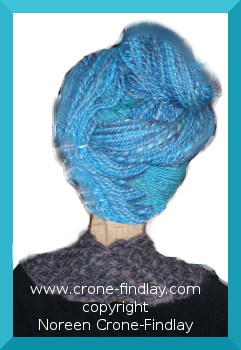
copyright Noreen Crone-Findlay
Instructions are also given for how to make big arty buttons from dead branches.
The lightweight version works well as a ‘keyhole’ scarf – one end pulls through an opening in the other end of the scarf.
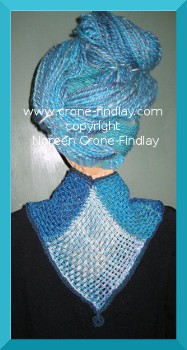
copyright Noreen Crone-Findlay
Adding a spool knitted edging is optional.
There are soooooooooooo many ways to express your creativity with this nifty scarf!
The best part is that it is so quick and easy to make, and a real delight to wear!
The pattern can be ordered from: http://www.crone-findlay.com/Crone-FindlayCreationsPotholderLoomWeaving.html
Happy Weaving! 😀
One of the joys of self publishing patterns is that I get to talk about them as soon as I finish them. (Not allowed to do that with commissioned projects! It’s up to the editors to decide when the word goes out on those).
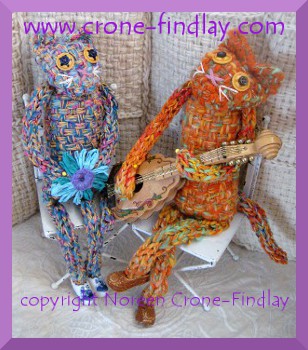
Whimsical-woven-cats-by-Noreen-Crone-Findlay-(c)
My most recent self published pattern is for the Woven Whimsical Cats.
You can order the pdf pattern from my website: Link
They have been so much fun to design.
I started the designing process for them last February.
I went through several variations of them before I settled on the two versions that are in the pattern.
There’s the sitting Whimsical Cats, who are infinitely poseable (and can be convinced to wear shoes and play musical instruments, too!)
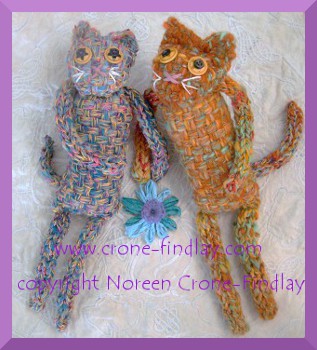
Whimsical-woven-cats-by-Noreen-Crone-Findlay-(c)
They have distinctly, ‘Who me?!’ expressions of feline innocence, which probably means that they are up to all manner of mischief!
Their ‘Laying Down’ cousins:
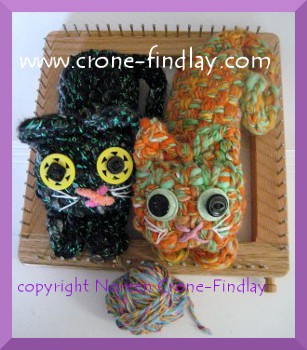
Whimsical-woven-cats-by-Noreen-Crone-Findlay-(c)
are lovely to rest your wrist on when playing with the computer mouse.
Of course, they might take a swipe at the mouse, but that’s to be expected, isn’t it?
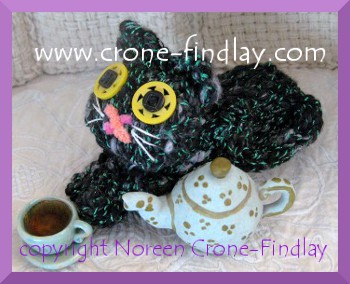
Whimsical-woven-cats-by-Noreen-Crone-Findlay-(c)
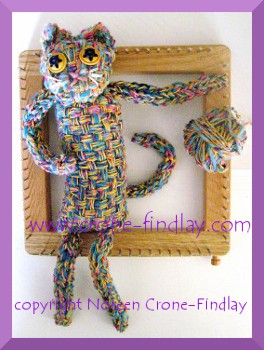
Whimsical-woven-cats-by-Noreen-Crone-Findlay-(c)
The yarn is art yarn, handspun by the delightful Nancy Nagle of Nangellini: www.nangellini.com
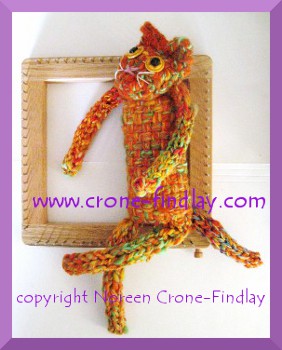
Whimsical-woven-cats-by-Noreen-Crone-Findlay-(c)
When I was designing and weaving the Whimsical Woven cats, I was remembering all the wonderful cats who have graced my life with their marvelous ways.
So, here’s to our Feline Friends! with love and thanks for all the blessings! 😀
Over the last couple of years, I have been weaving a series of tapestries and one of a kind art dolls.
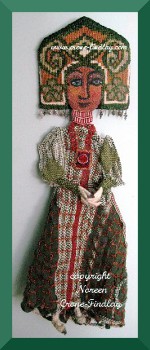
Green-Empress-art-doll-by-Noreen-Crone-Findlay-copyright
I am calling this series, ‘Woven Women’. I made a little video mini tour of one corner of my studio, showing ‘The Green Empress’.
The Green Empress brings together many of my favorite fiber techniques: Tapestry weaving, inkle weaving, small loom weaving, crochet, wire work, tatting and punch needle embroidery.
My plan is to eventually have enough ‘Woven Women’ for a one woman show. I don’t have enough of them finished yet, but I am working on it!
Here are some more photos and the video tour that shows The Green Empress:
Green-Empress-art-doll-by-Noreen-Crone-Findlay-copyright
Green-Empress-art-doll-by-Noreen-Crone-Findlay-copyright
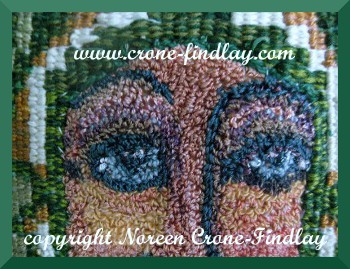
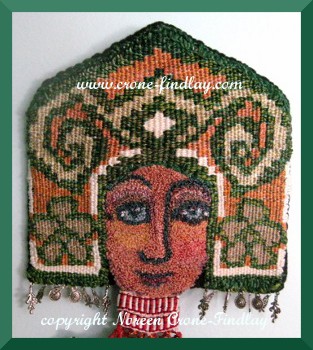
Her face is punch needle embroidery and her crown is tapestry weave.
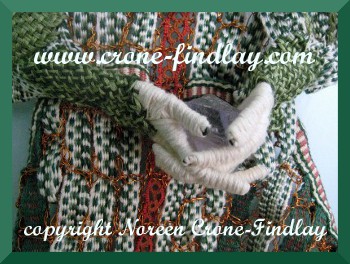
Green-Empress-art-doll-by-Noreen-Crone-Findlay-copyright
Her hands are heavy gauge wire, wrapped with cotton thread. They are cupped so they can hold small objects.
Her arms are inkle bands and 2 inch Weave it Squares, stitched and shaped and layered.
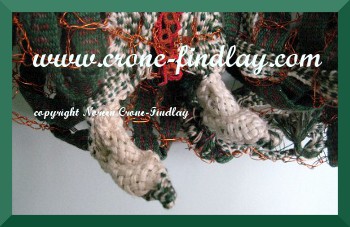
Green-Empress-art-doll-by-Noreen-Crone-Findlay-copyright
Her feet are a combination of 2 inch squares that I wove on my vintage Weave it loom, with Inkle weaving.
I just kept stitching and shaping until I was happy with her feet.
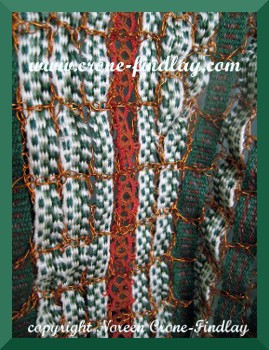
Green-Empress-art-doll-by-Noreen-Crone-Findlay-copyright
I crocheted wire in an open work mesh to shape her body and skirt.
They, I wove miles of inkle bands (woven on my Schacht inkle loom) through them.
I also wove in tatted lace, too. The skirt is about 24 inches wide, but is folded and stitched.
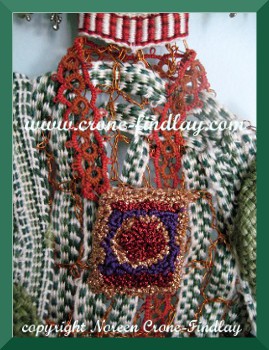
Green-Empress-art-doll-by-Noreen-Crone-Findlay-copyright
This closeup shows a small panel of punch needle embroidery , tatting, inkle weaving and the copper wire armature.
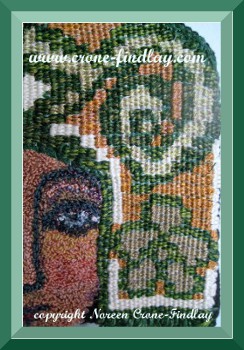
Green-Empress-art-doll-by-Noreen-Crone-Findlay-copyright
Close up of one eye and part of the crown. You can see that I love Byzantine art, as there is a definite influence here.
And, here is the link to a mini studio tour, with my wonderful husband playing one of his compositions (with our small dog in his lap, as small dog insists on sitting in Jim’s lap when he plays and practices!)
I was asked a very good question last week.
A lady on Ravelry was having a hard time with wonky edges on the Martha Stewart loom, when she wove with more than one color. How to fix this?
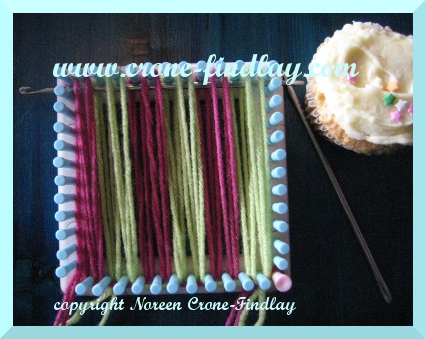
2 color weaving on Martha Stewart loom by Noreen Crone-Findlay (c
By the way in the photo above, I couldn’t resist including the yummy cupcake my daughter made for her little one’s birthday – I don’t recommend eating while weaving! 😀
Here’s the link to the video tutorial that shows the nifty trick that I have figured out for making lovely edges when weaving on small looms.
And yes, this technique works great for potholder looms, too!
Noreen Crone-Findlay, designer and author





 Tottie Talks Crafts Blog