Category Archives: tutorial & how to

Soumak Pouch Weave Along Part 4 Weaving Techniques

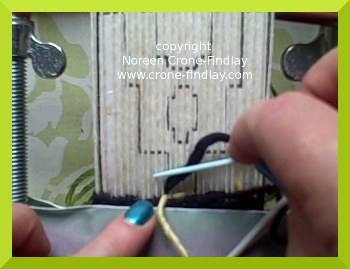
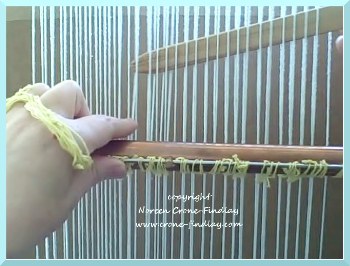
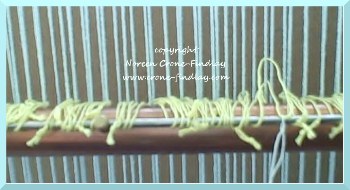
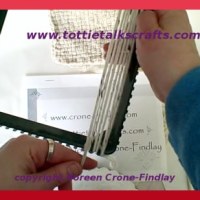
The video for Part 4 of the Soumak Pouch Weave Along is a really big one because it’s the ‘how to’s’ for the actual weaving of the pouch.

copyright Noreen Crone-Findlay

Here’s what’s covered in this video:

  • How to weave the 4:2 Soumak border
  • How to weave the 2:1 body of the pouch
  • How to add more weft yarn when you run out
  • How to add new colors
  • How to change colors and make perfect joins between the color blocks
  • How to  step colors sideways in an outward direction
  • How to step colors sideways in an inward direction
  • How to work horizontal stripes
  • How to do the ‘Topsy Turvey Trick’ with the Mini loom
  • How to remove the weaving from the Mini
  • Please note that the pouches are woven with 1 strand of the yarn from the Mirrix Kit, or 2 strands held together, of the Lion Brand Bonbon  yarn

When I went through the video after the final rendering, I smacked my hand to my forehead a couple of times as my directional challenges clearly pop up in the video-  arghhhhhhhhh………. several times, I call the left hand side of the loom, the ~right~ hand side.  arghhhhhhh

And, at one point, I called the weft, ‘warp’………….   oh sigh…………. so please forgive me for the errors.

Luckily, pretty quickly, I do say the ~correct~ thing.   But still……….. arghhhhhhhhhhhh………….

And, no, I am not willing to re-shoot the video….. there are days and days and days of shooting, and so I am not going back to do it again.

Said in the nicest possible way, with really the minimum of snarls and snaps.  😀

Anyhow…. I hope that you will have a WONDERFUL time weaving your pouches!

Without further ado, here’s the video: (bugs and all- and dogs barking and rain raining and thunder thundering…. the dogs were freaked out by the lighting and thunder, so they were indulging in a LOT of vocalizing about the bad bad sky!)

6 Comments

Filed under Loom & looms & small loom weaving, tutorial & how to, weaving & handwoven

Soumak Pouch Weave Along – Part 3 – Warping the Looms

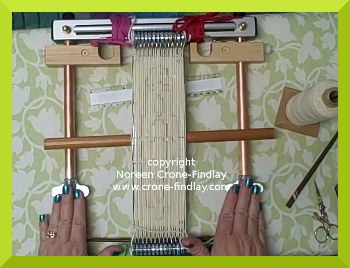
Today’s installment of the Soumak Pouch  Weave Along is a video tutorial about warping the looms for the ‘no warp ends’ technique that will be the foundation of the Soumak Pouches.

copyright Noreen Crone-Findlay

There are a number of hints and tips that I have found that make warping for the  pouches much quicker and easier.

The video shows how to warp  the 8 inch and 12 inch  Mirrix looms, using ‘s’ hooks.

The Mini (5 inch loom) is warped using the ‘no warp ends’ kit from Mirrix.

The looms are almost gift wrapped after warping!

Really?  Yes 🙂

I have found that using ribbons to tie around the ‘s’ hooks on the lower edge of the 8 inch, 12 inch or larger Mirrix looms keeps the weft yarn from getting snagged on the hooks while weaving.

And, the Mini wears little babushkas or headscarves!

Yep. I tie bias tape or ribbon around the ends to cover the paper clips and keep them from snagging on clothing and to protect them.

I know it may seem odd, but it makes the weaving go more  smoothly.

And, having the weaving be a joy is really important 🙂

Here’s the video that shows how the warping is done for the Weave Along:

6 Comments

Filed under Loom & looms & small loom weaving, tutorial & how to, weaving & handwoven

Soumak Pouch Weave Along Part 2-Design Notes

I am sure that everyone who is participating in the Soumak Pouch Weave Along wants to create a finished piece that is completely unique.

So, that’s why I am sharing a few design notes.

copyright Noreen Crone-Findlay

In Part One of the Weave Along LINK   I posted my design for the Soumak Pouch.

How did I come up with this design, and how can you make it be a reflection of your personality?

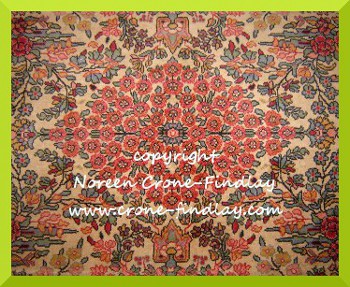
I started the design process by thinking of the rug that was in my grandmother’s dining room when I was a little girl:

copyright Noreen Crone-Findlay

I spent many a happy hour on that carpet, when I was a child, playing with my cousins.

The flowers became a deeply ingrained part of my ‘pattern language’.

So, when I was designing the pouch, it was natural to look at the flowers in the carpet and see if there was a starting point there.

Indeed there was, and I sketched and played with variations on carpet flowers:

copyright Noreen Crone-Findlay

I  traced out lots of copies of the prototype pattern.

I find that tracing the pattern by hand is better for me than scanning and printing the pattern.

When my hand and eyes are quietly engaged in tracing the design, then connections are made that are really helpful in making creative leaps.

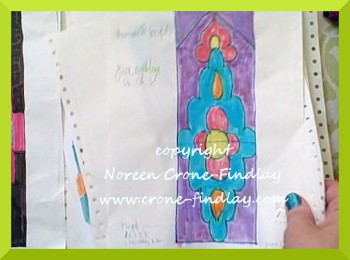
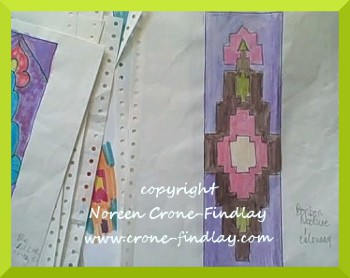
I choose aquarelles (watercolor pencils) that matched my weft colors.

Then, I colored lots and lots of variations on the theme, playing with combinations of colors and trying to push myself to use the weft colors in ways that I might not have considered.

I also would make little sidebar colorways when I was uncertain about a specific motif in the pattern.

And, then, when I was happy, I started weaving.

As I wove the prototype pouches, I discovered a few things:  OOPS! The weaving contracts when it’s released from the loom, so it NEEDS a header and footer beyond the pattern!

Also, I felt that making the pattern more geometrical would make it more weaver-friendly, so I re-designed the pattern to make it conform more closely to the warp strands:

copyright Noreen Crone-Findlay

I felt constrained to stick to using only the colors of yarn that were in the various kits and packages supplied by the yarn companies.

I didn’t mix and match, BUT… you can feel totally free to use yarn from your stash to personalize your pouch.

The only exception to the ‘no stash’ rule that I was following was that, for the black and white checkered pouch, I did pull white wool from my stash (well, my daughter in law’s stash to be perfectly honest… bless her for her donation to the cause ❤ and 😀 )

copyright Noreen Crone-Findlay

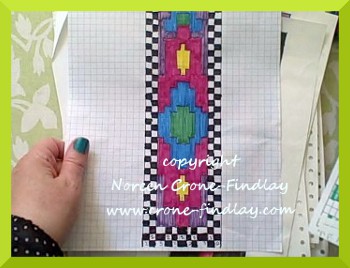
In this photo, you’ll see that I traced the pattern onto graph paper (4 squares to the inch or 2.5 cm).

(The photo of the pouch at the beginning of this post was woven with the Mirrix Soumak Pouch Kit yarns and this colorway.)

Graph paper is the top of the list of my favorite design tools…. it’s a weaver’s very good friend indeed!

Playing with graph paper allows you to try out all manner of interesting things.

So, in a nutshell, what are the key points of designing a unique project?

1-  Look for a starting point in something that you love or are inspired by.

2-  Be willing to make mistakes and to start over

3-  Trace, don’t print the extra copies of the design.

4-  Use colors in ways that you might not usually consider when you are experimenting with your coloring pages.

BUT… if you have signature colors, then, of course, feel free to use them.

5-  Make multiple color combination sidebars if you are uncertain about a part of the design.

6-  Use graph paper to work out colorways and patterns.

7- The ways that you choose to embellish your pouch will make your pouch TOTALLY unique, as the finishing and embellishment techniques are incredibly expressive 🙂

Here’s the Design Notes Video:

4 Comments

Filed under Loom & looms & small loom weaving, tutorial & how to, weaving & handwoven

Soumak Pouch Weave Along- Part One- Setting up the looms

Welcome to the first installment of the Soumak Pouch Weave Along!

I hope that you are going to have a wonderful time, weaving one of a kind pouches for your business cards and cellphone, or using it in any way that appeals to you.

If you would like to join in the conversation, you can leave comments here on this blog,

as well as on the Mirrix facebook page LINK and the Mirrix Ravelry page: LINK

copyright Noreen Crone-Findlay

I will be demonstrating on the Mirrix 12 inch, 8 inch and 5 inch Mini, which is a totally magical little loom.

Because of the small (but oh so perfect) size of the Mini, I have had to come up with some fairly ‘outside the box’ ways of working with it for the weave along- which certainly add to the functionality of this delightful little loom!

Several people have asked me if they can participate in the Weave Along, even though they don’t have Mirrix looms.

Yes, you can- in the first video, I have shown how to attach the cartoon to a Cricket Rigid Heddle loom.

If you have a tapestry loom that won’t accept the extra rods for the ‘no warp ends’ technique, then just warp it up in the normal way.

You won’t have the ‘no warp ends’ technique that the weave along is based on, but you can just finish your ends in the way you usually do.

HOW WILL THE WEAVE ALONG WORK?

I have made six video tutorials and one slide show (so far) for the Weave Along.

I will be posting installments of the Weave Along every Sunday and Wednesday from September 2, 2012 to September 23, 2012.

BUT… you don’t have to keep up with this pace…. you can follow along at your own speed, as the blog posts are going to be here for as long as Tottie still Talks Crafts!  😀

I have covered a TON of information, and some of the videos are very long.

To make them as user friendly as possible, I have made chapter headings for each segment of the videos.

This means that you can stop the video and move back or forward to review anything you want to, at any time in the video.

Here’s what the chapter headings look like:

copyright Noreen Crone-Findlay

So, without further ado, lets get started!

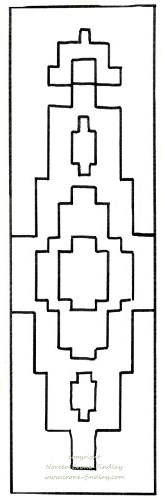
Here is the pattern for the Soumak Pouch:

copyright Noreen Crone-Findlay

Print the pattern so that it is 3 inches wide and 10 inches long.

Print several copies.

One of the Weave Along participants, Penny from Boulder, Co, made a pdf of the pattern, and Elena posted it to the Mirrix site.

Here’s the link to that, if you are having trouble figuring out how to print a copy of the pattern: LINK

And, now, for the video tutorial: (hope you enjoy it!)

6 Comments

Filed under Loom & looms & small loom weaving, tutorial & how to, weaving & handwoven

Furoshiki wrap technique to carry a small loom

I rarely leave home without a small loom.

If I am the passenger in a car, I  weave.

If I have to wait for an appointment, I weave.

When in an airport or flying…. I weave.

If I am sitting, listening to my husband’s Jazz trio/quartette/quintette, I weave.

I like to be able to to port along my small looms in  tote bags, backpacks or baskets.

But…. the warp strands and bobbins and needles can get seriously disarranged by being jostled in transit.

I have been mulling over the best way of protecting them while they are being trundled about…. and then it struck me….

By using the Japanese technique of creating perfect wraps and carriers from a scarf or cloth! :

FUROSHIKI  (link to a ton of ways of doing furoshiki wraps)

3 Mirrix looms wrapped with Furoshiki techniques
copyright Noreen Crone-Findlay

I always carry headscarves in my purse or bag, to use as instant tote bags.

The other day, it struck me that the perfect way to protect my beloved small looms when I am slipping them into bags or baskets for their travels, is to ‘Furoshiki’ them.

It works BRILLIANTLY!

I usually use square headscarves- and any size will work… smaller scarves are great for small looms or bundles of books and tools; larger scarves for larger bundles of looms and stuff.

But, you don’t have to use scarves: This is a great upcycling opportunity!

You can use squares of fabric cut from old shirts or skirts or dresses 🙂

You can also use cloth squares to gift wrap presies. Do check that link at the top of the page. Impressive 🙂

Here’s a video, showing how to use Furoshiki wrapping techniques to make an instant, customized carrier for your small loom:

The models in the video are my 3 smallest Mirrix looms.  I call them the Three Sisters.

I love, love LOVE my Three Little Sisters!  I have renamed them: The Mini is ‘Molly Whuppie’ (you can read her story in my book, Soul Mate Dolls), ‘Vasilisa’ (heroine of a wonderful Russian fairytale) is the name of the 8 inch loom, and the 12 inch is now known as ‘Jane’, after my beloved Jane Austen.

I do believe they quite like their travel wraps! 🙂

Here’s the video that I made to show how I wrap my looms :

Leave a comment

Filed under Loom & looms & small loom weaving, tutorial & how to, weaving & handwoven

Chalkboards are low tech dandy design tools

Sometimes, I get stuck in the design process.

That’s when I need to give myself nudges that break up the mental and emotional constriction that is keeping me from moving forward in a project.

And, so, I reach for some of my favorite tools that help me to see things differently.

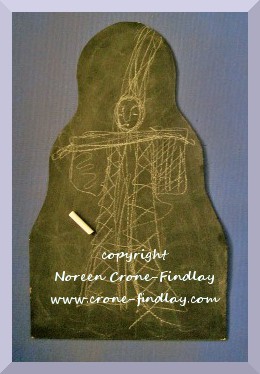
My chalkboards and chalk.

copyright Noreen Crone-Findlay

Eh? as we say in Canada 🙂

Really!  A chalkboard is a fabulous tool for knocking the design blechs sideways!

I have wondered about why they work so well for me and I think that there are a couple of reasons.

The first is that white chalk on a black surface reverses the way I normally see things when I am drawing.

This is invaluable, because it clears the deck of any pre-conceived notions that I had about sketching.

It’s like working with negatives instead of photographs. You really do see things differently.

And, if you are stuck, then that is really helpful!

The second reason why I love chalkboards so much is that drawing on a chalkboard is so playful.

There’s a real feeling of ‘little kid’-ness to them that is definitely very freeing.

You know that it’s not permanent… it’s just a bit of dust on black paint … so wheee…… draw, draw, draw!

If you don’t like it…. whoosh whoosh, wipe it off and it’s gone.

If only the rest of life were so easy!

AND… if you do like it, then grab a piece of paper and a pencil and copy the sketch onto the somewhat more permanent surface.

How did I get such a neat shape chalkboard?

Easy.

I drew the shape on masonite, cut it out and painted it with several coats of chalkboard paint from the hardware store.

I even like the scritchy sound the chalk makes when I am drawing.

Low tech is often a wonderful way of opening the doorways to creativity and imagination.

Try it…. you might like it 😀

PS: Anne, who is one of my online friends in the Mirrix facebook group suggested that you take pics of your favorite sketches and load them into your paint or bead making programs.  I don’t use those programs, so it didn’t occur to me.

Anne’s suggestion also reminded me that I do take ‘archival’ photos of some of the sketches that I really like… sorry… I completely forgot to mention that!  Thanks for the reminder, Anne! 🙂

Leave a comment

Filed under tutorial & how to

Mirrix Loom Weave Along Soumak Pouch- 2- Looms, tools, equipment

This is the second ‘Prelude Post’ for the Mirrix Loom Weave Along for the Soumak Pouch.

The pouches are perfect for both business cards:
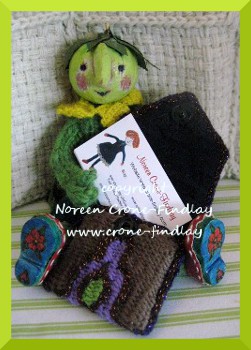
copyright Noreen Crone-Findlay

or for cellphones:

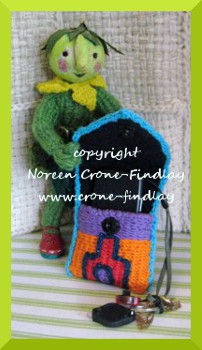
My cellphone is one of the smaller, lower tech ones  [4inches tall, 2 inches wide, 5/8 inch thick] if yours is larger, then you will want to upsize your pouch, if your pouch is going to be a cellphone pouch.
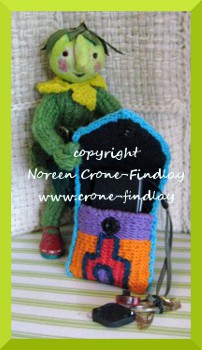
copyright Noreen Crone-Findlay

Alright… now onto the gathering up of tools and equipment:

First of all, you need a loom:

copyright Noreen Crone-Findlay

Most of the photos and videos for the weave along will feature my 8 inch Lani Mirrix loom. (Although I have ordered a Mini and a Little Guy, so hopefully, they will arrive soon, so I can use them in the photos and videos, too.)

The pouch can also be woven on any of the larger Mirrix looms as well- if you are using one of the smaller Mirrix looms, then warp up one pouch at a time. If you are using one of the larger looms, then you can warp and weave 2 pouches at the same time.

Even if you don’t have a Mirrix loom, please feel welcome to join in the Weave Along.

As long as you have a loom that you can get good tight tension on it, then you will be able to weave the pouches.

copyright Noreen Crone-Findlay

You will also need: A steam iron, a pressing cloth, a good source of light, pencil crayons or watercolors or some other way of coloring your preliminary pattern colorways, 2 clothespins, scissors, needle and thread for finishing, snap fastener and a swivel clip, you’ll also need paper for tracing out your patterns and trying out different color schemes.

copyright Noreen Crone-Findlay

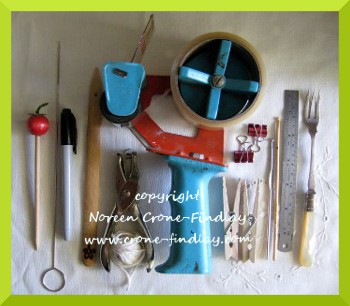
Knitting needles and crochet hooks are very helpful, and  a loop turning tool is  handy (I bought mine at my local fabric store),  a piece of cardboard that is 10 inches tall by 3 inches wide (25 cm tall by 7.5 cm wide),  a weaving stick, small paper clamps, a fork or beater, a hole punch, at least a yard of firm yarn or cord, clear tape (packing tape works well); a black fine tip permanent marker
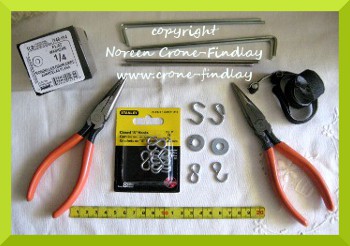
copyright Noreen Crone-Findlay

You’ll need rods for the top and lower edge of the weaving: 6 inch (15 cm) tent pegs or 6 inch (15 cm) lengths of steel or brass rods 1/8 inch in diameter (I bought a 36 inch long one at the hardware store and cut it to 6 inch lengths with a hacksaw);  velcro straps (I bought mine from Lee Valley:  Link‘S’ HOOKS: 25  “S” hooks, either 7/8 inch or 1 inch- opened or closed :[ I had a huge ‘AHA’ when I bought closed ‘S’ hooks…. having one end closed is just GREAT… so if you buy closed ‘S’ hooks, open one end with pliers.  If you buy open ‘S’ hooks, squeeze one of the ends closed. Having the closed end keeps the ‘S’ hooks on the rod.  🙂 ] ; 1/4 inch Washers: 54 in total; 1 or 2 pairs of pliers for adjusting the ‘S’ hooks; ruler and tape measure.
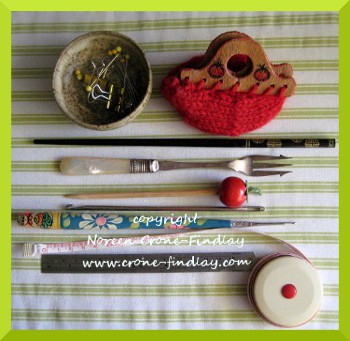
copyright Noreen Crone-Findlay

Some of these things have shown up in other photos, so I won’t list them again, but the other things are:  A small bowl for holding pins, needles, clamps etc;  a bag or box to store and transport the project (that’s Tottie Tomato’s knitting bag); chopsticks are very handy for several things  besides your Pad Thai 🙂

copyright Noreen Crone-Findlay

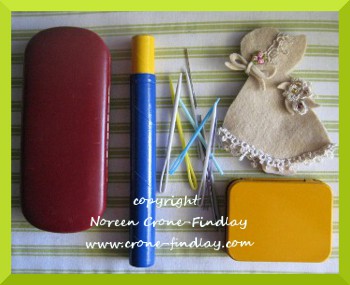
You will need at least 5 or 6 blunt tapestry or craft or darning needles. It’s handy to have a needlebook or tin, or cardboard tube or eyeglass case to store them in.
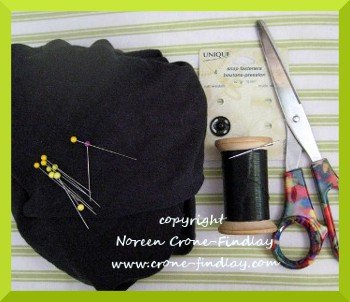
copyright Noreen Crone-Findlay

To line the pouch: Fabric (I upcycled one of my son’s abandoned t shirts for the lining of the first 4 bags), scissors, pins, needle and thread, snap fastener: I used the 15 mm size.
copyright Noreen Crone-Findlay

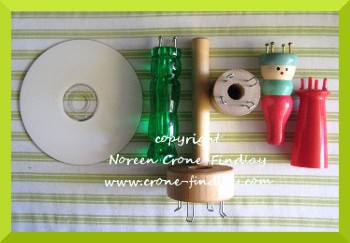
To make the edging cord: A kumihimo kit

OR a spool knitter: Lion Brand: LINK

or Harrisville:  LINK

CHECKLIST at a glance:

– Loom

– steam iron

– pressing cloth

-a good source of light

– pencil crayons or watercolors or some other way of coloring your preliminary pattern colorways

– paper for tracing out your patterns and trying out different color schemes

– 2 clothespins

-scissors

-needle and thread for finishing

-snap fastener 15 mm size

-swivel snap hook (optional)

-knitting needles & crochet hooks

-Optional:  a loop turning tool is  handy

-a piece of cardboard that is 10 inches tall by 3 inches wide (25 cm tall by 7.5 cm wide)

–  a weaving stick

– small paper clamps

-a fork or beater

-a hole punch

-at least a yard of firm yarn or cord

-clear tape (packing tape works well)

-a black fine tip permanent marker

Rods for the top and lower edge of the weaving: 6 inch (15 cm) tent pegs or 6 inch (15 cm) lengths of steel or brass rods 1/8 inch in diameter

-velcro straps   Link

‘S’ HOOKS: 25  “S” hooks, either 7/8 inch or 1 inch- opened or closed 

–  1/4 inch Washers: 54 in total

-1 or 2 pairs of pliers for adjusting the ‘S’ hooks

-ruler and tape measure

– small bowl for holding pins, needles, clamps etc

– a bag or box to store and transport the project

– chopstick (optional)

– At least 5 or 6 blunt tapestry or craft or darning needles and a needlebook or tin, or cardboard tube or eyeglass case to store them in.

-Lining fabric

– Straight pins

-kumihimo kit  OR a spool knitter

-any other embellishments, beads, buttons, charms or found objects that you wish to use.

6 Comments

Filed under Loom & looms & small loom weaving, tutorial & how to, weaving & handwoven

Mirrix Loom Weave Along Soumak Pouch- 1- Warp and Weft

In September, I will be leading a Weave Along, using Mirrix Looms.

I will be posting the  pattern, video tutorials, instructions and step by step photos for the Weave Along here on Tottie Talks Crafts.

copyright Noreen Crone-Findlay

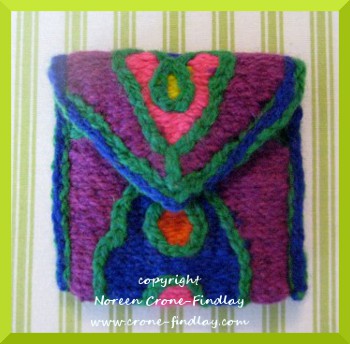
The project is a Business Card Pouch, which also works well as a cellphone pouch, woven in Soumak, embellished with corded edges and chain stitch embroidery.

I have designed it to be welcoming to entry level weavers, but also, with options that will appeal (I hope) to more advanced weavers, too.

Because it can take awhile to get orders cleared and shipped, I am posting some suggested warp and weft yarns, as well as the links for ordering them now.

Hopefully, your yarns will arrive before September first.

Here are a few photos of some of the Business Card pouches that I have woven so far:

copyright Noreen Crone-Findlay

This is the first Business card pouch that I wove, using:

copyright Noreen Crone-Findlay

Harrisville Warp LINK

and: Wool weft:  Harrisville Variety Yarn Pack: Brights LINK

copyright Noreen Crone-Findlay

I wove the second  pouch with the Harrisville warp and for weft:

copyright Noreen Crone-Findlay

Harrisville Variety Yarn Pack Jewels LINK

copyright Noreen Crone-Findlay

I quite like both p0uches, but …. OOPS!

They are slightly too small for their intended purpose!  EEGADS! Business cards don’t fit in them!

copyright Noreen Crone-Findlay

So, I went back to the drawing board, and altered the pattern.

By then, gorgeous yarn had arrived from Lion Brand yarns: LINK TO BONBON YARN

copyright Noreen Crone-Findlay

The photo doesn’t convey the scale of the balls of Bonbon…

They are tiny, perfect little balls of loveliness. Each of them is 2 1/2 inches (6cm) tall.

The cotton is simply gorgeous to weave with.  I love it.

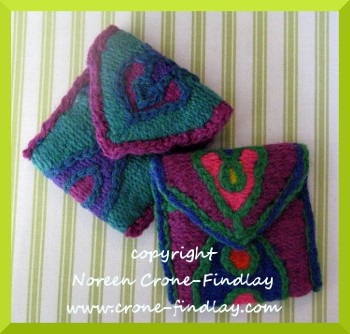
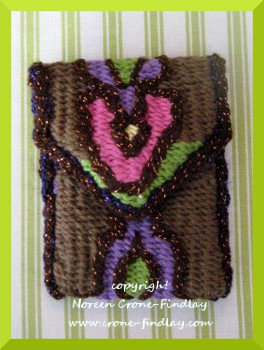
I wove these Pouches in Bonbon cottons, with Metallic chain stitch embroidery:

copyright Noreen Crone-Findlay

I used the  ‘Nature’ colorway for the pouch in the photo above, and ‘Beach for the pouch in the photo below:

copyright Noreen Crone-Findlay

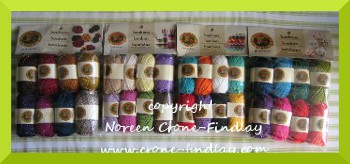
The Metallic yarns come in six packs, as does the cotton. I used yarns from both colorways: Party and Celebrate, for these pouches.

copyright Noreen Crone-Findlay

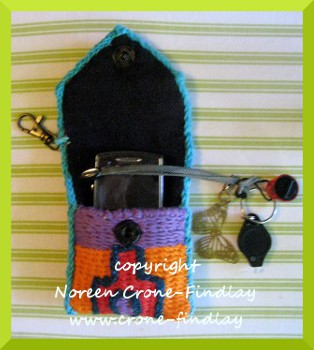
My daughter in law suggested that I add a swivel snap hook to the upper corner of the pouch.

I thought that it was a great suggestion, and so I have added it.

The swivel clip allows you to clip it to your bag, or the belt loop of blue jeans.

If your cellphone is one of the larger ones, you may need to upsize your pouch if you would rather use it as a cellphone pouch instead of a business card pouch.

copyright Noreen Crone-Findlay

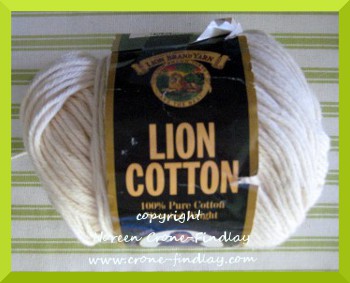
I used Lion Cotton for the warp for these two pouches, because I wanted to use yarns that you can order at the same time to make this all easier for you:

copyright Noreen Crone-Findlay

I wasn’t sure if it would work for the projects, but it does just fine.

I don’t think that I would use it for tapestry warp for a really large project, because it has a cheerful slightly bouncy nature.

Warp for tapestry really does need to be made of sterner stuff 😀  None of that youthful springiness!

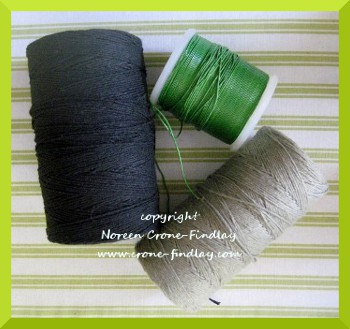
Speaking of warp- a couple of my Ravelry friends have asked if carpet warp would be okay for the Weave Along, and yes, indeed, it will work fine.

copyright Noreen Crone-Findlay

I am going to weave some of the pouches on carpet warp, and also on the green linen that’s on that ginormous spool.

In my next post, I will show you the equipment, materials and tools that you will need to gather up for the Weave Along.

Here’s the link to  a post that has all the blog post links, to keep everything quick and easy to refer to : LINK

You are invited to post comments on the blog posts here on Tottie Talks Crafts.

CHECK LIST FOR WARP AND WEFT:

– warp

-weft

-optional contrast yarn for chain stitch embellishment

9 Comments

Filed under Loom & looms & small loom weaving, tutorial & how to, weaving & handwoven

Mirrix Loom Weave Along Soumak Pouch- All the links

This blog post is going to be growing, as I will be listing all the links to each of the posts for the Weave Along Soumak Business Card Pouch.

copyright Noreen Crone-Findlay

Mirrix Loom Weave Along Soumak Pouch-  1- Warp and Weft suggestions and links to order them: LINK

copyright Noreen Crone-Findlay

Mirrix Loom Weave Along Soumak Business Card or Cellphone pouch – 2 – Tools, equipment and materials: LINK

copyright Noreen Crone-Findlay

Information about the Kit from Mirrix, and the tools and materials for edgings: LINK

copyright Noreen Crone-Findlay

Two more pouches and links for Kreinik threads: LINK

copyright Noreen Crone-Findlay

Part One: Setting up the Looms: LINK

copyright Noreen Crone-Findlay

Part Two: Design Notes: LINK

copyright Noreen Crone-Findlay

Part Three: Warping the Looms: LINK

copyright Noreen Crone-Findlay

Part 4: Weaving Techniques: LINK

copyright Noreen Crone-Findlay

Part Five: The checkerboard border LINK

copyright Noreen Crone-Findlay

Part SIX: The Edging Cords: LINK

Part SEVEN: Finishing Techniques: LINK

5 Comments

Filed under Loom & looms & small loom weaving, tutorial & how to, weaving & handwoven

Tips for quick and easy heddling on Mirrix looms

I love how easy it is to warp the Mirrix looms.

I’ve found that there are a few things that can make the process of attaching the heddles go quick as a wink.

Efficient is good!  🙂

copyright Noreen Crone-Findlay

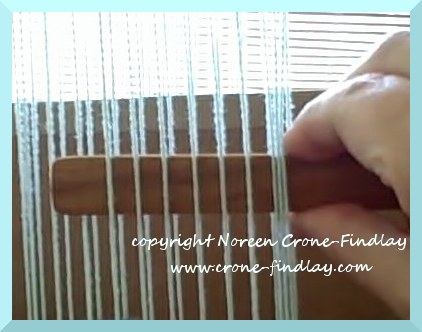
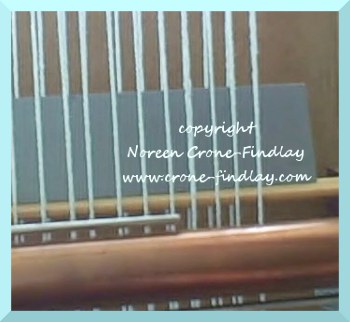
The first thing that I do, after I release the warping bar from the blocks and turn them around, is to slide a piece of cardboard or masonite between the layers of warp strands at the front of the loom and the back of the loom.

It sits there, in the middle, blocking the distracting view of those warp strands at the back of the loom. 🙂

Then, I use a shed stick that is at least as long as the width of the loom to pick up every other warp strand.

copyright Noreen Crone-Findlay

Then, I flip the shed stick on it’s side, with each end being supported by the shedding device blocks.

I now have 2 layers of warp strands because of this shed being open.

So, to keep the back warp strands out of view, I slide a ruler or strip of cardboard into the open shed.

Bliss! Now, I just have one set of warp strands ready for the heddles- Yay!

This makes things sooooo much easier!

I like the center brass knob of the shed changer to be as close to the exact center of the warp strands.

So, I count how many strands I need to attach to the rod, and divide that in 1/2.

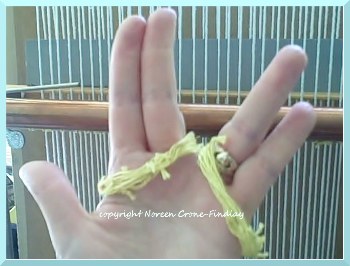
I place 1/2 the heddles on 2 of my fingers, and 1/2 on the other 2 fingers.

copyright Noreen Crone-Findlay

I loosen the heddle rod and slide it along so it’s about 2 inches/5 cm from the edge of the warp strands.

copyright Noreen Crone-Findlay

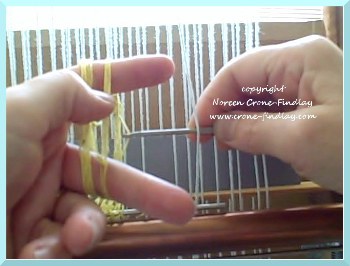
Then, I reach behind the warp strand with a crochet hook, pluck a heddle off my fingers, and pull it behind the warp strand.

I catch both ends of the heddle loop and pop them onto the heddle bar. Slide the bar along as you go.

When I run out of the the first clump of heddles, I should be half way along the warp strands.

I work across , picking up all the strands, and attaching them to the heddle bar, then tighten up the little nut that holds the heddle bar in place.

Remove the shed stick and ruler, then rotate the heddle bar, sliding the heddles down the warp strands.

Turn the shed opener enough so the heddles open your first shed.

copyright Noreen Crone-Findlay

Use the shed stick to pick up the warp strands that are between the warp strands that you have just heddled.

Turn it on it’s side, insert the ruler, and repeat the process.

Check to make sure that all the heddles are securely attached to the heddle rods.

When I was making the video, one little bounder escaped, which was actually a good thing.

This allowed me to show how to capture the escapee heddle and tie it back in place.


copyright Noreen Crone-Findlay

Remove the shed stick and ruler and check the sheds, then attach the handle or treadle and Voila!

You’re ready to weave!

Here’s the video:

Happy Weaving! 😀


6 Comments

Filed under Loom & looms & small loom weaving, tutorial & how to, video tutorial, weaving & handwoven