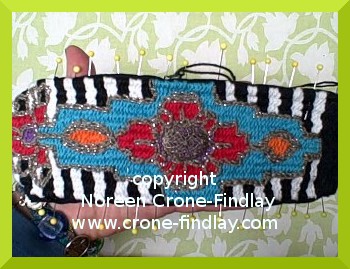
A couple of years ago, when I was working on the designs for The Lily Speed O Weave design book LINK,
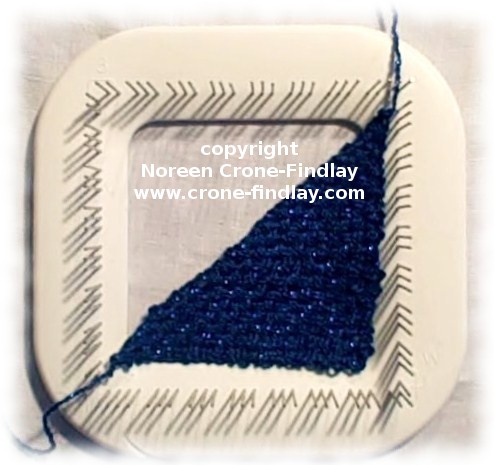
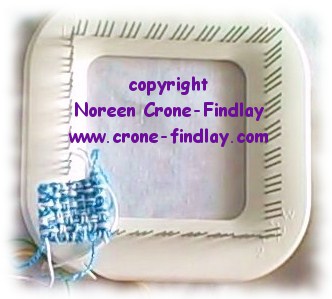
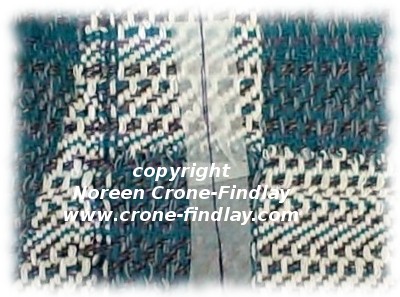
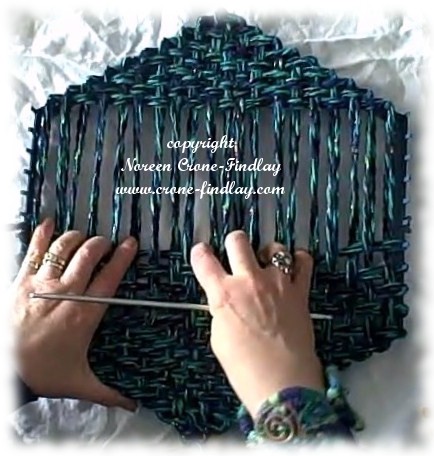
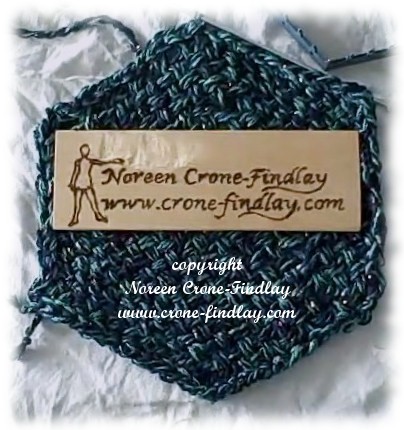
I figured out how to weave a hexagon on the loom, using continuous weaving methods.
copyright Noreen Crone-Findlay
The method is slightly tricky (it took me a LOT of experimenting to figure it out!) and has one disadvantage….
You have to use quite bulky yarn or else the hexagon is really loopy and open meshy (aka ‘sleazy’).
I decided that this made it not worthwhile to share the technique, as the knotting technique that was traditional for the Lily Speed O Weave loom allowed you to use absolutely any weight of yarn or thread.
Besides, I had figured out a way of speeding up and streamlining the knotting process, so I decided to just go with that.
But, a few days ago, a lady on Ravelry asked if anyone knew how to weave continuously on the hex loom and wasn’t into the knotting technique.
So, I figured…. okay…. I’ll make a video showing how to do this….
copyright Noreen Crone-Findlay
The secret to weaving continuously on the Lily Speed O weave looms?
Mashing up triangle loom weaving techniques with the continuous weaving technique of the potholder loom.
AND>>>> There’s a VERY important switcheroo that you have to make, mid-stream, as it were. 🙂
Once you have mastered the technique, it’s REALLY quick and easy to weave up hexagons on the Lily Speed O Weave loom!
I have just released a new pattern that has step by step photos showing how to weave these gorgeous baskets, using the easiest little loom ever made, the weaving stick loom:
copyright Noreen Crone-Findlay
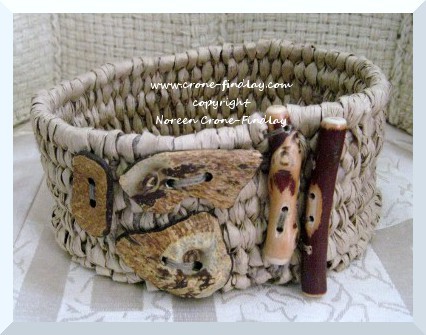
This basket was woven with paper ribbon and embellished with buttons that I made from arbutus twigs and coconut shells.
copyright Noreen Crone-Findlay
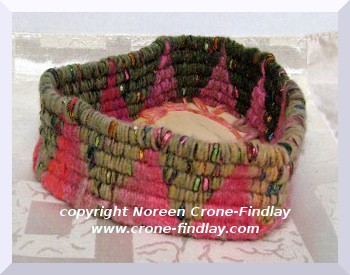
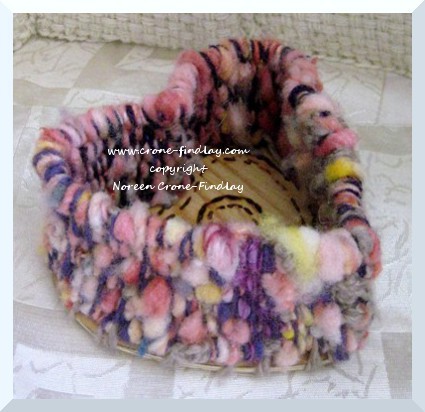
The heart shaped basket has a plywood heart base (the template for the heart is included in the pattern).
Here, the heart basket is woven with art yarn:
copyright Noreen Crone-Findlay
Workshop participants who were learning how to weave the baskets asked me:
What can we use these baskets for?
Anything that fits in them that you want to keep organized! Beads, hair clips, packages of smallness, buttons, thread, bobbins, yarn….
copyright Noreen Crone-Findlay
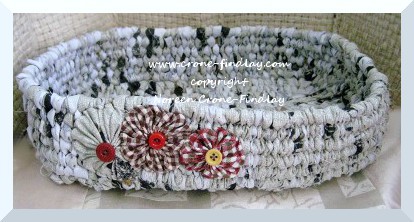
The large oval basket in the photo above was woven with strips of torn fabric, so it’s a great eco option.
The yo yo flowers that embellish it’s side are made from scraps of upcycled fabric. (The instructions on how to make the yo yo circles are also included in the pattern).
This basket is great for holding fruit or heaps of little green tomatoes while they ripen, or anything else your heart desires.
Because it’s made of cloth, if it gets soiled, it can just be rinsed clean.
copyright Noreen Crone-Findlay
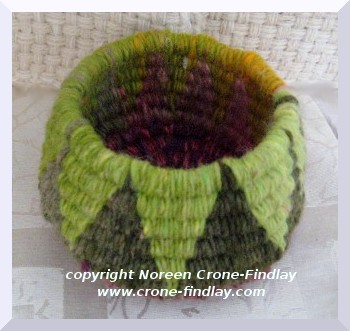
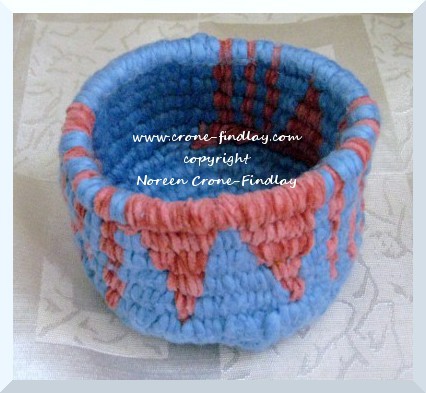
The green round basket is woven in the same way as the pink and blue one in the photo below, but I pulled up on the warp strands of the upper edges of the green one to curve it in.
copyright Noreen Crone-Findlay
So you can see that a small change makes a huge difference in the look of the basket.
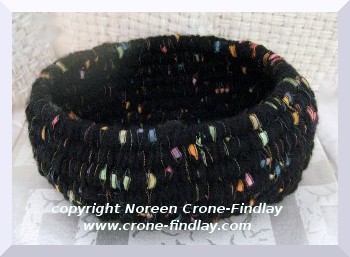
I did the same thing to curve the top edge of the black oval shaped basket that is woven in exactly the same way as the paper ribbon basket.
copyright Noreen Crone-Findlay
The yarn that you use (combine several strands to get neat effects) and how you embellish the basket will guarantee that each basket that you make is totally unique.
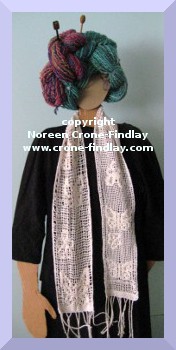
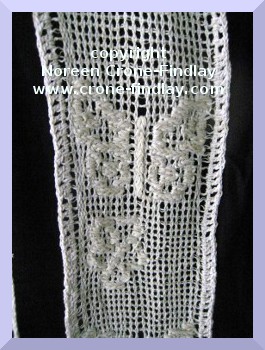
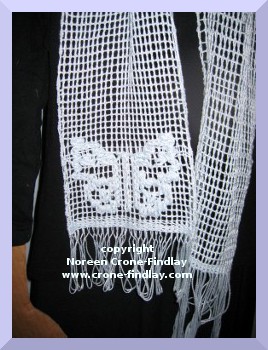
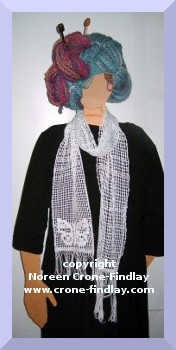
And, recently, I have been experimenting with weaving lace.
Well… weaving leno lace and then embroidering it…..
copyright Noreen Crone-Findlay
This was my first attempt, and to be honest, it’s wonky and woobley and ‘real weavers’ would consider it to be a messy failure.
copyright Noreen Crone-Findlay
But, I really learned a lot while I was working on it- and am intrigued and intend to keep working with this technique.
By the way, this was woven on my 16 inch Mirrix loom, with loom extenders attached.
When I was warping up for my second embroidered Leno lace scarf, I made a video about the things I figured out while warping with loom extenders:
I got so overwhelmed with all the work for the Soumak Weave Along that I didn’t have time to do much more with the embroidered leno lace.
I needed my 16 inch loom for a tapestry, so I wove off the blue scarf to get it off the loom, and will be doing the embroidery with the scarf being off loom.
copyright Noreen Crone-Findlay
I am pleased with the progress I have made with the embroidery, and look forward to doing more of this technique.
I love scarves and wear them year round.
Leno lace scarves are light enough to be comfortable even in the summer, especially in the evening.
copyright Noreen Crone-Findlay
I haven’t had a chance to wash and block this one yet, so it’s not as nice as it will be.
I am planning on working a twisted cord with beads on it for the fringes.
Leno lace is so wonderful and has so much design potential that I intend to continue experimenting with it!
And, so, the Soumak Pouch Weave Along draws to a close with a very long video on finishing techniques.
copyright Noreen Crone-Findlay
Here are the chapters in the final installment:
1- Steam, Press and block the finished weaving
2- Overcast the straight edge of the inside front of the pouch
3- Making the point for the tip of the pouch
4- How to do the chain stitch embroidery
5- Cut out a lining
6- How to stitch the lining to the pouch invisibly
7- Stitch the side seams
8- Sew on the snaps
9- Stitching the edging cords to the pouch – in the video, I show how to add things like large beads at the ends and center of the cord, as well as the swivel clip hook. I also show how to stitch size 8 seed beads to the edging to embellish it. You don’t have to add these extra flourishes, but I thought that it made sense to show you how to do it so you ~could~ do it, if you want to.
It’s the embellishments that make the pouch the truly individual statement of your creativity!
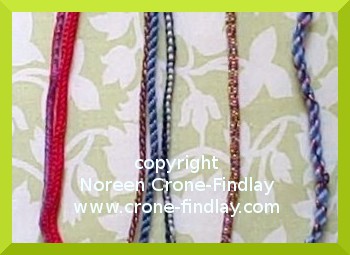
Square cord spool knitted with 2 colors on 4 pegs,
Cord Spool knitted with 3 pegs
Kumihimo cords – the directions for how to braid the round cords come with the Kumihimo kit from Mirrix
Tubular Peyote stitch cord- instructions are available in beading books and when you google ‘tubular peyote stitch’.
And last, but certainly NOT least, and definitely the fastest, easiest cord of all to make is the Simple Twisted cord, using the method that I have developed, using a spool and a crochet hook.
You will need a cord that is about 15 inches (37.5 cm) long to go around the sides and upper edge of your pouch.
The instructions for how to attach them to your pouch will be in the final installment of the Weave Along: Finishing Techniques.
Here are some videos that I have made to help you make your decorative edging cords:
How to spool knit a cord with just 3 of the 4 pegs on the spool knitter:
How to spool knit a square cord with 2 colors on a 4 peg spool knitter:
How to make a twisted cord with a spool and crochet hook:
The video for Part 4 of the Soumak Pouch Weave Along is a really big one because it’s the ‘how to’s’ for the actual weaving of the pouch.
copyright Noreen Crone-Findlay
Here’s what’s covered in this video:
How to weave the 4:2 Soumak border
How to weave the 2:1 body of the pouch
How to add more weft yarn when you run out
How to add new colors
How to change colors and make perfect joins between the color blocks
How to step colors sideways in an outward direction
How to step colors sideways in an inward direction
How to work horizontal stripes
How to do the ‘Topsy Turvey Trick’ with the Mini loom
How to remove the weaving from the Mini
Please note that the pouches are woven with 1 strand of the yarn from the Mirrix Kit, or 2 strands held together, of the Lion Brand Bonbon yarn
When I went through the video after the final rendering, I smacked my hand to my forehead a couple of times as my directional challenges clearly pop up in the video- arghhhhhhhhh………. several times, I call the left hand side of the loom, the ~right~ hand side. arghhhhhhh
And, at one point, I called the weft, ‘warp’…………. oh sigh…………. so please forgive me for the errors.
Luckily, pretty quickly, I do say the ~correct~ thing. But still……….. arghhhhhhhhhhhh………….
And, no, I am not willing to re-shoot the video….. there are days and days and days of shooting, and so I am not going back to do it again.
Said in the nicest possible way, with really the minimum of snarls and snaps. 😀
Anyhow…. I hope that you will have a WONDERFUL time weaving your pouches!
Without further ado, here’s the video: (bugs and all- and dogs barking and rain raining and thunder thundering…. the dogs were freaked out by the lighting and thunder, so they were indulging in a LOT of vocalizing about the bad bad sky!)
Today’s installment of the Soumak Pouch Weave Along is a video tutorial about warping the looms for the ‘no warp ends’ technique that will be the foundation of the Soumak Pouches.
copyright Noreen Crone-Findlay
There are a number of hints and tips that I have found that make warping for the pouches much quicker and easier.
The video shows how to warp the 8 inch and 12 inch Mirrix looms, using ‘s’ hooks.
The Mini (5 inch loom) is warped using the ‘no warp ends’ kit from Mirrix.
The looms are almost gift wrapped after warping!
Really? Yes 🙂
I have found that using ribbons to tie around the ‘s’ hooks on the lower edge of the 8 inch, 12 inch or larger Mirrix looms keeps the weft yarn from getting snagged on the hooks while weaving.
And, the Mini wears little babushkas or headscarves!
Yep. I tie bias tape or ribbon around the ends to cover the paper clips and keep them from snagging on clothing and to protect them.
I know it may seem odd, but it makes the weaving go more smoothly.
And, having the weaving be a joy is really important 🙂
Here’s the video that shows how the warping is done for the Weave Along:
I am sure that everyone who is participating in the Soumak Pouch Weave Along wants to create a finished piece that is completely unique.
So, that’s why I am sharing a few design notes.
copyright Noreen Crone-Findlay
In Part One of the Weave Along LINK I posted my design for the Soumak Pouch.
How did I come up with this design, and how can you make it be a reflection of your personality?
I started the design process by thinking of the rug that was in my grandmother’s dining room when I was a little girl:
copyright Noreen Crone-Findlay
I spent many a happy hour on that carpet, when I was a child, playing with my cousins.
The flowers became a deeply ingrained part of my ‘pattern language’.
So, when I was designing the pouch, it was natural to look at the flowers in the carpet and see if there was a starting point there.
Indeed there was, and I sketched and played with variations on carpet flowers:
copyright Noreen Crone-Findlay
I traced out lots of copies of the prototype pattern.
I find that tracing the pattern by hand is better for me than scanning and printing the pattern.
When my hand and eyes are quietly engaged in tracing the design, then connections are made that are really helpful in making creative leaps.
I choose aquarelles (watercolor pencils) that matched my weft colors.
Then, I colored lots and lots of variations on the theme, playing with combinations of colors and trying to push myself to use the weft colors in ways that I might not have considered.
I also would make little sidebar colorways when I was uncertain about a specific motif in the pattern.
And, then, when I was happy, I started weaving.
As I wove the prototype pouches, I discovered a few things: OOPS! The weaving contracts when it’s released from the loom, so it NEEDS a header and footer beyond the pattern!
Also, I felt that making the pattern more geometrical would make it more weaver-friendly, so I re-designed the pattern to make it conform more closely to the warp strands:
copyright Noreen Crone-Findlay
I felt constrained to stick to using only the colors of yarn that were in the various kits and packages supplied by the yarn companies.
I didn’t mix and match, BUT… you can feel totally free to use yarn from your stash to personalize your pouch.
The only exception to the ‘no stash’ rule that I was following was that, for the black and white checkered pouch, I did pull white wool from my stash (well, my daughter in law’s stash to be perfectly honest… bless her for her donation to the cause ❤ and 😀 )
copyright Noreen Crone-Findlay
In this photo, you’ll see that I traced the pattern onto graph paper (4 squares to the inch or 2.5 cm).
(The photo of the pouch at the beginning of this post was woven with the Mirrix Soumak Pouch Kit yarns and this colorway.)
Graph paper is the top of the list of my favorite design tools…. it’s a weaver’s very good friend indeed!
Playing with graph paper allows you to try out all manner of interesting things.
So, in a nutshell, what are the key points of designing a unique project?
1- Look for a starting point in something that you love or are inspired by.
2- Be willing to make mistakes and to start over
3- Trace, don’t print the extra copies of the design.
4- Use colors in ways that you might not usually consider when you are experimenting with your coloring pages.
BUT… if you have signature colors, then, of course, feel free to use them.
5- Make multiple color combination sidebars if you are uncertain about a part of the design.
6- Use graph paper to work out colorways and patterns.
7- The ways that you choose to embellish your pouch will make your pouch TOTALLY unique, as the finishing and embellishment techniques are incredibly expressive 🙂