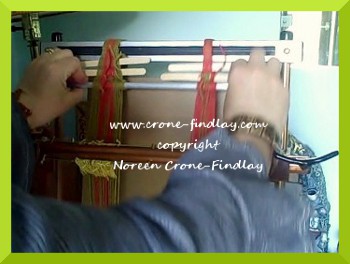
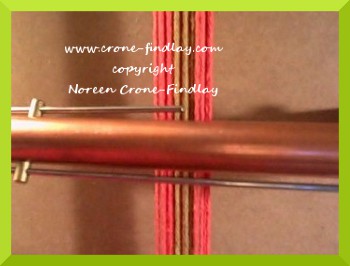
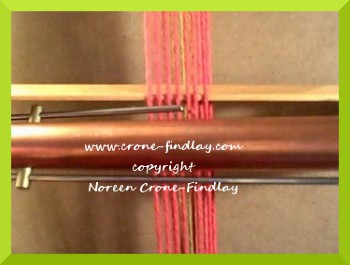
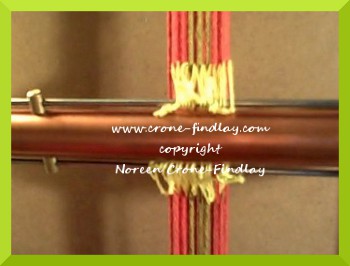
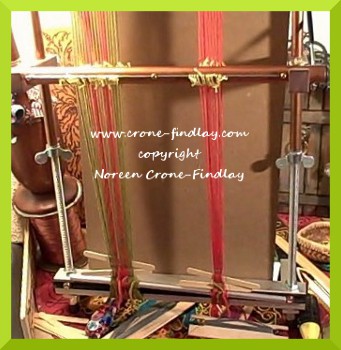
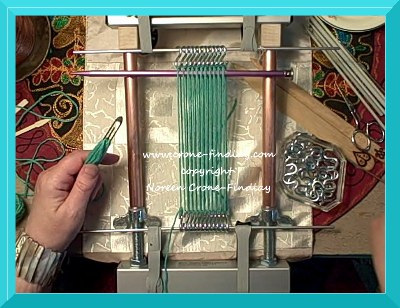
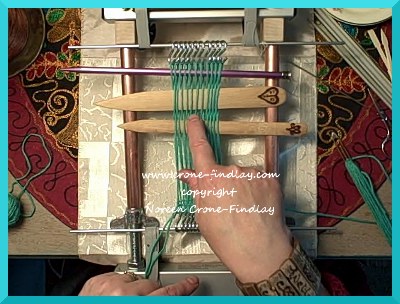
Tag Archives: Mirrix loom

Tips for quick and easy heddling on Mirrix looms

I love how easy it is to warp the Mirrix looms.

I’ve found that there are a few things that can make the process of attaching the heddles go quick as a wink.

Efficient is good!Β  πŸ™‚

copyright Noreen Crone-Findlay

The first thing that I do, after I release the warping bar from the blocks and turn them around, is to slide a piece of cardboard or masonite between the layers of warp strands at the front of the loom and the back of the loom.

It sits there, in the middle, blocking the distracting view of those warp strands at the back of the loom. πŸ™‚

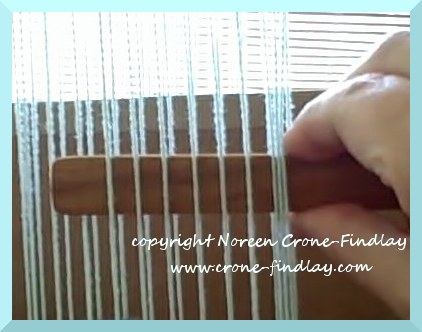
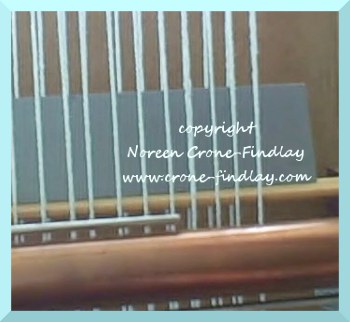
Then, I use a shed stick that is at least as long as the width of the loom to pick up every other warp strand.
copyright Noreen Crone-Findlay

Then, I flip the shed stick on it’s side, with each end being supported by the shedding device blocks.

I now have 2 layers of warp strands because of this shed being open.

So, to keep the back warp strands out of view, I slide a ruler or strip of cardboard into the open shed.

Bliss! Now, I just have one set of warp strands ready for the heddles- Yay!

This makes things sooooo much easier!

I like the center brass knob of the shed changer to be as close to the exact center of the warp strands.

So, I count how many strands I need to attach to the rod, and divide that in 1/2.

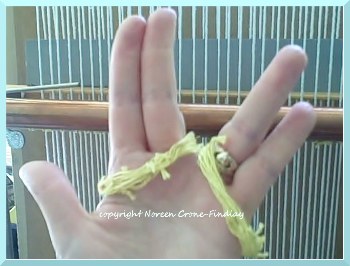
I place 1/2 the heddles on 2 of my fingers, and 1/2 on the other 2 fingers.
copyright Noreen Crone-Findlay

I loosen the heddle rod and slide it along so it’s about 2 inches/5 cm from the edge of the warp strands.
copyright Noreen Crone-Findlay

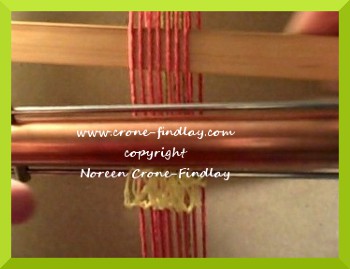
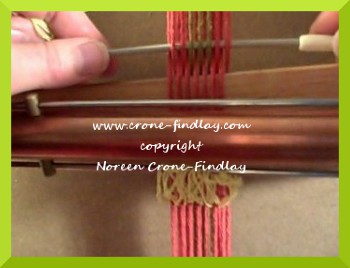
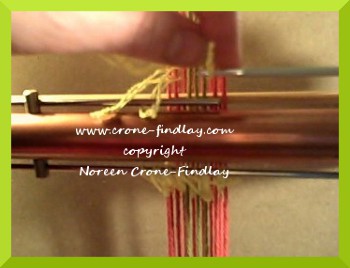
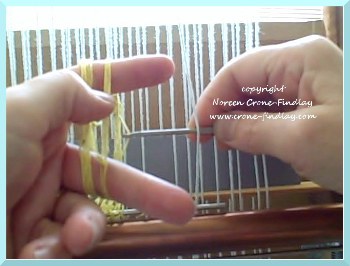
Then, I reach behind the warp strand with a crochet hook, pluck a heddle off my fingers, and pull it behind the warp strand.

I catch both ends of the heddle loop and pop them onto the heddle bar. Slide the bar along as you go.

When I run out of the the first clump of heddles, I should be half way along the warp strands.

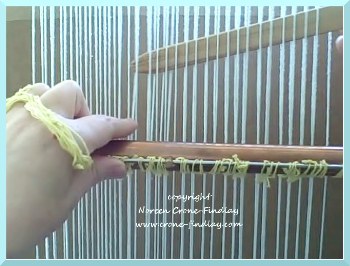
I work across , picking up all the strands, and attaching them to the heddle bar, then tighten up the little nut that holds the heddle bar in place.

Remove the shed stick and ruler, then rotate the heddle bar, sliding the heddles down the warp strands.

Turn the shed opener enough so the heddles open your first shed.
copyright Noreen Crone-Findlay

Use the shed stick to pick up the warp strands that are between the warp strands that you have just heddled.

Turn it on it’s side, insert the ruler, and repeat the process.

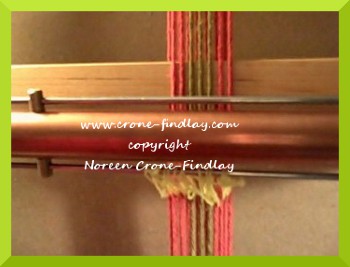
Check to make sure that all the heddles are securely attached to the heddle rods.

When I was making the video, one little bounder escaped, which was actually a good thing.

This allowed me to show how to capture the escapee heddle and tie it back in place.
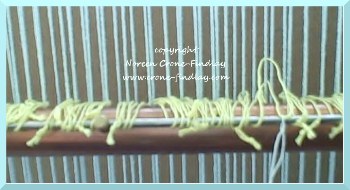
 

copyright Noreen Crone-Findlay

Remove the shed stick and ruler and check the sheds, then attach the handle or treadle and Voila!

You’re ready to weave!

Here’s the video:

Happy Weaving! πŸ˜€


6 Comments

Filed under Loom & looms & small loom weaving, tutorial & how to, video tutorial, weaving & handwoven

Warping Mirrix Looms with Loom Extenders

Loom extenders for the Mirrix looms are sooooooo neat!

You’ll need to make a few adjustments when you are warping the extended loom.

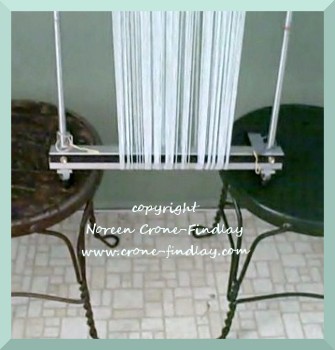
Your best friends when warping the extended loom: Two chairs that don’t have upholstery or cushions:

copyright Noreen Crone-Findlay

PlaceΒ  the chairs as far apart as possible:

copyright Noreen Crone-Findlay

This leaves a gap that allows you to easily pass the ball of warp around the loom.

You could use 2 small tables if you would prefer, but I like the height of the chairs.

The loom is still happily very stable when it’s extended.

Amazing, isn’t it?

That’s great design for you. πŸ™‚

One of the other things that I have found while weaving on the extended loom is that the weaving can pull in on you.

So, to rectify this, take 2 rubber bands, and 2 paperclips.

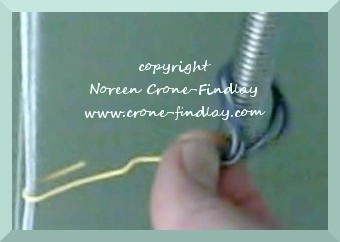
Open the paperclips, fold the rubber bands around the side bars, and squeeze the shorter end of the paperclip closed.

copyright Noreen Crone-Findlay

Hook the larger end of the paperclip through the selvedge, about a half inch below the fell line.

Make sure that the end of the paperclip is towards the back of the loom, as this makes it be less of a snaggle hazard.

Here’s the video:

Happy weaving! πŸ™‚

Leave a comment

Filed under Loom & looms & small loom weaving, tutorial & how to, weaving & handwoven

Setting up loom extenders on the Mirrix loom

Normally, I tend to prefer small looms, but I have just fallen in love with usingΒ  loom extender bars on the Mirrix loom.

copyright Noreen Crone-Findlay

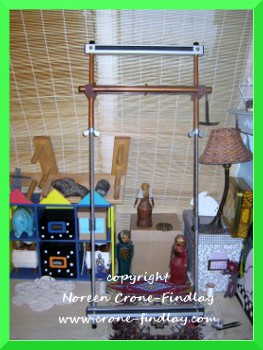
It’s really hard to convey how tall the ‘Alice in Wonderland’ version of the Big Sister 16 inch loom is when she’s got her stilts on.

With the extenders, she is 40 inches/1 m tall.

Now, that’s tall!

This means that you can achieve lots more weaving with one warp up.

(I’m working on some really fun stuff with my Big Sister Stiltie! So, stay tuned!)

My husband bought me the components for the extenders at the place he buys parts for our ancient tractor, so I didn’t have instructions on how to do this.

So, I had to figure it out for myself.

I found that there are a few tricks that make the set up easier when adding the loom extenders to your Mirrix loom.

copyright Noreen Crone-Findlay

First, lift the top of the loom off the side rails and set aside.

copyright Noreen Crone-Findlay

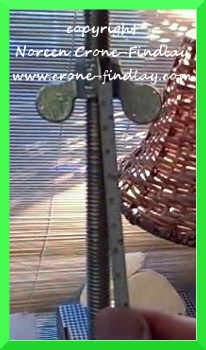
Unscrew the thumbscrews from the threaded rods, and screw them onto the extension rods.

I screwed them on so they were 5 inches/12.5 cm from the top end of the extensions.

Put the washers back on top of the thumbscrews.

copyright Noreen Crone-Findlay

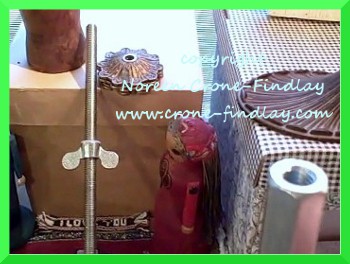
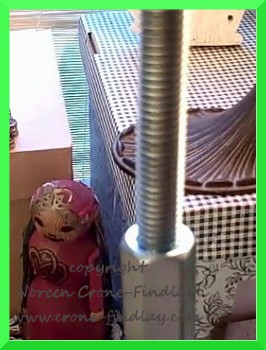
Screw the coupler to the top of the loom rod.

copyright Noreen Crone-Findlay

Hot tip: Place the end ofΒ  a tape measure inside the coupler so you can watch to see that you have screwed it on so it is half way onto the lower rod.

I had my doubts about how stable this was going to be, because the coupler seemed wobbly to me.

copyright Noreen Crone-Findlay

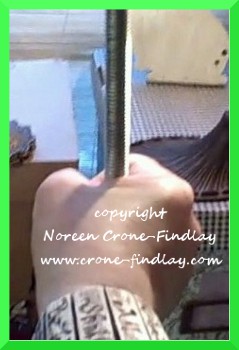
But, I went ahead, and screwed the extension rod in anyhow….

copyright Noreen Crone-Findlay

And, then, when I tightened it up by hand, I was amazed at how it was suddenly rock solid!

WHEEE!

This is good!

Wobbly bad!

Solid- GOOD!!!

Repeat for the other side…

copyright Noreen Crone-Findlay

Measure to be sure you have everything square, and put the top half of your loom back on.

Stand back in amazement at your loomie on stilts! Wowsa!

The best part is that the loom is still miraculously stable and works perfectly.

I find that resting it against the edge of the desk and having the lower edge sitting in my lap is the most comfortable way to weave with the extensions on.

Also, weaving standing up works well.

Having the stand for it would be sublime.

I made a video of the ‘putting it together’ process:

Happy weaving! πŸ˜€

Leave a comment

Filed under Loom & looms & small loom weaving, tutorial & how to, video tutorial, weaving & handwoven

How to weave inkle bands on Mirrix looms part 4

This is the fourth video tutorial about how to weave inkle bands on Mirrix looms.

copyright Noreen Crone-Findlay

A dear friend asked me: “Why are you spending all this time figuring out how to weave inkle bands on the Mirrix loom? You have inkle looms! ”

Yes, I do… an open sided one, a closed side one that my husband built me from upcycled pallet wood, and a mini.

And, I love them…. but, I find that the open side and mini inkle looms both kind of flop when I have one end on the desk edge and one end in my lap. This is the way that I like to weave with inkle looms, and I find the wobble/flop rather frustrating.

I really like how stable the Mirrix is when I have the lower edge in my lap and the upper edge against a workbench, table or desk.

Also, I love the precision of the tensioning on the Mirrix… those thumbscrews are sweet!

And, I also love the shedding device………. soooooooooo smooth.Β  πŸ˜€

Besides, the Mirrix takes up sooooooooooooo little room to store it- inkle looms do take up a chunk of space in the studio!

That’s four good reasons that have made this rather challenging learning curve worthy of the time I have invested.

Here’s the video for the finishing process of weaving inkle bands on the Mirrix loom:

When you have woven your bands to the point that the warping rod is sitting on top of the loom, you will need to remove the spring:

copyright Noreen Crone-Findlay

Loosen the tension upΒ  a lot….

copyright Noreen Crone-Findlay

Lift the spring rod out of the spring.

Release the ends of the springs from the knobs.

Gently, ease the spring out of the warp strands by spreading the warp strands out slightly and pushing on the spring to disengage it.

Continue weaving until the shuttle almost can’t make it through the shed.

copyright Noreen Crone-Findlay

Weave one row.

Keep the shuttle in the shed, and place a darning or tapestry needle in the shed with the point pointing in the direction that the shuttle exits the shed.

Weave the next row, and repeat with a second darning needle.

The needles now point in opposite directions.

Weave one more row.

Cut the weft strand, and thread it into the first needle.

Pull it through, and remove the needle.

Thread the weft strand into the remaining needle and pull it through.

La de dah! you have finished your inkle band!

Wheee! πŸ˜€

I always weave the tail end in a little bit more before I trim it off.

Loosen the tension wayyyyyyyyyyyyyyyyyy off, and slide the warping rod out of the loops.

Trim the ends, and pull them through the heddles.

Congratulations, you’ve woven some scrumptious new inkle bands! πŸ™‚

Happy Weaving!

1 Comment

Filed under Loom & looms & small loom weaving, tutorial & how to, weaving & handwoven

How to weave inkle bands on the Mirrix loom part two

This is the second stage of the video tutorials that I made on how to weave inkle bands on the Mirrix loom.

copyright Noreen Crone-Findlay

There are two bands on the loom, because in this video, I am working on the 16 inch loom.

When you work on the 8 inch loom, it’s okay to just weave one band at a time, as the warping bar doesn’t flop around.

But, on the 16 inch loom, you do need to either warp up 2 bands, or secure the other end of the warping bar with a cord so it will stay perfectly horizontal.

I tried weaving 3 bands at once on the 16 inch loom, and didn’t like it, as the center knobs on the shedding device got in the way.

Two bands are just great though.

AND…. if you want to weave longer bands, and have either a 12 inch or 16 inch Mirrix loom then the loom extenders will be your friend πŸ™‚


I use a crochet hook and a weaving stick to make the heddling process go quick like a bunny.

Here’s the video tutorial:

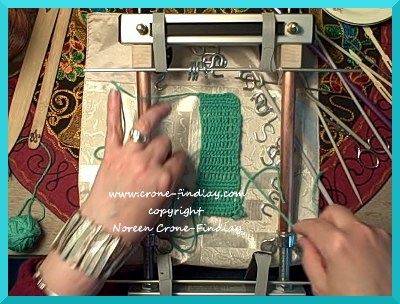
Start by placing a piece of cardboard between the layers at the front of the loom and the back so you can’t see the warp strands at the back of the loom.

copyright Noreen Crone-Findlay

Place the shed changing device into the brackets.Β  Unscrew the little knob that holds the heddle rod in place.

Pull the heddle rod back so it’s about half way along the warp strands.

copyright Noreen Crone-Findlay

Place the heddles onto the fingers of your non dominant hand.

copyright Noreen Crone-Findlay

Look down at the warp strands that are at the lower edge of the front of the loom.

There’s a gap between the strands that have gone in front of the warping bar and behind it.

Slip your fingers into the gap and scoot them up to the shedding device.

Slide a shed stick into the gap.

Voila! (which is how ‘walla’ is really spelled πŸ™‚Β  )

You have shed one ready to heddle!

copyright Noreen Crone-Findlay

Now, slip the crochet hook behind the first warp strand, pluck a heddle off your fingers, and pull it forward.

Catch the other end of the heddle loop and place both loops on the heddle rod.

Go slowly, and be sure that both ends of the heddle loop stay politely on the heddle rod.

copyright Noreen Crone-Findlay

When you have all of the warp strands heddled, slide the heddle bar into position in the knobs, and tighten the lock nut.

Repeat the heddling process on the second set of warp strands for your other band.

copyright Noreen Crone-Findlay

Push the first set of heddles down as you rotate the shedding device.

copyright Noreen Crone-Findlay

Leave the shed stick in place, and use the crochet hook to pick up the warp strands for the other shed.

Take the warp strand from the back to the right of the one in front, and onto the hook,

take the hook over the front strand, and pick up the next strand and carry on across.

copyright Noreen Crone-Findlay

Slide the weaving stick out of the first shed, and slip it along the crochet hook to transfer the warp strands from the crochet hook to the weaving stick.

copyright Noreen Crone-Findlay

Turn the weaving stick on it’s side, and then pick up the warp strands one at a time and capture them with the heddles just as you did for the first set of warp strands.

copyright Noreen Crone-Findlay

Repeat this process for the second band.

Check your heddles carefully to make sure that they are opening the sheds properly.

Ahhhhh! a warped loom is a thing of beauty!

copyright Noreen Crone-Findlay

Attach the handle to the shedding device and adjust the tension by turning the thumbscrews.

Open the first shed, and insert a craft stick, then open the second shed and insert another craft stick.

Squish the warp strands together to establish the width of your band.

copyright Noreen Crone-Findlay

Weave one row, leaving a 6 inch/15 cm tail.

Change sheds, and weave the next row.

Pull up firmly on the tail end and weave it through the same shed.

Repeat several times until the tail end is woven in, and the band is established.

Next video: The fun part! Wheeeeeee…. weaving…… πŸ™‚


Leave a comment

Filed under Loom & looms & small loom weaving, tutorial & how to, video tutorial, weaving & handwoven

How to weave Leno Lace on the Mirrix loom

I am fascinated by exploring allΒ  the different things that I can do with Mirrix looms.

While I am involved in this four month long co-creation with Mirrix looms, I am going to beΒ  looking at what I can and can’t do with the Mirrix looms.

(Guess what I am NO GOOD at? Bead weaving on the Mirrix!

Yep. All my bead weaving has been off loom and I am TERRIBLE at bead weaving on the loom.Β 

That one came as a surprise…Β  ah well… we shall see if that changes! )

In my previous blog post, LINK, I showed how I set up my Lani Mirrix loom, using the ‘No Warp Ends’ warping technique.

copyright Noreen Crone-Findlay

There are several advantages in setting up your Mirrix loom for the ‘No Warp Ends’ technique:

It allows you to sample different weaving techniques quickly and efficiently.

You won’t waste time OR yarn when using the ‘No Warp Ends’ technique.

I love that!

Because the ‘No Warp Ends’ warping technique precludes using a shedding device, it is perfect for weaving techniques that are hand manipulated, like: LENO lace! Yay!

I think that Leno lace is the bee’s knees.

It’s kind of a miniature version of the ancient technique of twisting fibers, called, Sprang.

You do this nifty twist thing, and tadah! You get aΒ  bonus free row that is cheerfully waiting for you, gratis! Whee!

copyright Noreen Crone-Findlay

Leno can seem a little challenging at first, so I figured that a videoΒ  tutorial is a good idea.

Here it is:

Happy Weaving!

πŸ™‚


6 Comments

Filed under Loom & looms & small loom weaving, tutorial & how to, video tutorial, weaving & handwoven

How to make yarn butterflies and upcycled wooden tapestry bobbins

Some people love weaving with yarn butterflies.

And some people (like me) don’t.

I love wooden tapestry bobbins and I love making each one a unique piece- and I especially like using upcycled wood to make them.

So, for those of you who like yarn butterflies, here’s a video tutorial on how to make yarn butterflies:

And, here’s how I make my one of a kind tapestry bobbins, which wouldn’t suit everyone, but I love them and find them to be a pleasure to use:

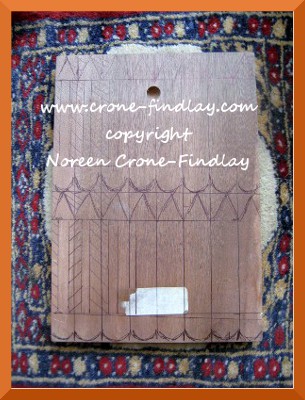
Start with a piece of cast off wood. In this case, a wooden plaque (don’t use chipboard or mdf ! This needs to be hardwood)

a thrown away plaque from a garage sale

Flip it over, and draw in the rough lines for the first cuts:

copyright Noreen Crone-Findlay

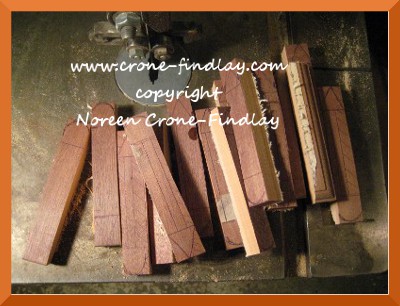
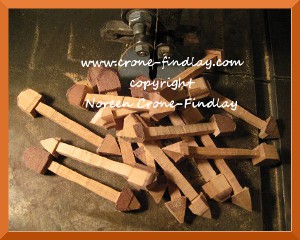
next, saw them into rough shape:

copyright Noreen Crone-Findlay

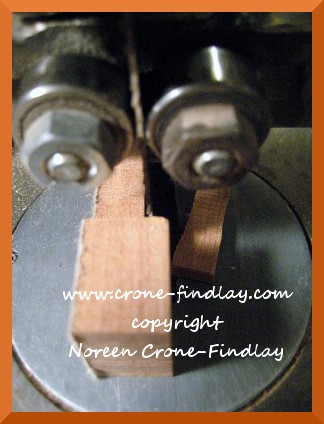
Working on getting more definition and shaping:

copyright Noreen Crone-Findlay

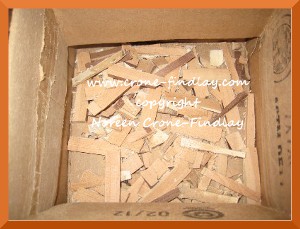
All the wooden offcuts are going to be burned in the wood burning stove in the studio in the winter- nothing’s wasted!

copyright Noreen Crone-Findlay

When the rough saw shaping is done:

copyright Noreen Crone-Findlay

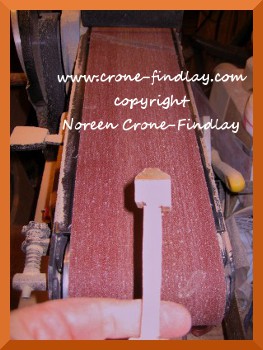
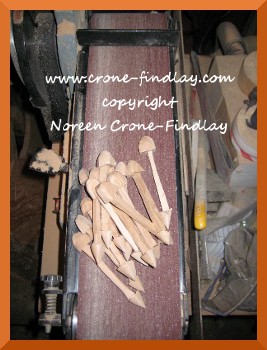
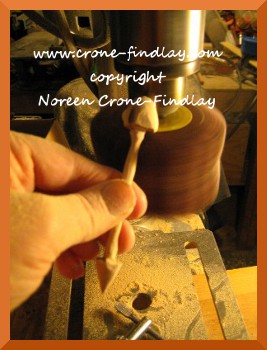
I move over to the belt sander:

copyright Noreen Crone-Findlay

and I do a whole bunch of sanding (very carefully)

copyright Noreen Crone-Findlay

Did I mention that this is a really slow, meditative process? Yup.

Go slowly… and pay attention….

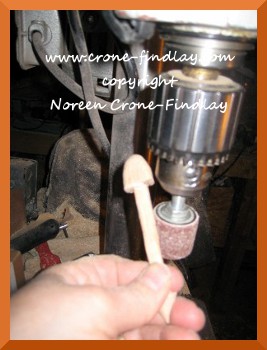
Then, it’s off to work with a bunch of different small sanding drums:

copyright Noreen Crone-Findlay

and files:

copyright Noreen Crone-Findlay

And more sanding:

copyright Noreen Crone-Findlay

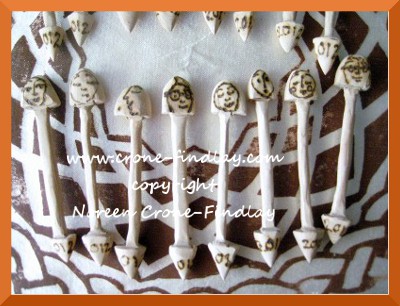
and then, I draw faces on each one, and get out my wood burning tool and draw and burn faces and the year on each one:

copyright Noreen Crone-Findlay

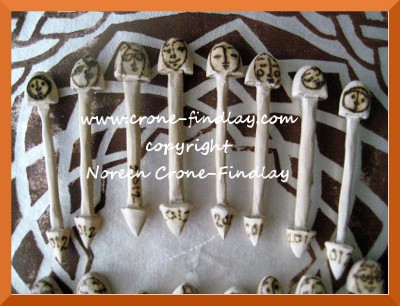
Here’s a closer look:

copyright Noreen Crone-Findlay

I just listen to what each bobbin wants, and then I draw on their faces. Some of them crack me up.

copyright Noreen Crone-Findlay

Like the ‘Get to the Point’ guy… 3rd from the left….Β  I know, I am easily amused….

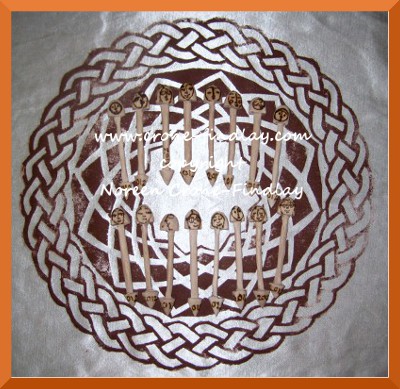
And, here they are, all wrapped up and ready to weave!

copyright Noreen Crone-Findlay

I hope that the photos will all open for you!

So, happy butterflies, and happy bobbin-ing!

Happy weaving! πŸ™‚

6 Comments

Filed under eco crafts & green projects, Loom & looms & small loom weaving, tutorial & how to, weaving & handwoven

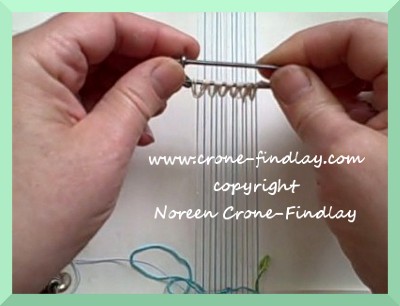
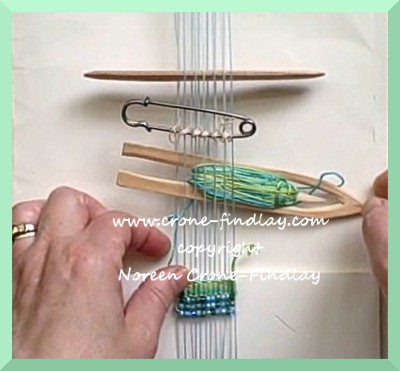
A pin a stick and a loop of string to open the shed

If you have a loom that doesn’t have a shedding device, picking up the warp strands for every row you weave can be a tedious process.

I like to use a stick,Β  a pin and a loop of string to open the sheds. It’s a huge time saver!

I’ve made a video tutorial on how to do this for narrow bands, but this technique also works on wider pieces, too.

copyright Noreen Crone-Findlay

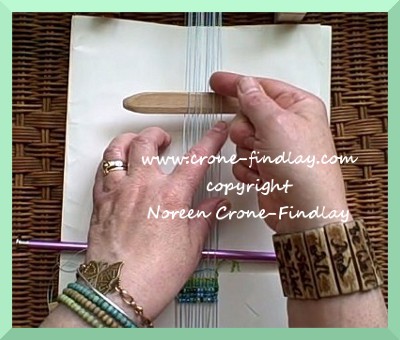
Pick up every other warp strand with a weaving stick (even a popsicle/craft stick or a paint stick will work).

Push that stick up to the top of the loom.

copyright Noreen Crone-Findlay

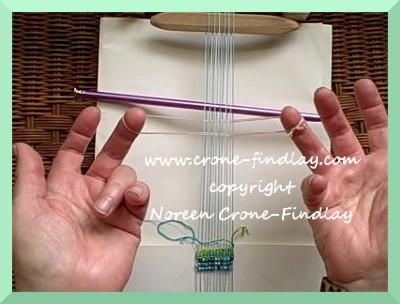
Now, use a knitting needle to pick upΒ  the ~remaining~ warp strands, to open the second shed.

You’ll be going over the strands that you went under in the first shed, and under the ‘overs’.

copyright Noreen Crone-Findlay

Take a loop of string (in this case, I used 2 string heddles from one of my inkle looms held together for more strength, and to make it easier to see in the video) through the open shed.

copyright Noreen Crone-Findlay

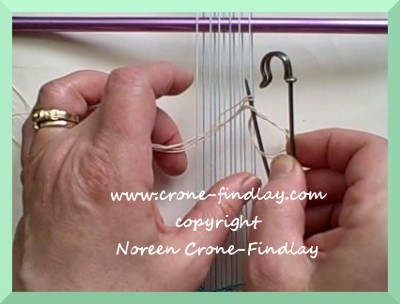
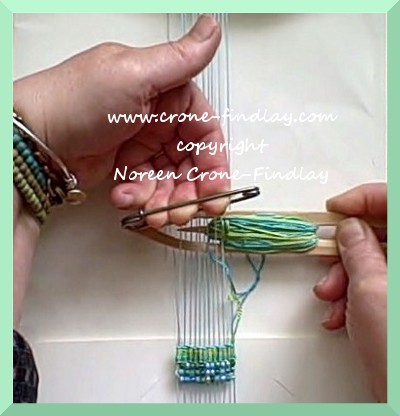
Pick up the end of the loop with a kilt pin, and then lift the loop strings between each warp strand onto the pin.

copyright Noreen Crone-Findlay

Take the second end of the loop up onto the pin, and close it.

Adjust the length of each section of the loop.

And, Voila! you now have a handy, dandy way of opening both sheds!

copyright Noreen Crone-Findlay

copyright Noreen Crone-Findlay

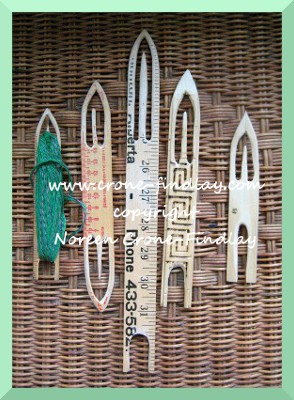
Here’s a pic of the shuttles that I make by upcycling old rulers and bits of decorative trim:

copyright Noreen Crone-Findlay

HOT TIP that I mentioned in the video: If you use a file folder as the separator/background thingie between the front and back of your loom, you can use the pocket of the file folder to park your shuttle and beading needle when you’re not weaving.

And, here’s the video tutorial:

1 Comment

Filed under Loom & looms & small loom weaving, tutorial & how to, video tutorial, weaving & handwoven

Making string heddles for my Mirrix loom

At the beginning of May,Β  a ‘new-to-me’ loom , a largeΒ  Mirrix tapestry loom, arrived in my studio. (Courtesy of my son and daughter in law who picked her up in the city 4 hours away, that used to be her home- the previous owner didn’t want to ship her).

copyright Noreen Crone-Findlay

I immediately sat down and made a whole lot of heddles for her, as she didn’t come with them.

And then, I warped her up- ooooooooohhhhhhhhhh, I love how easily she warps! Bliss!

As I was warping her up and starting to weave,Β  I thought…. ‘Hmmmm…. there must be a group for Mirrix weavers on Ravelry’

(Ravelry= the facebook of the yarn world)

I looked, and sure enough! There is a Mirrix group…. which I joined, pronto.

And the first thing I saw was that Claudia (the inventor of the magical Mirrix looms) and Elena, her talented daughter, had posted that they were accepting applications for their annual ‘Social Networking for a Mirrix Loom’ campaign. Link

Well… I had decided within hours of starting to weave on my ‘Joni’ loom that I wanted to fill my studio with Mirrix looms.

So, I sent off an application….

Um… I wanted to fill the studio with ~Smaller~ Mirrix looms!

MEANWHILE>>>> The Joni is one big Mamma, and even though I am tall, my arms are short, so I found that I was having shoulder pain.

MyΒ  clever daughter in law subtly sneaked the information out of me that I was longing for the treadle kit for the Mirrix loom. Then, she orchestrated the family buying me the treadle kit for Mother’s Day! What a sweetheart!

To say that I was thrilled was an understatement!

THEN!Β  on the 18th of May, was just tickled pink to hear from Elena that they had picked me as one of their team for the 4 months of the ‘Social Networking’ campaign. Whee!Β  What a couple of thrilling days!

And, now… I am starting to keep my part of the bargain, which is to chronicle my experiences with the Mirrix loom(s).

So, since I began my Mirrix adventures with making string heddles, I am going to show you my quick and easy way of making the string heddles for the Mirrix looms (or inkle or frame looms, too).

copyright Noreen Crone-Findlay

And, here is the video:

How to make string heddles by Noreen Crone-Findlay (c)

Happy Weaving!

11 Comments

Filed under Loom & looms & small loom weaving, tutorial & how to, Uncategorized, video tutorial, weaving & handwoven

Bead love

I love beads- how could I NOT love beads?

The colors! the textures! the complete wonderfulness of them- sigh….

For many years, I did a lot of off loom beading- using brick stitch and peyote stitch to create pieces like this necklace:

copyright Noreen Crone-Findlay

This necklace is an homage to the Minoan Goddess of the Bees.

The blue teardrop shapes areΒ  dew drops, as the Minoan Goddess of the Bees is also known as ‘The Dewdrop Goddess’.

I love that—- dew happens when the earth is waking up and shifting from the dreamtime to the waking world.

How wonderful that there is a tiny Goddess there, guiding us back from our dreams, to our waking lives, and refreshing our spirits with dewdrops!

The red petal is a pomegranate seed, as The Minoan Goddess of the Bees is also closely aligned with the Goddess, Persephone.

Persephone was snatched from this world, and taken to the underworld, where she ate 3 pomegranate seeds. This meant that she had to return to the depths for 6 months of every year.

In Western Canada, where we live, winter reigns for at least 6 months of the year, often longer, so I resonate deeply with Persephone’s journey!

By the way, I love how the corded part of the necklace formed a figure ‘8’ – tilt it sideways, and you have infinity!

I worked the cord in peyote stitch, using tiny brass beads that a friend found in a thrift shop.Β  Nice!!! πŸ™‚

copyright Noreen Crone-Findlay

I carved her face from a tagua nut (an ecologically harvested palm nut) that is also known as vegetable ivory.

I have never done much loom beading, but that is about to change!

Every year, Claudia and Elena at Mirrix looms have a ‘social media campaign’.

They choose 2 weavers (a bead weaver and a tapestry weaver) to be part of the team, and then give them each a Mirrix loom.

Then, the weavers blog and post and tweet and fb etc about their adventures with their Mirrix looms for 4 months.

Well… I am soooooooooooooo delighted!

They picked me as one of their weavers! wheeeeeeeeeeeeeeeee!

A few weeks ago, I bought a Mirrix Joni from another Canadian weaver who hadn’t bonded with it. I am working on a series of woven tapestries and fiber arts collages and I need Joni Mirrix to be my loomie for that πŸ˜€

Woots! I fell madly in love with Joni MirrixΒ  (although I felt unworthy of her at first… will tell you more about it, later) and thought-

‘Hmmmmm… there must be a Ravelry group for Mirrix looms’.

I looked for it, and sure enough, there is! Link

I joined, and the first thing I saw was that they were having their annual Social Media networking campaign.

I sent in my application, and last night, I was doing a huge happy dance to discover that I got picked for the team!

(good thing I don’t have to catch a ball or throw one to be on the team, or else I would still be standing on the sidelines! ahem)

Oh ho! I want to fill my studio with Mirrix looms, (tapestry is slow, and I want to be doing bead weaving, toooooooo, so I am just ecstatic!)

Speaking of bead weaving, I treated myself to Claudia’s bracelet workshop on Craftsy Β (anyone who has seen any of my video tutorials will know that I am madly in love with bracelets!) and I am chomping at the bit to get going on a bunch of yummy woven bracelets!

Alright…. back to work on design deadlines so I get back to my weaving!

Go gently! πŸ™‚

Oh! PS: if you would like to knit yourself a Minoan Goddess of the Bees, I designed one for you to knit, andΒ  can be ordered here:

Link to the doll page on my website (scroll down, waaaaaaaaay down the page to click the ‘buy now’ button)


6 Comments

Filed under doll & dolls & dollmaking & doll making, knitting, Loom & looms & small loom weaving