Part 3 of the video tutorial series on how to weave inkle bands on Mirrix looms is about the weaving process:
copyright Noreen Crone-Findlay
Something that I learned as I trundled up my ever so steep learning curve with figuring out how to weave inkle bands on the Mirrix loom:
I started out by weaving one row on one band, putting it’s shuttle down, then picking up the second shuttle and weaving one row on the other band.
Sounds slow and clunky, doesn’t it? Well, you’re right.
The most efficient way to weave 2 bands at once is to weave as far as you can on one band, then set that shuttle aside, and weave away on the second band.
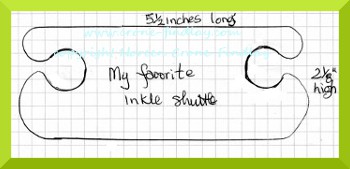
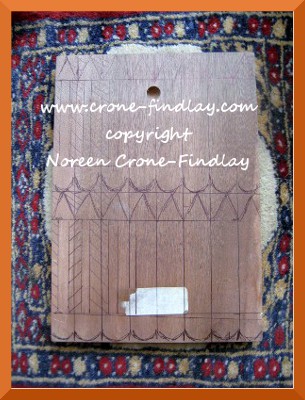
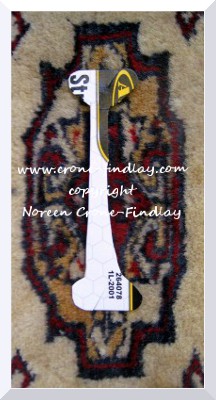
Oh… speaking of shuttles, here’s the tracing of my most favorite inkle shuttle:
copyright Noreen Crone-Findlay
I designed this one several years ago, and I love it. Works like a charm.
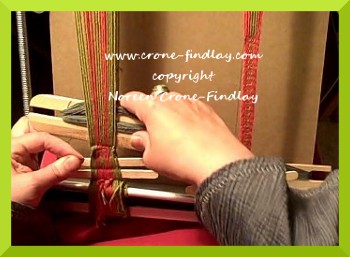
Here’s the video that shows the weaving process:
copyright Noreen Crone-Findlay
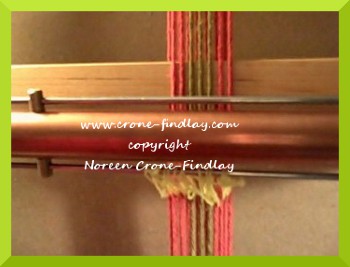
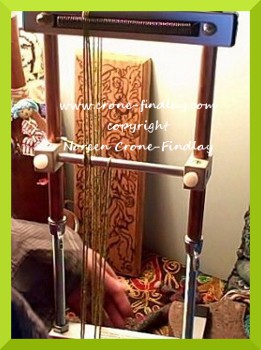
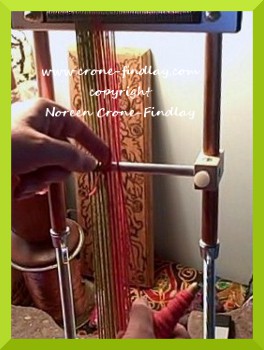
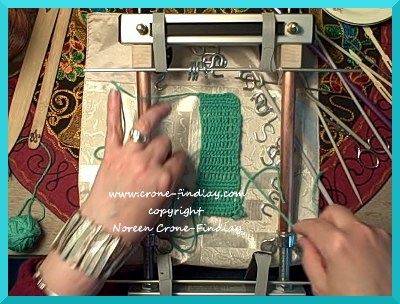
When you need to advance the warp, loosen the tension quite a lot.
Support the spring as you gently ooze the warp rod around and up the back of the loom.
Pat the warp strands back into the channel, and tighten up the tension again.
Remember, you do not need to have the tension as tight as when you are weaving a tapestry or beading.
You’ll find the perfect tension that suits you best.
Keep on weaving until the warp rod is sitting on top of the loom, and then check into the 4 th video in the series:
This is the second stage of the video tutorials that I made on how to weave inkle bands on the Mirrix loom.
copyright Noreen Crone-Findlay
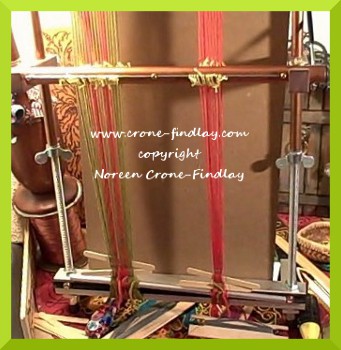
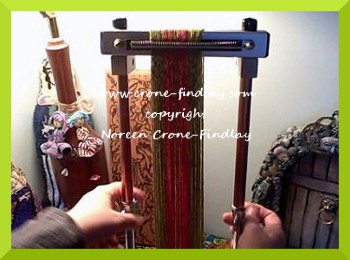
There are two bands on the loom, because in this video, I am working on the 16 inch loom.
When you work on the 8 inch loom, it’s okay to just weave one band at a time, as the warping bar doesn’t flop around.
But, on the 16 inch loom, you do need to either warp up 2 bands, or secure the other end of the warping bar with a cord so it will stay perfectly horizontal.
I tried weaving 3 bands at once on the 16 inch loom, and didn’t like it, as the center knobs on the shedding device got in the way.
Two bands are just great though.
AND…. if you want to weave longer bands, and have either a 12 inch or 16 inch Mirrix loom then the loom extenders will be your friend 🙂
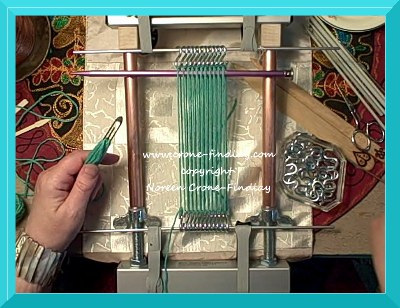
I use a crochet hook and a weaving stick to make the heddling process go quick like a bunny.
Here’s the video tutorial:
Start by placing a piece of cardboard between the layers at the front of the loom and the back so you can’t see the warp strands at the back of the loom.
copyright Noreen Crone-Findlay
Place the shed changing device into the brackets. Unscrew the little knob that holds the heddle rod in place.
Pull the heddle rod back so it’s about half way along the warp strands.
copyright Noreen Crone-Findlay
Place the heddles onto the fingers of your non dominant hand.
copyright Noreen Crone-Findlay
Look down at the warp strands that are at the lower edge of the front of the loom.
There’s a gap between the strands that have gone in front of the warping bar and behind it.
Slip your fingers into the gap and scoot them up to the shedding device.
Slide a shed stick into the gap.
Voila! (which is how ‘walla’ is really spelled 🙂 )
You have shed one ready to heddle!
copyright Noreen Crone-Findlay
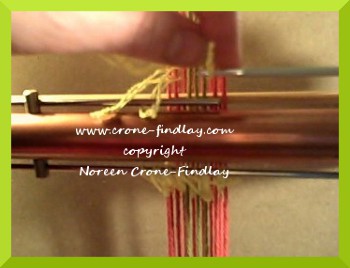
Now, slip the crochet hook behind the first warp strand, pluck a heddle off your fingers, and pull it forward.
Catch the other end of the heddle loop and place both loops on the heddle rod.
Go slowly, and be sure that both ends of the heddle loop stay politely on the heddle rod.
copyright Noreen Crone-Findlay
When you have all of the warp strands heddled, slide the heddle bar into position in the knobs, and tighten the lock nut.
Repeat the heddling process on the second set of warp strands for your other band.
copyright Noreen Crone-Findlay
Push the first set of heddles down as you rotate the shedding device.
copyright Noreen Crone-Findlay
Leave the shed stick in place, and use the crochet hook to pick up the warp strands for the other shed.
Take the warp strand from the back to the right of the one in front, and onto the hook,
take the hook over the front strand, and pick up the next strand and carry on across.
copyright Noreen Crone-Findlay
Slide the weaving stick out of the first shed, and slip it along the crochet hook to transfer the warp strands from the crochet hook to the weaving stick.
copyright Noreen Crone-Findlay
Turn the weaving stick on it’s side, and then pick up the warp strands one at a time and capture them with the heddles just as you did for the first set of warp strands.
copyright Noreen Crone-Findlay
Repeat this process for the second band.
Check your heddles carefully to make sure that they are opening the sheds properly.
Ahhhhh! a warped loom is a thing of beauty!
copyright Noreen Crone-Findlay
Attach the handle to the shedding device and adjust the tension by turning the thumbscrews.
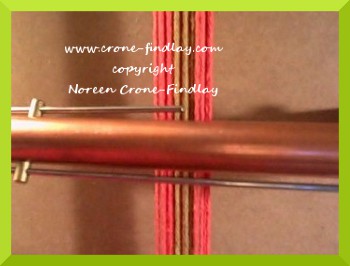
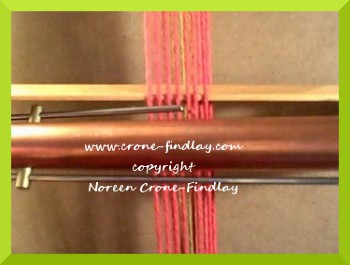
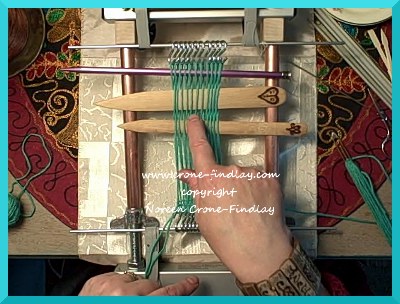
Open the first shed, and insert a craft stick, then open the second shed and insert another craft stick.
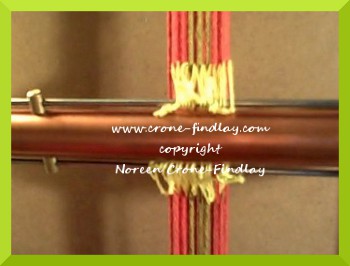
Squish the warp strands together to establish the width of your band.
copyright Noreen Crone-Findlay
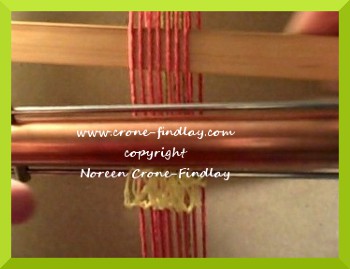
Weave one row, leaving a 6 inch/15 cm tail.
Change sheds, and weave the next row.
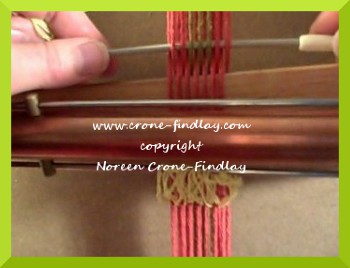
Pull up firmly on the tail end and weave it through the same shed.
Repeat several times until the tail end is woven in, and the band is established.
Link to purchase pattern for Inkle dolls: Inkle Dolls
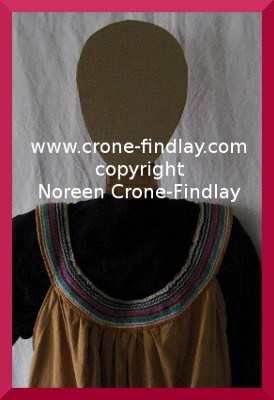
And, they are wonderful for trimming handwoven clothing:
copyright Noreen Crone-Findlay
Link to post that shows how to shape inkle bands to make a yoke or other shaped pieces of garments: Warp pulling
Over the years, I have also made hat bands, book marks, all kinds of jewelry, key fobs, vests, bags, bag handles, the garters for the men’s kilt hose for my son’s wedding, shawls, freeform pieces that combine inkle weaving, knitting, embroidery, spool knitting and crochet, as well as rugs.
Yep. I love inkle weaving.
So, as I have been exploring the possibilities of weaving with my Mirrix looms, I had to give inkle weaving a try.
I found that it was quite challenging at first. But, I don’t give up easily 🙂
I ended up spending waaaaaaaaaaaaaaay more hours than I should have, experimenting and obsessing over making inkle bands on the Mirrix.
Well… I finally succeeded.
Since it was so challenging, I figured that I should share what I have learned, so that other intrepid inkle weavers can leap right in, without all the trial, error and frogging that I went through!
There are definitely tricks to weaving inkle bands on the Mirrix looms, and I have made 4 videos to share those tricks.
Here’s part one of the video:
Here is the draft for the bands that I wove in the videos:
copyright Noreen Crone-Findlay
To read the draft: Each square represents one warp strand.
You can check your warping by looking at each shed to see that it has the same number of strands, in the order that they appear in the line.
You will be putting a total of 8 green strands on, followed by 4 orange strands, 3 sets of (1 orange, 1 green) for a total of 6 strands, then 4 orange strands and ending with 8 green strands.
At the top and bottom of the loom, you’ll see the full count of warp strands.
At the warping bar, the 2 sheds will be separated into their correct (we hope!) configuration for each shed.
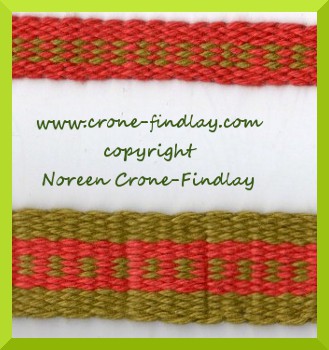
The chart will give you bands like this:
copyright Noreen Crone-Findlay
The upper band is the band on the right hand side of the loom in videos 2 – 4.
I only used the center of the draft for it, without the green border strands.
The yarn is Lion Brand Cotton.
copyright Noreen Crone-Findlay
Setting up the loom for inkle bands is different than normal warping.
You need to have the warping bar at the front of the loom.
copyright Noreen Crone-Findlay
Tie the green yarn onto the warping bar and take it up and around the loom, just the same as if the warping bar was in the back.
copyright Noreen Crone-Findlay
You will need to cut the warp strand of color 1 to tie on color 2 at the warping bar, for EVERY color change.
WHAT?!?!?!
Yes. really.
It sounds insane, but this is the biggest key to making the whole inkle thing work on the Mirrix loom.
Trust me. You ~can~ twist your yarns around each other, and are welcome to, I’m sure, if that would make you happy….
BUT…. the quickest, easiest way to have problem free warping for inkle is to cut those little darlin’s and tie the knots between the colors.
copyright Noreen Crone-Findlay
Yay! Warped! Insert the spring rod into the spring to keep the warp strands locked into their notches.
This is sooooooooooo important! (yep… voice of ‘oops’ experience here 😦 )
And in Part 2…. it’s on to the heddles.
I have a nifty, super friendly way of using a crochet hook and weaving stick to make the heddling process go like a breeze.
I am fascinated by exploring all the different things that I can do with Mirrix looms.
While I am involved in this four month long co-creation with Mirrix looms, I am going to be looking at what I can and can’t do with the Mirrix looms.
(Guess what I am NO GOOD at? Bead weaving on the Mirrix!
Yep. All my bead weaving has been off loom and I am TERRIBLE at bead weaving on the loom.
That one came as a surprise… ah well… we shall see if that changes! )
In my previous blog post, LINK, I showed how I set up my Lani Mirrix loom, using the ‘No Warp Ends’ warping technique.
copyright Noreen Crone-Findlay
There are several advantages in setting up your Mirrix loom for the ‘No Warp Ends’ technique:
It allows you to sample different weaving techniques quickly and efficiently.
You won’t waste time OR yarn when using the ‘No Warp Ends’ technique.
I love that!
Because the ‘No Warp Ends’ warping technique precludes using a shedding device, it is perfect for weaving techniques that are hand manipulated, like: LENO lace! Yay!
I think that Leno lace is the bee’s knees.
It’s kind of a miniature version of the ancient technique of twisting fibers, called, Sprang.
You do this nifty twist thing, and tadah! You get a bonus free row that is cheerfully waiting for you, gratis! Whee!
copyright Noreen Crone-Findlay
Leno can seem a little challenging at first, so I figured that a video tutorial is a good idea.
I hate wasting yarn… so I really don’t like loom waste – who wants to toss their yarn in the trash? Really 🙂
That’s why I love Claudia Chase’s ‘No Warp Ends’ technique for the Mirrix looms.
copyright Noreen Crone-Findlay
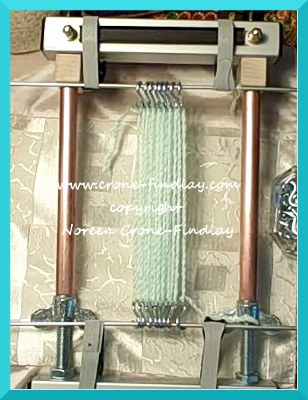
The one thing that I wasn’t keen on was using paper clips to be the holders for the yarn ends, so I thought about it and mulled it over.
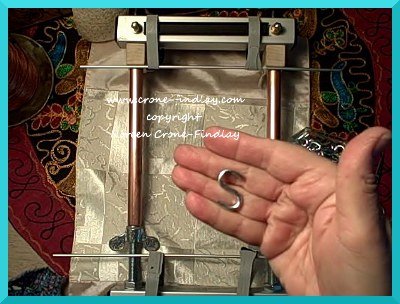
Hmmmm…. I use ‘S’ hooks all the time to hang things and connect them, but I have never used them on a loom.
This called for some experimenting.
I don’t know about you…. but, I have a tendency to start with a really complicated plan, and have to do a lot of trial and errors to get to the elegant and simple final version.
I was thinking about all kinds of ways of making harnesses to hold the bars for the ‘s’ hooks…. oh my!
I also figured that I wanted to use both sides of the loom while setting up for this technique.
I had woven two affinity bracelets at the same time- one on the front of the loom, and one on the back, so this seemed to stick in my mind as ‘the way to go’.
Well… I twiddled and fiddled, and threw away the whole overly elaborate harness idea, and ended up using 4 loops of double sided velcro to hold the bars to the upper and lower edges of the loom.
That was a big breakthrough- talk about a simple way to do this! Yay!~
And, I am really pleased with the final method that I came up with- it really works for me!
copyright Noreen Crone-Findlay
Here is the video, showing how I warp the Mirrix Lani using the ‘No Warp Ends’ technique, with ‘S’ hooks:
My daughter-in-law spins gorgeous yarn. Which makes me very happy.
Because, sometimes a skein or two finds its way into my studio.
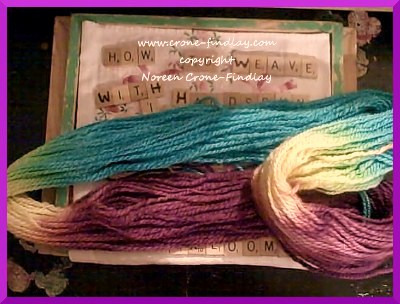
Recently, she spun Merino and silk and dyed it turquoise and purple, separated by short sneezes of sunshine yellow.
copyright Noreen Crone-Findlay
I love it, and have been puzzling over how to use it in one of my new tapestries in a way that keeps the integrity of the colorway, while working across the entire width of the tapestry. Weaving narrow bands of it in vertical columns would not be a problem with maintaining the colors as units… but… horizontally- ah, well… that’s another cup of soup entirely.
I didn’t want to have the colors end up in little splats of one color arguing with another.
That meant working in short segments, weaving small blocks of each color.
I could have woven little squares of each color, with little slits that would need to be stitched or interlocked. Myech…
I sat down with my trusty little pencil and thought about this conundrum….
and came up with this:
copyright Noreen Crone-Findlay
If I started at the left hand edge, and wove a little triangle with one length of turquoise, then, I could use the little bursts of yellow to tell me when to nip down, and start a slanting wedge of purple.
This completely worked for me! I wouldn’t have any joins to deal with, and I could work each little section of color in order, so the colorway of the yarn stays intact.
It’s a happy solution to an interesting problem!
Tapestry weaving is full of nifty little voyages of discovery 🙂
copyright Noreen Crone-Findlay
My first little purple patch was not so perfect, but by the time I had woven across to the right hand side I was pleased with it.
If you have a loom that doesn’t have a shedding device, picking up the warp strands for every row you weave can be a tedious process.
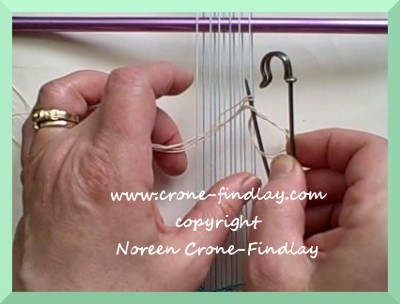
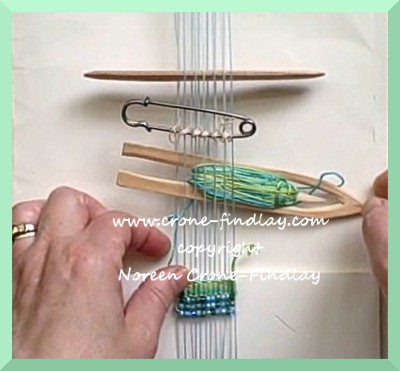
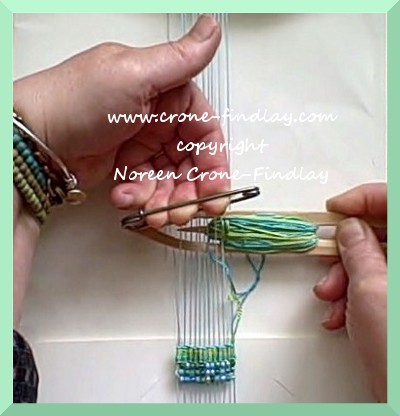
I like to use a stick, a pin and a loop of string to open the sheds. It’s a huge time saver!
I’ve made a video tutorial on how to do this for narrow bands, but this technique also works on wider pieces, too.
copyright Noreen Crone-Findlay
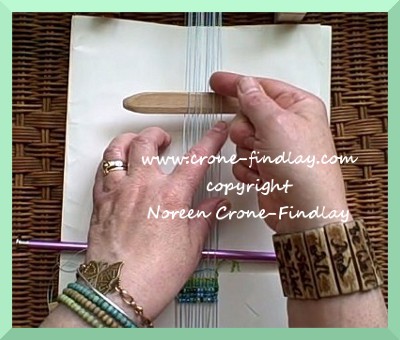
Pick up every other warp strand with a weaving stick (even a popsicle/craft stick or a paint stick will work).
Push that stick up to the top of the loom.
copyright Noreen Crone-Findlay
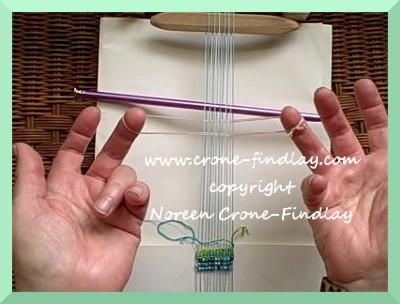
Now, use a knitting needle to pick up the ~remaining~ warp strands, to open the second shed.
You’ll be going over the strands that you went under in the first shed, and under the ‘overs’.
copyright Noreen Crone-Findlay
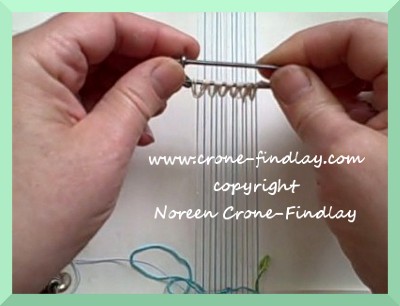
Take a loop of string (in this case, I used 2 string heddles from one of my inkle looms held together for more strength, and to make it easier to see in the video) through the open shed.
copyright Noreen Crone-Findlay
Pick up the end of the loop with a kilt pin, and then lift the loop strings between each warp strand onto the pin.
copyright Noreen Crone-Findlay
Take the second end of the loop up onto the pin, and close it.
Adjust the length of each section of the loop.
And, Voila! you now have a handy, dandy way of opening both sheds!
copyright Noreen Crone-Findlay
copyright Noreen Crone-Findlay
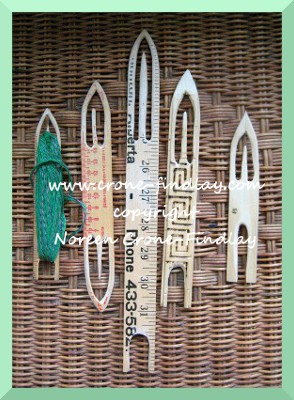
Here’s a pic of the shuttles that I make by upcycling old rulers and bits of decorative trim:
copyright Noreen Crone-Findlay
HOT TIPthat I mentioned in the video: If you use a file folder as the separator/background thingie between the front and back of your loom, you can use the pocket of the file folder to park your shuttle and beading needle when you’re not weaving.
I love buying vintage crochet cotton at the thrift shop. It speaks to me of the hands that it has passed through, and the pleasure it has brought to other thread lovers.
I like to use it in my weaving, crochet and tatting, as it gives me a sense of connection to needlewomen of the past.
BUT… storing balls of crochet cotton can be a problem. Those hollow cores take up a LOT of space!
So, for many years, I have been upcycling old credit cards or pieces of cardstock to make bobbins like this:
copyright Noreen Crone-Findlay
Because, storing yarn or thread on a small flat bobbin is so much more efficient than leaving it on the cardboard tubes:
copyright Noreen Crone-Findlay
Last night, I had insomnia, and was thinking about winding off a pile of vintage crochet cotton, when I had a flash of inspiration!!
Instead of making chubby little embroidery style bobbins, if I made ‘dog bone’ shape bobbins, I could use my bobbin winder to speed up the process of winding them. AND, they’d take up less room, as it would be a longer, leaner shape.
I jumped out of bed, and started cutting the new shape bobbins:
copyright Noreen Crone-Findlay
And, winding up balls of cotton:
copyright Noreen Crone-Findlay
In a twinkling of an eye, I have compactly wound bobbins that won’t tangle with other bobbins, as the thread is taken through a slot and secured. Another bonus! No snaggles!
copyright Noreen Crone-Findlay
This shape of bobbin is great for warping the Mirrix loom, as it’s so compact. Yep – it’s a win!
And, they can be easily stored in unusual containers, like this:
copyright Noreen Crone-Findlay
I made a video to show how quickly and easily this works:
I haven’t tried using these bobbins for tapestry weaving, but I will, and will let you know how I like them.
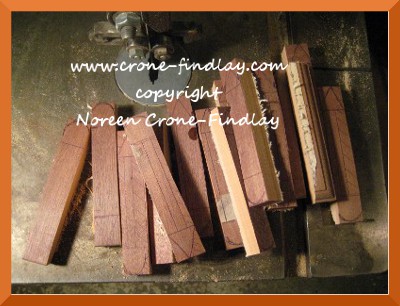
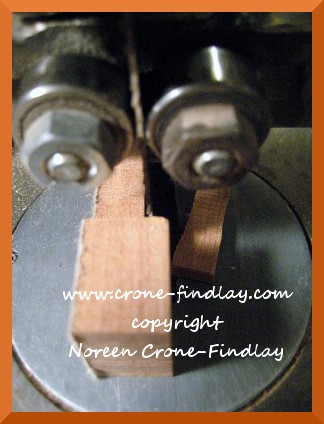
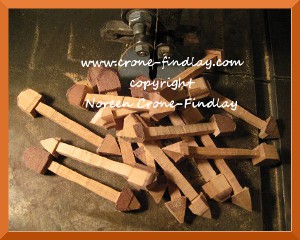
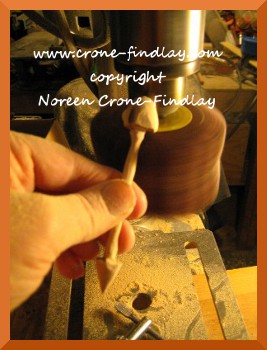
I love making tapestry bobbins from wood- especially upcycled wood, so I will be showing you how I do that in an upcoming post.
Happy weaving, and here’s to creative ways of storing yarn and thread stash! 😀




















 Tottie Talks Crafts Blog