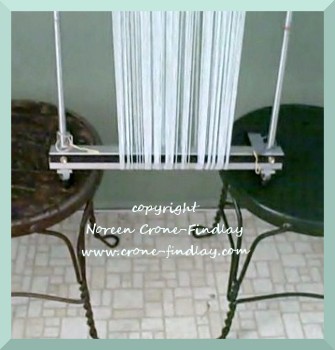
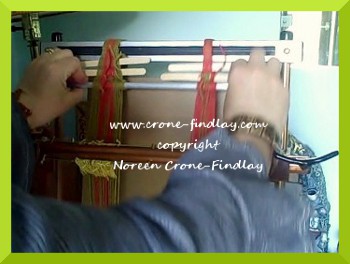
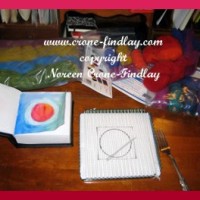
A couple of years ago, when I was working on the designs for The Lily Speed O Weave design book LINK,
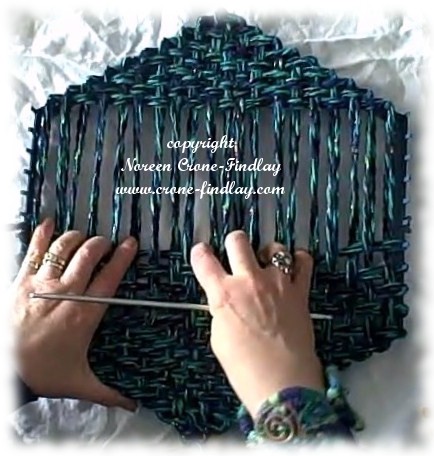
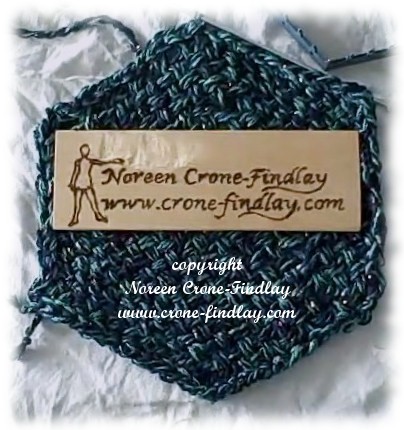
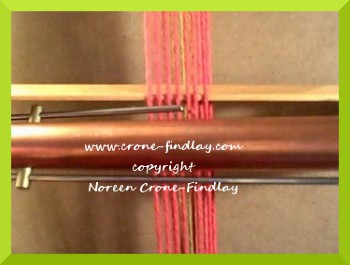
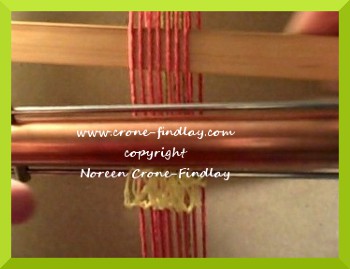
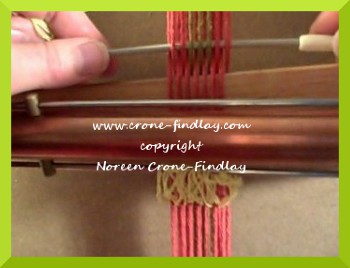
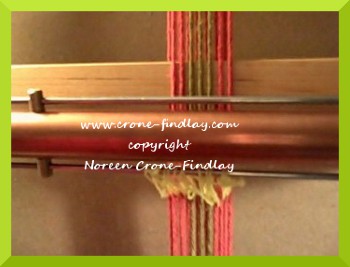
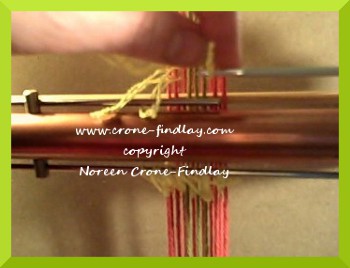
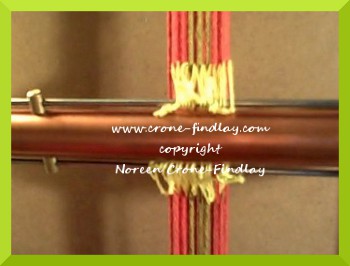
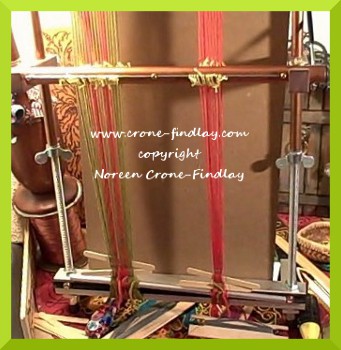
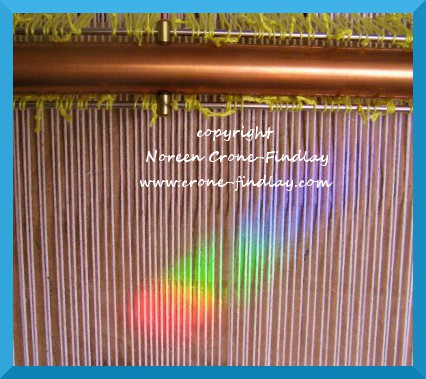
I figured out how to weave a hexagon on the loom, using continuous weaving methods.
copyright Noreen Crone-Findlay
The method is slightly tricky (it took me a LOT of experimenting to figure it out!) and has one disadvantage….
You have to use quite bulky yarn or else the hexagon is really loopy and open meshy (aka ‘sleazy’).
I decided that this made it not worthwhile to share the technique, as the knotting technique that was traditional for the Lily Speed O Weave loom allowed you to use absolutely any weight of yarn or thread.
Besides, I had figured out a way of speeding up and streamlining the knotting process, so I decided to just go with that.
But, a few days ago, a lady on Ravelry asked if anyone knew how to weave continuously on the hex loom and wasn’t into the knotting technique.
So, I figured…. okay…. I’ll make a video showing how to do this….
copyright Noreen Crone-Findlay
The secret to weaving continuously on the Lily Speed O weave looms?
Mashing up triangle loom weaving techniques with the continuous weaving technique of the potholder loom.
AND>>>> There’s a VERY important switcheroo that you have to make, mid-stream, as it were. 🙂
Once you have mastered the technique, it’s REALLY quick and easy to weave up hexagons on the Lily Speed O Weave loom!
The video for Part 4 of the Soumak Pouch Weave Along is a really big one because it’s the ‘how to’s’ for the actual weaving of the pouch.
copyright Noreen Crone-Findlay
Here’s what’s covered in this video:
How to weave the 4:2 Soumak border
How to weave the 2:1 body of the pouch
How to add more weft yarn when you run out
How to add new colors
How to change colors and make perfect joins between the color blocks
How to step colors sideways in an outward direction
How to step colors sideways in an inward direction
How to work horizontal stripes
How to do the ‘Topsy Turvey Trick’ with the Mini loom
How to remove the weaving from the Mini
Please note that the pouches are woven with 1 strand of the yarn from the Mirrix Kit, or 2 strands held together, of the Lion Brand Bonbon yarn
When I went through the video after the final rendering, I smacked my hand to my forehead a couple of times as my directional challenges clearly pop up in the video- arghhhhhhhhh………. several times, I call the left hand side of the loom, the ~right~ hand side. arghhhhhhh
And, at one point, I called the weft, ‘warp’…………. oh sigh…………. so please forgive me for the errors.
Luckily, pretty quickly, I do say the ~correct~ thing. But still……….. arghhhhhhhhhhhh………….
And, no, I am not willing to re-shoot the video….. there are days and days and days of shooting, and so I am not going back to do it again.
Said in the nicest possible way, with really the minimum of snarls and snaps. 😀
Anyhow…. I hope that you will have a WONDERFUL time weaving your pouches!
Without further ado, here’s the video: (bugs and all- and dogs barking and rain raining and thunder thundering…. the dogs were freaked out by the lighting and thunder, so they were indulging in a LOT of vocalizing about the bad bad sky!)
Welcome to the first installment of the Soumak Pouch Weave Along!
I hope that you are going to have a wonderful time, weaving one of a kind pouches for your business cards and cellphone, or using it in any way that appeals to you.
If you would like to join in the conversation, you can leave comments here on this blog,
as well as on the Mirrix facebook page LINK and the Mirrix Ravelry page: LINK
copyright Noreen Crone-Findlay
I will be demonstrating on the Mirrix 12 inch, 8 inch and 5 inch Mini, which is a totally magical little loom.
Because of the small (but oh so perfect) size of the Mini, I have had to come up with some fairly ‘outside the box’ ways of working with it for the weave along- which certainly add to the functionality of this delightful little loom!
Several people have asked me if they can participate in the Weave Along, even though they don’t have Mirrix looms.
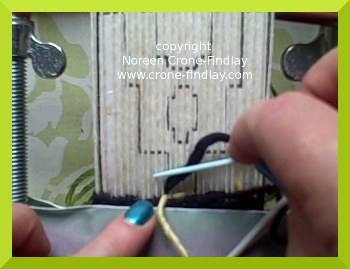
Yes, you can- in the first video, I have shown how to attach the cartoon to a Cricket Rigid Heddle loom.
If you have a tapestry loom that won’t accept the extra rods for the ‘no warp ends’ technique, then just warp it up in the normal way.
You won’t have the ‘no warp ends’ technique that the weave along is based on, but you can just finish your ends in the way you usually do.
HOW WILL THE WEAVE ALONG WORK?
I have made six video tutorials and one slide show (so far) for the Weave Along.
I will be posting installments of the Weave Along every Sunday and Wednesday from September 2, 2012 to September 23, 2012.
BUT… you don’t have to keep up with this pace…. you can follow along at your own speed, as the blog posts are going to be here for as long as Tottie still Talks Crafts! 😀
I have covered a TON of information, and some of the videos are very long.
To make them as user friendly as possible, I have made chapter headings for each segment of the videos.
This means that you can stop the video and move back or forward to review anything you want to, at any time in the video.
Here’s what the chapter headings look like:
copyright Noreen Crone-Findlay
So, without further ado, lets get started!
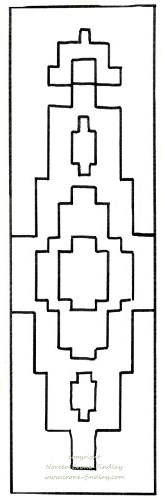
Here is the pattern for the Soumak Pouch:
copyright Noreen Crone-Findlay
Print the pattern so that it is 3 inches wide and 10 inches long.
Print several copies.
One of the Weave Along participants, Penny from Boulder, Co, made a pdf of the pattern, and Elena posted it to the Mirrix site.
Here’s the link to that, if you are having trouble figuring out how to print a copy of the pattern: LINK
And, now, for the video tutorial: (hope you enjoy it!)
This is the fourth video tutorial about how to weave inkle bands on Mirrix looms.
copyright Noreen Crone-Findlay
A dear friend asked me: “Why are you spending all this time figuring out how to weave inkle bands on the Mirrix loom? You have inkle looms! ”
Yes, I do… an open sided one, a closed side one that my husband built me from upcycled pallet wood, and a mini.
And, I love them…. but, I find that the open side and mini inkle looms both kind of flop when I have one end on the desk edge and one end in my lap. This is the way that I like to weave with inkle looms, and I find the wobble/flop rather frustrating.
I really like how stable the Mirrix is when I have the lower edge in my lap and the upper edge against a workbench, table or desk.
Also, I love the precision of the tensioning on the Mirrix… those thumbscrews are sweet!
And, I also love the shedding device………. soooooooooo smooth. 😀
Besides, the Mirrix takes up sooooooooooooo little room to store it- inkle looms do take up a chunk of space in the studio!
That’s four good reasons that have made this rather challenging learning curve worthy of the time I have invested.
Here’s the video for the finishing process of weaving inkle bands on the Mirrix loom:
When you have woven your bands to the point that the warping rod is sitting on top of the loom, you will need to remove the spring:
copyright Noreen Crone-Findlay
Loosen the tension up a lot….
copyright Noreen Crone-Findlay
Lift the spring rod out of the spring.
Release the ends of the springs from the knobs.
Gently, ease the spring out of the warp strands by spreading the warp strands out slightly and pushing on the spring to disengage it.
Continue weaving until the shuttle almost can’t make it through the shed.
copyright Noreen Crone-Findlay
Weave one row.
Keep the shuttle in the shed, and place a darning or tapestry needle in the shed with the point pointing in the direction that the shuttle exits the shed.
Weave the next row, and repeat with a second darning needle.
The needles now point in opposite directions.
Weave one more row.
Cut the weft strand, and thread it into the first needle.
Pull it through, and remove the needle.
Thread the weft strand into the remaining needle and pull it through.
La de dah! you have finished your inkle band!
Wheee! 😀
I always weave the tail end in a little bit more before I trim it off.
Loosen the tension wayyyyyyyyyyyyyyyyyy off, and slide the warping rod out of the loops.
Trim the ends, and pull them through the heddles.
Congratulations, you’ve woven some scrumptious new inkle bands! 🙂
Part 3 of the video tutorial series on how to weave inkle bands on Mirrix looms is about the weaving process:
copyright Noreen Crone-Findlay
Something that I learned as I trundled up my ever so steep learning curve with figuring out how to weave inkle bands on the Mirrix loom:
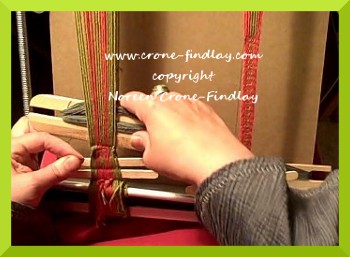
I started out by weaving one row on one band, putting it’s shuttle down, then picking up the second shuttle and weaving one row on the other band.
Sounds slow and clunky, doesn’t it? Well, you’re right.
The most efficient way to weave 2 bands at once is to weave as far as you can on one band, then set that shuttle aside, and weave away on the second band.
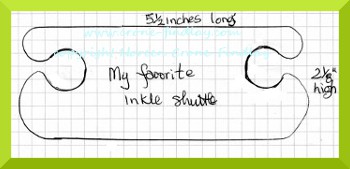
Oh… speaking of shuttles, here’s the tracing of my most favorite inkle shuttle:
copyright Noreen Crone-Findlay
I designed this one several years ago, and I love it. Works like a charm.
Here’s the video that shows the weaving process:
copyright Noreen Crone-Findlay
When you need to advance the warp, loosen the tension quite a lot.
Support the spring as you gently ooze the warp rod around and up the back of the loom.
Pat the warp strands back into the channel, and tighten up the tension again.
Remember, you do not need to have the tension as tight as when you are weaving a tapestry or beading.
You’ll find the perfect tension that suits you best.
Keep on weaving until the warp rod is sitting on top of the loom, and then check into the 4 th video in the series:
This is the second stage of the video tutorials that I made on how to weave inkle bands on the Mirrix loom.
copyright Noreen Crone-Findlay
There are two bands on the loom, because in this video, I am working on the 16 inch loom.
When you work on the 8 inch loom, it’s okay to just weave one band at a time, as the warping bar doesn’t flop around.
But, on the 16 inch loom, you do need to either warp up 2 bands, or secure the other end of the warping bar with a cord so it will stay perfectly horizontal.
I tried weaving 3 bands at once on the 16 inch loom, and didn’t like it, as the center knobs on the shedding device got in the way.
Two bands are just great though.
AND…. if you want to weave longer bands, and have either a 12 inch or 16 inch Mirrix loom then the loom extenders will be your friend 🙂
I use a crochet hook and a weaving stick to make the heddling process go quick like a bunny.
Here’s the video tutorial:
Start by placing a piece of cardboard between the layers at the front of the loom and the back so you can’t see the warp strands at the back of the loom.
copyright Noreen Crone-Findlay
Place the shed changing device into the brackets. Unscrew the little knob that holds the heddle rod in place.
Pull the heddle rod back so it’s about half way along the warp strands.
copyright Noreen Crone-Findlay
Place the heddles onto the fingers of your non dominant hand.
copyright Noreen Crone-Findlay
Look down at the warp strands that are at the lower edge of the front of the loom.
There’s a gap between the strands that have gone in front of the warping bar and behind it.
Slip your fingers into the gap and scoot them up to the shedding device.
Slide a shed stick into the gap.
Voila! (which is how ‘walla’ is really spelled 🙂 )
You have shed one ready to heddle!
copyright Noreen Crone-Findlay
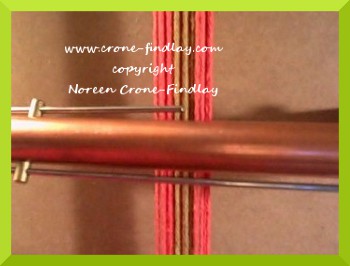
Now, slip the crochet hook behind the first warp strand, pluck a heddle off your fingers, and pull it forward.
Catch the other end of the heddle loop and place both loops on the heddle rod.
Go slowly, and be sure that both ends of the heddle loop stay politely on the heddle rod.
copyright Noreen Crone-Findlay
When you have all of the warp strands heddled, slide the heddle bar into position in the knobs, and tighten the lock nut.
Repeat the heddling process on the second set of warp strands for your other band.
copyright Noreen Crone-Findlay
Push the first set of heddles down as you rotate the shedding device.
copyright Noreen Crone-Findlay
Leave the shed stick in place, and use the crochet hook to pick up the warp strands for the other shed.
Take the warp strand from the back to the right of the one in front, and onto the hook,
take the hook over the front strand, and pick up the next strand and carry on across.
copyright Noreen Crone-Findlay
Slide the weaving stick out of the first shed, and slip it along the crochet hook to transfer the warp strands from the crochet hook to the weaving stick.
copyright Noreen Crone-Findlay
Turn the weaving stick on it’s side, and then pick up the warp strands one at a time and capture them with the heddles just as you did for the first set of warp strands.
copyright Noreen Crone-Findlay
Repeat this process for the second band.
Check your heddles carefully to make sure that they are opening the sheds properly.
Ahhhhh! a warped loom is a thing of beauty!
copyright Noreen Crone-Findlay
Attach the handle to the shedding device and adjust the tension by turning the thumbscrews.
Open the first shed, and insert a craft stick, then open the second shed and insert another craft stick.
Squish the warp strands together to establish the width of your band.
copyright Noreen Crone-Findlay
Weave one row, leaving a 6 inch/15 cm tail.
Change sheds, and weave the next row.
Pull up firmly on the tail end and weave it through the same shed.
Repeat several times until the tail end is woven in, and the band is established.
At the beginning of May, a ‘new-to-me’ loom , a large Mirrix tapestry loom, arrived in my studio. (Courtesy of my son and daughter in law who picked her up in the city 4 hours away, that used to be her home- the previous owner didn’t want to ship her).
copyright Noreen Crone-Findlay
I immediately sat down and made a whole lot of heddles for her, as she didn’t come with them.
And then, I warped her up- ooooooooohhhhhhhhhh, I love how easily she warps! Bliss!
As I was warping her up and starting to weave, I thought…. ‘Hmmmm…. there must be a group for Mirrix weavers on Ravelry’
(Ravelry= the facebook of the yarn world)
I looked, and sure enough! There is a Mirrix group…. which I joined, pronto.
And the first thing I saw was that Claudia (the inventor of the magical Mirrix looms) and Elena, her talented daughter, had posted that they were accepting applications for their annual ‘Social Networking for a Mirrix Loom’ campaign. Link
Well… I had decided within hours of starting to weave on my ‘Joni’ loom that I wanted to fill my studio with Mirrix looms.
So, I sent off an application….
Um… I wanted to fill the studio with ~Smaller~ Mirrix looms!
MEANWHILE>>>> The Joni is one big Mamma, and even though I am tall, my arms are short, so I found that I was having shoulder pain.
My clever daughter in law subtly sneaked the information out of me that I was longing for the treadle kit for the Mirrix loom. Then, she orchestrated the family buying me the treadle kit for Mother’s Day! What a sweetheart!
To say that I was thrilled was an understatement!
THEN! on the 18th of May, was just tickled pink to hear from Elena that they had picked me as one of their team for the 4 months of the ‘Social Networking’ campaign. Whee! What a couple of thrilling days!
And, now… I am starting to keep my part of the bargain, which is to chronicle my experiences with the Mirrix loom(s).
So, since I began my Mirrix adventures with making string heddles, I am going to show you my quick and easy way of making the string heddles for the Mirrix looms (or inkle or frame looms, too).
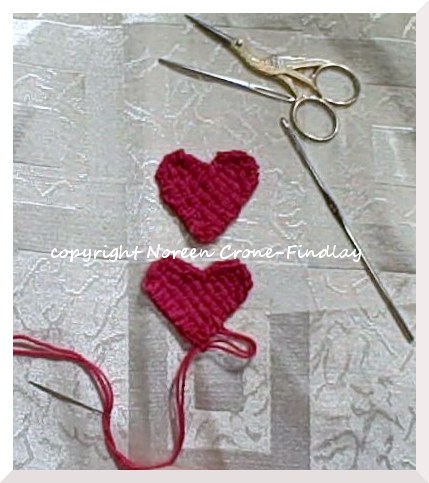
Hearts are one of my most favorite design motifs ever.
I decided that I should design a tiny little woven heart motif as a project for the ‘Stitch Red’ heart health campaign, and also work as an embellishment on a special ‘I love you’ scarf for my daughter.
Here’s the link to the previous post about using tambour crochet to embellish the scarf: Link
The yarn used in the heart motif is from Koigu, made specially for the Stitch Red campaign. Link
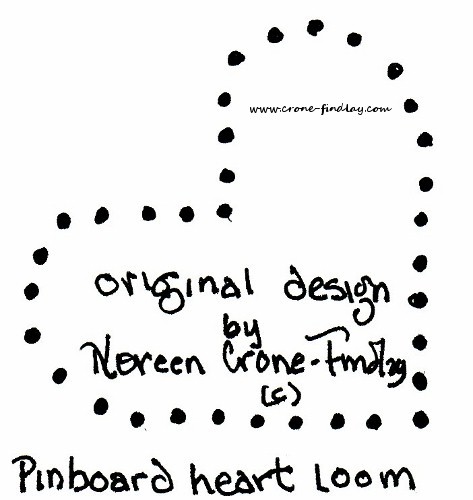
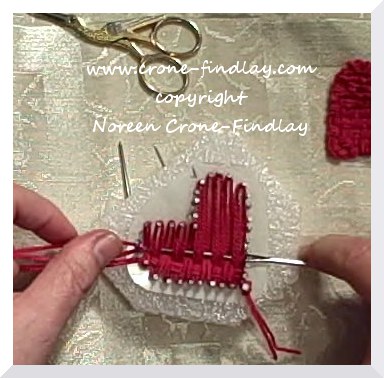
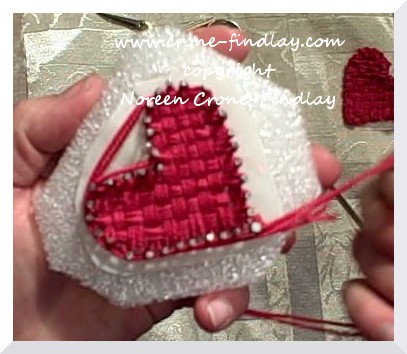
Here is the pattern to make the pin board loom to weave the heart:(Note: Print it out so the pattern is 2 inches by 2 inches)
copyright Noreen Crone-Findlay
Materials and equipment: a square of foam (I upcycled some packing material) that’s about 4 inches square by an inch or so thick.
34 pins or 1 inch fine finishing nails. (You may need a nail file to file rough edges off the tops)
A 3 or 4 inch square of clear plastic from a clamshell package or other recycled thingie.
Knife to cut the foam, scissors.
2.5 mm crochet hook
small tapestry needle
Instructions
1: Copy the pattern, and trim to fit the size of piece of foam.
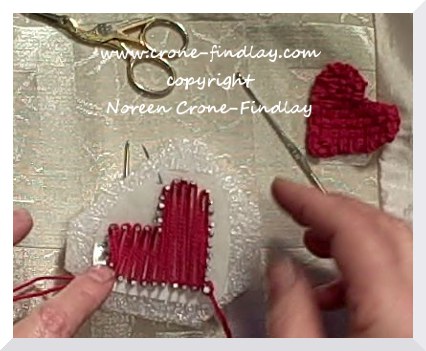
2: Place the piece of clear plastic over the pattern. Push the pins into the dots.
Warping: The right hand arch of the heart is held vertical and the left hand arch is horizontal.
3: Tie 2 strands of yarn together (Note, you need to be working with fine yarn, like a sock weight) and place over the pin at the point of the heart.
4: Skip 8 pins, go around the next pin and down to the lower edge, and around the pin to the left of the pin at the point.
5: Go up and down across the 5 pins at the top and their mathcing pins on the lower edge.
6: Take the yarn up to th emifpoint pin (there are 3 empty pins above it) and down.
7: Go up and down across the next 5 sets of pins. There will be 3 vertical pins/nails left empty. Make an ‘8’ around the last set of nails to bring the yarn back down to the lower set of nails.
copyright Noreen Crone-Findlay
8: Weaving
Row 1: Weave hook from right to left: Over 4/Under 4 between the 1st and 2nd pins.
Make a loop of yarn and place it on the hook, then draw it through the warp strands. Place the loop on the 2nd nail on the right hand side.
Adjust yarn.
Rows 2 & 4: Weave Under 4/Over 4 across, pick up the loop of yarn, ease through, place loop on nail/pin.
copyright Noreen Crone-Findlay
Row 3: WEave Over 4/Under 4 across, pick up loop, ease through, place on nail on right hand side of loom.
Rows 5 & 7: Weave )ver 4/Under 4/Over 4/Under 4/Over 4… make loop, ease through, place on pin on right hand side.
Note: on Row 7, the yarn passes by 5 pins before it’s woven in.
Rows 6 & 8: U4/O4/U4/O4/U4 make loop, ease through, place on pin on right hand side.
Row 9: Working with top 3 pins only: U4/O4/U 4 make loop, ease through, place on pin on right hand side. (It already has loops on it, but not to worry).
copyright Noreen Crone-Findlay
Finishing:
Wrap the yarn around the circumference of the heart 2 1/2 ties and snip.
Working in a counter clockwise direction: Thread the yarn ends into a darning needle and lift the stitches off, one by one, stitching through them.
copyright Noreen Crone-Findlay
Some nails have 2 sets of threads on them, so lift the sets of yarn off one at a time.
Stitch over the long floating threads to capture them.
Stitch twice at the tip of the heart.
Untie the beginning knot and weave in the ends.
Adjust the circumference stitching to shape the heart, and stitch through the outside edge again if desired.
Weave in ends and trim.
copyright Noreen Crone-Findlay
The hearts can be used to embellish or trim scarves, hats, mittens, gloves, cowls, hair ornaments, bags, stuffies, dolls, toys, blankets, shawls, stoles, vests, coats, wall hangings, cellphone and tablet covers. The sky’s the limit!
Here’s the video tutorial on how to weave the heart motif:
I think that people might like to have a heart loom in wood, so I asked Donna and Gary McFarland of Dewberry Ridge looms Link if they would make them, and they said yes, so if you want one, drop them a note.
PLEASE NOTE: All content of this blog, including video, audio, written and photographed is the sole work and property of Noreen Crone-Findlay, and MAY NOT be used without my permission. Thanks so much!