Tag Archives: weaving

How to weave inkle bands on the Mirrix loom part 3

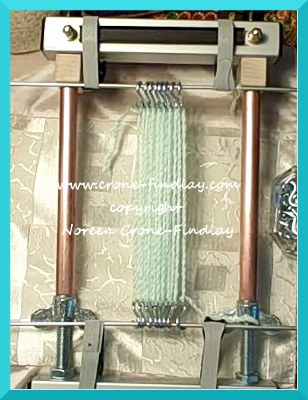
Part 3 of the video tutorial series on how to weave inkle bands on Mirrix looms is about the weaving process:

copyright Noreen Crone-Findlay

Something that I learned as I trundled up my ever so steep learning curve with figuring out how to weave inkle bands on the Mirrix loom:

I started out by weaving one row on one band, putting it’s shuttle down, then picking up the second shuttle and weaving one row on the other band.

Sounds slow and clunky, doesn’t it? Well, you’re right.

The most efficient way to weave 2 bands at once is to weave as far as you can on one band, then set that shuttle aside, and weave away on the second band.

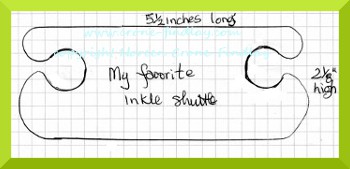
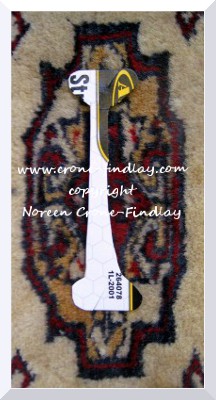
Oh… speaking of shuttles, here’s the tracing of my most favorite inkle shuttle:

copyright Noreen Crone-Findlay

I designed this one several years ago, and I love it. Works like a charm.

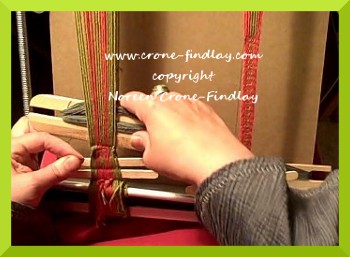
Here’s the video that shows the weaving process:

copyright Noreen Crone-Findlay

When you need to advance the warp, loosen the tension quite a lot.

Support the spring as you gently ooze the warp rod around and up the back of the loom.

Pat the warp strands back into the channel, and tighten up the tension again.

Remember, you do not need to have the tension as tight as when you are weaving a tapestry or beading.

You’ll find the perfect tension that suits you best.

Keep on weaving until the warp rod is sitting on top of the loom, and then check into the 4 th video in the series:

How to finish the bands.

๐Ÿ™‚

Leave a comment

Filed under Loom & looms & small loom weaving, tutorial & how to, video tutorial, weaving & handwoven

A slightly different approach to the ‘No Warp Ends’ on the Mirrix

I hate wasting yarn… so I really don’t like loom waste – who wants to toss their yarn in the trash? Really ๐Ÿ™‚

That’s why I love Claudia Chase’s ‘No Warp Ends’ technique for the Mirrixย  looms.

copyright Noreen Crone-Findlay

The one thing that I wasn’t keen on was using paper clips to be the holders for the yarn ends, so I thought about it and mulled it over.

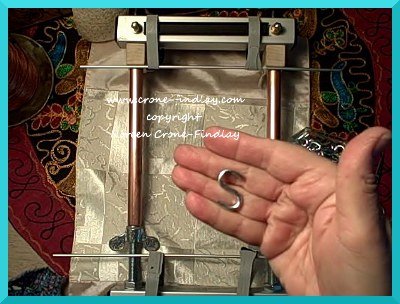
Hmmmm….ย  I use ‘S’ hooks all the time to hang things and connect them, but I have never used them on a loom.

This called for some experimenting.

I don’t know about you…. but, I have a tendency to start with a really complicated plan, and have to do a lot of trial and errors to get to the elegant and simple final version.

I was thinking about all kinds of ways of making harnesses to hold the bars for the ‘s’ hooks…. oh my!

I also figured that I wanted to use both sides of the loom while setting up for this technique.

I had woven two affinity bracelets at the same time- one on the front of the loom, and one on the back, so this seemed to stick in my mind as ‘the way to go’.

Well… I twiddled and fiddled, and threw away the whole overly elaborate harness idea, and ended up using 4 loops of double sided velcro to hold the bars to the upper and lower edges of the loom.

That was aย  big breakthrough- talk about a simple way to do this! Yay!~

And, I am really pleased with the final method that I came up with- it really works for me!

copyright Noreen Crone-Findlay

Here is the video, showing how I warp the Mirrix Lani using the ‘No Warp Ends’ technique, with ‘S’ hooks:

Happy Weaving! ๐Ÿ™‚

8 Comments

Filed under Loom & looms & small loom weaving, tutorial & how to, video tutorial, weaving & handwoven

How to make yarn butterflies and upcycled wooden tapestry bobbins

Some people love weaving with yarn butterflies.

And some people (like me) don’t.

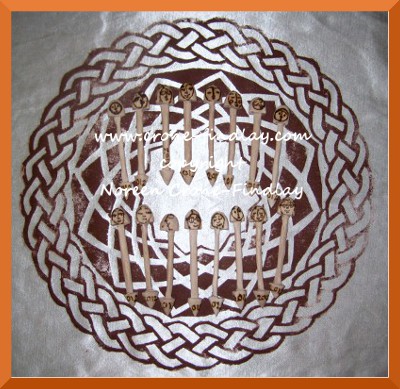
I love wooden tapestry bobbins and I love making each one a unique piece- and I especially like using upcycled wood to make them.

So, for those of you who like yarn butterflies, here’s a video tutorial on how to make yarn butterflies:

And, here’s how I make my one of a kind tapestry bobbins, which wouldn’t suit everyone, but I love them and find them to be a pleasure to use:

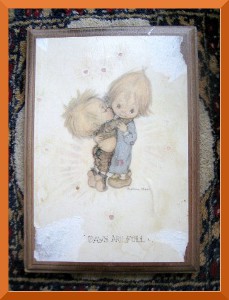
Start with a piece of cast off wood. In this case, a wooden plaque (don’t use chipboard or mdf ! This needs to be hardwood)

a thrown away plaque from a garage sale

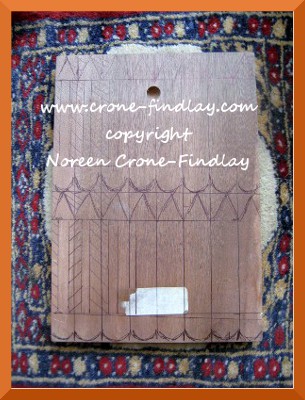
Flip it over, and draw in the rough lines for the first cuts:

copyright Noreen Crone-Findlay

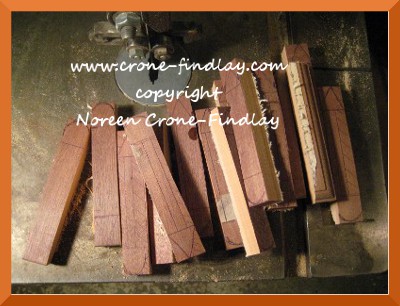
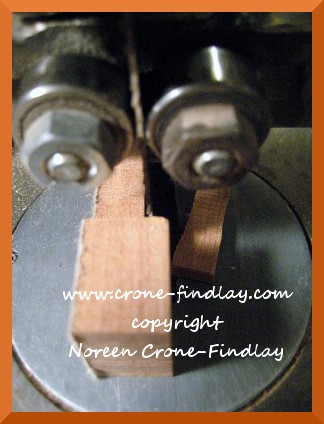
next, saw them into rough shape:

copyright Noreen Crone-Findlay

Working on getting more definition and shaping:

copyright Noreen Crone-Findlay

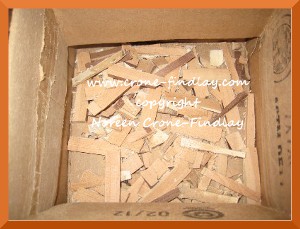
All the wooden offcuts are going to be burned in the wood burning stove in the studio in the winter- nothing’s wasted!

copyright Noreen Crone-Findlay

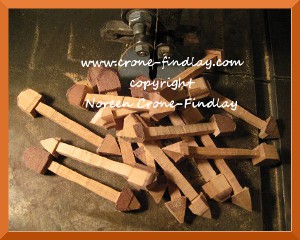
When the rough saw shaping is done:

copyright Noreen Crone-Findlay

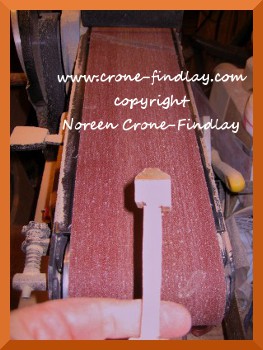
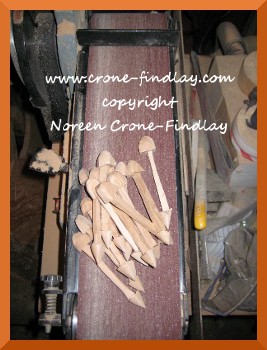
I move over to the belt sander:

copyright Noreen Crone-Findlay

and I do a whole bunch of sanding (very carefully)

copyright Noreen Crone-Findlay

Did I mention that this is a really slow, meditative process? Yup.

Go slowly… and pay attention….

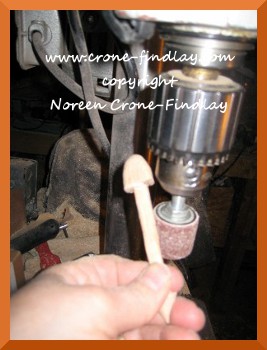
Then, it’s off to work with a bunch of different small sanding drums:

copyright Noreen Crone-Findlay

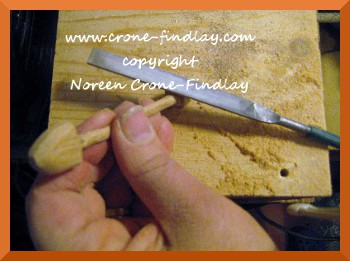
and files:

copyright Noreen Crone-Findlay

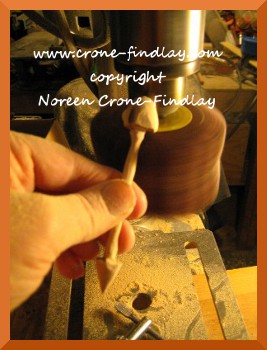
And more sanding:

copyright Noreen Crone-Findlay

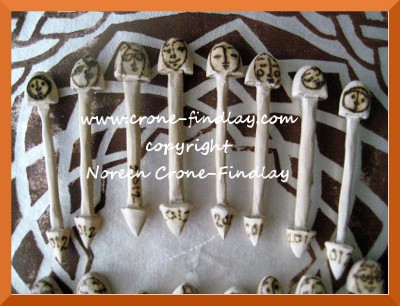
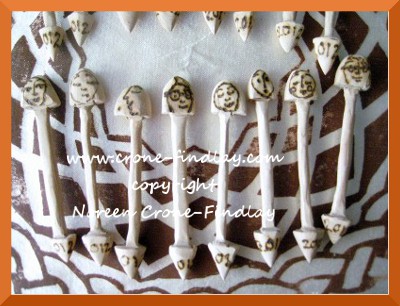
and then, I draw faces on each one, and get out my wood burning tool and draw and burn faces and the year on each one:

copyright Noreen Crone-Findlay

Here’s a closer look:

copyright Noreen Crone-Findlay

I just listen to what each bobbin wants, and then I draw on their faces. Some of them crack me up.

copyright Noreen Crone-Findlay

Like the ‘Get to the Point’ guy… 3rd from the left….ย  I know, I am easily amused….

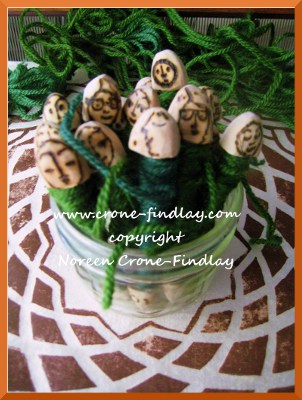
And, here they are, all wrapped up and ready to weave!

copyright Noreen Crone-Findlay

I hope that the photos will all open for you!

So, happy butterflies, and happy bobbin-ing!

Happy weaving! ๐Ÿ™‚

6 Comments

Filed under eco crafts & green projects, Loom & looms & small loom weaving, tutorial & how to, weaving & handwoven

A neat variation on Card stock bobbins for storing threads and yarn

I love buying vintage crochet cotton at the thrift shop. It speaks to me of the hands that it has passed through, and the pleasure it has brought to other thread lovers.

I like to use it in my weaving, crochet and tatting, as it gives me a sense of connection to needlewomen of the past.

BUT… storing balls of crochet cotton can be a problem. Those hollow cores take up a LOT of space!

So, for many years, I have been upcycling old credit cards or pieces of cardstock to make bobbins like this:

copyright Noreen Crone-Findlay

Because, storing yarn or thread on a small flat bobbin is so much more efficient than leaving it on the cardboard tubes:

copyright Noreen Crone-Findlay

Last night, I had insomnia, and was thinking about winding off a pile of vintage crochet cotton, when I had a flash of inspiration!!

Instead of making chubby little embroidery style bobbins,ย  if I made ‘dog bone’ shape bobbins, I could use my bobbin winder to speed up the process of winding them. AND, they’d take up less room, as it would be a longer, leaner shape.

I jumped out of bed, and started cutting the new shape bobbins:

copyright Noreen Crone-Findlay

And, winding up balls of cotton:

copyright Noreen Crone-Findlay

In a twinkling of an eye, I have compactly wound bobbins that won’t tangle with other bobbins, as the thread is taken through a slot and secured. Another bonus! No snaggles!

copyright Noreen Crone-Findlay

This shape of bobbin is great for warping the Mirrix loom, as it’s so compact.ย  Yep – it’s a win!

And, they can be easily stored in unusual containers, like this:

copyright Noreen Crone-Findlay

I made a video to show how quickly and easily this works:

I haven’t tried using these bobbins for tapestry weaving, but I will, and will let you know how I like them.

I love making tapestry bobbins from wood- especially upcycled wood, so I will be showing you how I do that in an upcoming post.

Happy weaving, and here’s to creative ways of storing yarn and thread stash! ๐Ÿ˜€

10 Comments

Filed under eco crafts & green projects, Loom & looms & small loom weaving, tutorial & how to, weaving & handwoven

Whatcha working on these days? he asked

Last week, a friend asked me what I was working on these days.

In response, Iย  rattled off a list of projects and tasks that is the length of my arm.

The next day, as I was leaving the dentist, he drove up to the stop sign, he said: ‘Oh yah, you say you’re working on all these things, but here you are, just walking down the street!’ ๐Ÿ˜€

Um… if I could master the transporter, I would! Zap! into the dentist chair! Zap! Home again! Sparkle sparkle zing. ๐Ÿ™‚

I would like that…. ๐Ÿ™‚

Anyhow, here are some of the things that are happening in my studio right now….

(Not ~ allย  ~ the things that are happening, as I can’t show projects that I am designing for magazines etc- the editors would be smacking me on the side of the head if I did….)

(and I am working on some stuff that I need to not talk about until it ripens. You know how it is.)

Okay… first things first…

We have adopted an adorable little rescue…. he’s 4 1/2 years old and is just wonderful.

(except for being a cat botherer… that is NOT good ๐Ÿ˜ฆย  )ย  This is him (in his fetching blue harness) with his adopted big brother. (Ourย  dear old chihuahua/daschund cross).

copyright Noreen Crone-Findlay

Ah, well, other than being oh so barkie about the cats, he is completely adorable. As you can see, he has settled in beautifully.

Although, every adoption takes time and patience and attention….

Alright…. a brief zip around the studio:

Okay, in the southeast corner, there’s a big project happening on my tri loom (configured to the 3 foot size).

I’ll be posting more about this as the project moves closer to the finish line:

copyright Noreen Crone-Findlay

My tri loom is from Dewberry Ridge looms, and it’s beautifully crafted. I love it.

I have other projects on the go on Dewberry Ridge looms:

copyright Noreen Crone-Findlay

I am weaving a scarf for my daughter on the 14 inch tri loom. Link to another post about this scarf: linkie

And, I am using a Dewberry Ridge Potholder loom for a new design that I will be releasing soon:

copyright Noreen Crone-Findlay

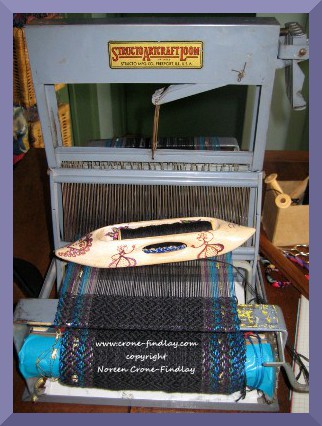
And, I am still working on my husband’s vest on the Structo Loom:

copyright Noreen Crone-Findlay

And…. I am working on several new tapestries in my series of ‘Woven Women’-

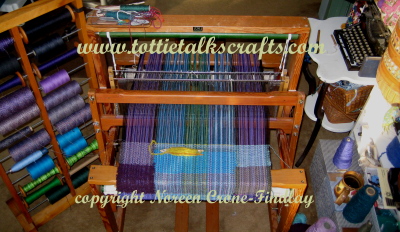
I have two ‘new to me’ looms that I bought from other weavers who didn’t bond with them:

copyright Noreen Crone-Findlay

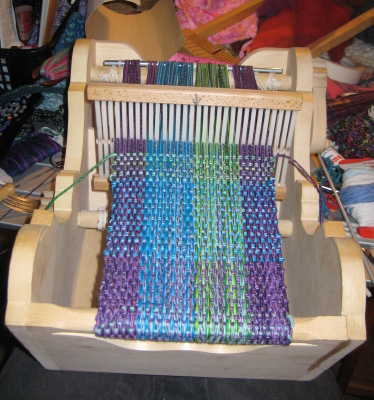
I am delighted with my ‘new to me’ Mirrix ‘Joni’ tapestry loom.ย  I am just singing Joni’s praises!

I am loving working with her! Perfection!

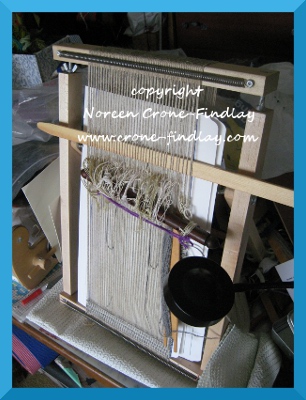
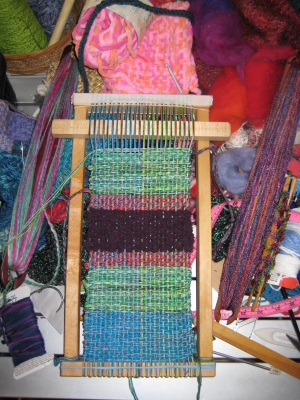
At the same time that I bought Joni Mirrix, I spotted a little wooden tapestry loom on Kijiji, and happily bought her.

copyright Noreen Crone-Findlay

This is a very slow little loom to work with, as there are no built in shedding devices, just good old fashioned weaving swords and string heddles.

Even though, I quite love this little loom and am enjoying working on her. ๐Ÿ™‚

And………… I am also working on a whole buncha other stuff, that I’ll be telling you more about later.

Until then, may the sun shine softly upon you!

Happy weaving!


4 Comments

Filed under Loom & looms & small loom weaving, potholder loom, weaving & handwoven

A video showing the Woven Women Mermaids Song tapestry

I am working on a large series of woven and mixed fiber media pieces that I am calling: Woven Women.

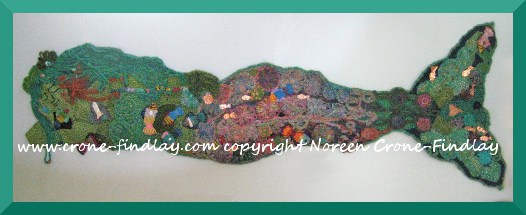
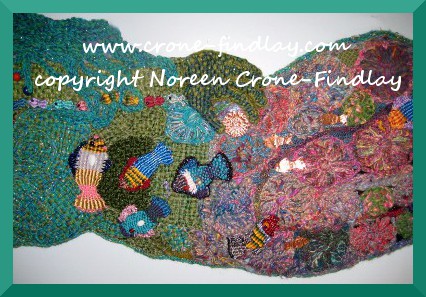
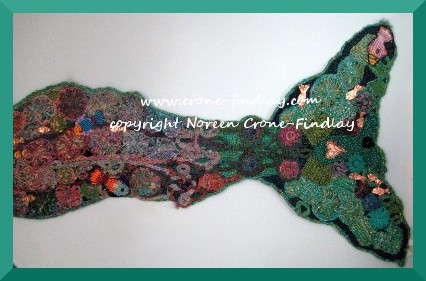
I am almost done a fairly large piece, called: Mermaid’s Song:ย 

copyright Noreen Crone-Findlay

She’s large- 6 ft by 2ft, and hard to photograph in my studio, so I figured that I would show a video of her.

I used small looms, knitting, crochet, tatting, spoolknitting and flower looms to make her, along with copper foil work.

Some of the looms were: 2 inch square vintage weave it loom, potholder loom, pinboard looms, Martha Stewart loom and flower looms.

copyright Noreen Crone-Findlay

copyright Noreen Crone-Findlay

http://www.crone-findlay.com copyright Noreen Crone-Findlay

And, here’s the video:

Remember: The size of your loom doesn’t limit the size of your finished piece!

Happy weaving! ๐Ÿ™‚

25 Comments

Filed under crochet, knitting, Loom & looms & small loom weaving, spool knitter & spoolknitter & spool knitting & spool knitting, weaving & handwoven, Woven Women tapestries and woven works

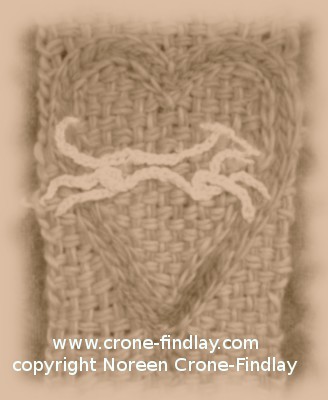
Run free dear greyhound

I’ve gone silent on my blog, as the last couple of weeks have been extremely challenging.

I went down with a nasty flu, and also had major design deadlines to meet.

But – the hardest part of all, was that our beloved greyhound, who has been sick for more than a year, went into kidney failure and died.

copyright Noreen Crone-Findlay

We adopted him from the Canadian Greyhound Rescue almost a decade ago, and he was a beautiful, loving, wonderful companion.

I have been weaving pieces about him…. and will post more about them, later.

But for now, I just say, “thank you, dear friend, run free in the Spirt…..”

To learn how to do the chain stitch embroidery technique see this post:ย  LINK

20 Comments

Filed under weaving & handwoven

Sewing a tunic from fabric handwoven on a vintage Structo Loom

If you are afraid to cut your handwoven fabrics so you can sew them into garments, DON’T BE!!

Raise up those scissors, and start cutting!ย  I’ve been snipping and sewing some fun new clothes.

In my last post, (link) I talked about weaving my husband, Jim, a shirt to wear while he performs with his Jazz Trio.

And, here he is, wearing his spiffy, and most importantly: COMFORTABLEย  ๐Ÿ˜€ shirt, while playing at the Edmonton International Jazz Festival with his trio:

Jim playing at the Jazz Festival 2011

When I was weaving the fabric for his shirt, I also decided to weave fabric for a tunic for me. I blogged about weaving up heaps of fabric here: Link

I have a favorite dress or tunic pattern that I decided to sew from my handwoven fabrics. It’s Simplicity 2702

I decided that I would weave the fabric for it on my Structo looms.

They are vintage 4 harness looms that weave a fabric that comes off the loom at 8 inches wide. The fabric does shrink, so it’s usually about 7 inches wide after it’s been washed and steam pressed. The reeds are 15 epi.

I used cotton and mixed fibres from my stash to weave up lonnnnnnnnnnnnnnnnnnnng lengths of fabric.

I put on a rather too long warp onto one of the Structos, and ended up having to release some of the fabric from the cloth beam, as I couldn’t advance it any more. Oops:
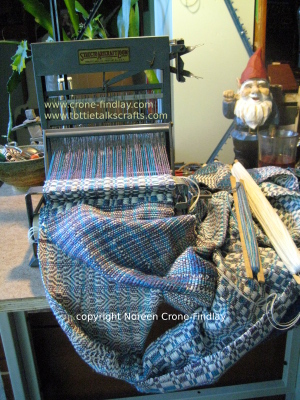
handwoven fabric on Structo loom

I was being very playful with the weaving, as I am in the process of getting to know my ‘new to me’ Structo looms.

I decided that I would have aย  freeform, anything goes exploration while weaving. This is a great way to learn about what I like and don’t like about different weave structures on the Structo loom. I wanted to get to know the Structo loom and this has been a fun way to get acquainted!

I also wanted to push the boundaries to see what would happen when I experimented with all kinds of combinations of patterns, while sticking to a single group of colors- although I did end up throwing in a little pink and green. ๐Ÿ™‚

I really like weaving pockets on potholder looms, as I like having all 4 sides with clean edges, and not having to turn seam allowances under.

I am just getting to know my ‘Lil Weaver’ square looms from Donna and Gary McFarland at Dewberry Ridge Looms, so I decided to weave the pockets on a 7 inch Lil Weaver.ย  It worked great ๐Ÿ™‚ The flash makes it look a lot more open than it really is, and of course, when I washed it, it closed up very nicely.
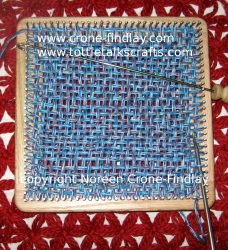
weaving a pocket on a Lil Weaver square loom

I added a little of theย  trim that I wove for Jim’s shirt to the top of the pocket, and that’s just perfect.

Cutting into narrow bands to piece them together is not at all intimidating- although I got the jitters at how wild the fabric was looking when I laid it all out. I fussed a bit about it on facebook and got lots of encouragement from my friends to go ahead and just make the tunic. They told me to be brave and not worry and that it would be fine.

cutting out and piecing handwoven fabric

I really didn’t want to have people raise their eyebrow, and wonder if I had lost my senses!

But, with the encouragement of friends, I went, what the heck! This is a celebration dress, why not celebrate?

And then, I remembered the BEST thing my father ever said to me. Once, when I was wondering if I should combine some wild fabrics and held them up to him and asked if he thought that they were just too wild and crazy, he rubbed his chin thoughtfully, and said:

“Just wear it with panache!”

Isn’t that the best thing you could imagine? It’s become a mantra for me.

So, I carried on, piecing the sections of the tunic together:

piecing handwoven fabrics to sew a tunic

I really didn’t like the first placket section, so I nipped off to the dining room, and snitched 2 placemats that I had woven a couple of years ago. I cut them up, and love the new placket.

The fabric sewed up beautifully.

I quite like using narrow strips of fabric to piece together for garments.

Why?

Well, it is much less intimidating to cut a narrow piece than to cut into a wide piece. Snipping a narrow piece feels so much less threatening because the fear of loosing hours of weaving work is so much less.

Also, narrow bands allow you to experiment and explore, and then to put the pieces together any way you want- it’s a lot like quilting.
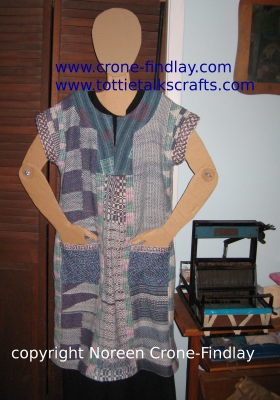
tunic sewn from handwoven fabric - front

The tunic came together really nicely. It was important to me to add in some fabric and bands that were left over from weaving Jim’s shirt. I am really happy with the way they blend into the tunic just perfectly.

Here’s Patient Zillah, standing beside one of the Structo looms that I used to weave the fabric for the tunic.

and here’s the back view:

tunic sewn from handwoven fabric - back

I had a serious- Oh oh… moment, when I remembered that I had pieced and stitched the tunic to last summer’s measurements, and I have put on weight on this winter.

I thought…. oh no! What if it doesn’t fit?ย 

Well, luckily, it does, but it’ll look a whole lot better when I loose that unwelcome weight!

Sewing with handwoven fabric is really rewarding, but it is slower than sewing commercial fabrics.

But, it’s a mindful, contemplative,wonderful journey!

Here are a few tips for sewing with handwoven fabrics:

1] Pins are your friends. Use a LOT of them. And, then, use some more.

2] Stay stitching, overcasting, basting andย  top stitching are all your friends. Do a LOT of all of them when sewing handwoven fabrics.

3] If your pattern tells you to clip to a pivot point, it can be scary, but do it. BUT, make sure that you have done several rows of stay stitching to secure your threads. And, don’t be afraid to go back and sneak a little more stitching in to secure it.

4] Interfacing is your friend- and I interfaced the placket sections with iron on interfacing. But, I decided that I wanted the shoulder bands to not be too energetic about standing to attention. I figured that using the ย  Celtic interlace band to embellish them would add enough structure, and I was right. They sit just nicely where I want them to.

5] Change the needle in your sewing machine frequently. You MUST have a very sharp needle for sewing handwoven fabrics.

6] Bias tape is perfect for hemming. It gives a hem that isn’t bulky, and is probably more secure than a rolled handwoven one.

7] Sew all seams more than once. I like to sew the seam, then fold the seam allowance over and stitch it to the garment.

8] Your steam iron is your friend- (although my steam iron and I had a little contretemps when it spewed brown stuff all over a section ofย  white fabric. Wailie wailie. But all is well,as stain remover removed the splorches). Steam and press the living daylights out of EVERY seam, after you stitch it, including the zigzagging of any cut edges. My mother, who was a fabulous seamstress in her day, impressed this fact into me, and it makes a world of difference to be steaming and pressing as you sew.

9] Zigzag stitching every cut edge is essential. I use a stitch that is running straight stitches in a zig zag formation.

10] Sew your pattern up in commercial fabric first, so you know how it fits and also, how the pattern goes together. Knowing the pattern is going to give you confidence in working with your handwoven fabrics!

I am feeling very self conscious and uncomfortable about having gotten so hefty, and wasn’t going to put a pic of myself up wearing the new tunic, but, what the heck. Fat happens.ย ย  So, like my father said: I’ll just have to wear it with panache!!!! ๐Ÿ˜€

Jim and me in our handwoven festival clothes

23 Comments

Filed under weaving & handwoven

Clasped weft weaving for handwoven Gypsy Jacket

People kept asking me how many hours it took to weave my first “Gypsy Jacket”. See: First Gypsy Jacket

So, I thought that I would set myself a challenge.

I decided that I would weave another one and log in, keeping track of all the hours I put into weaving a Gypsy Jacket.

I logged in an absurd number of hours of weaving time, and decided that I just didn’t want to know anymore just how many hours I put in.

Why did it take so long?

copyright Noreen Crone-Findlay

Because I was using a very slow technique, of working with 2 sets of clasped wefts to get more color play into my fabric.

I only used one shuttle, but had yarn on cones to the right of the loom, and yarn on spools on a spool rack to the left of the loom.

copyright Noreen Crone-Findlay

The shuttle comes out of the warp strands between picks and sits on the surface of the web, about 6 inches from the left hand edge.
The first motion is to open a new shed, pass the shuttle into the shed, take it out to the left, go under the strands of yarn that are hanging from the spool rack, pull them into the shed with the yarn from the shuttle.

Bring them into the place where you want them to end. There is a double strand of that set of weft strands.
Now, the shuttle goes to the right hand edge and out , and goes under the yarn that is on the cones. The shuttle goes back into the shed, and is pulled up, bringing the 3rd color as far as desired. The shuttle then is moved back to itโ€™s exit point, the shed is closed, beaten, and the next shed is opened. The whole process is repeated.
Itโ€™s slow, but you can create pretty intense colorways this way.

copyright Noreen Crone-Findlay

Of course, itโ€™s faster to just use one set of clasped weft yarns, but by clasping from both selvedges, you can get some pretty gorgeous patterning.

So far, I have used 5 different looms for this jacket, and still have a couple more that I will be working with to complete the weaving of the parts of the new Gypsy Jacket.

copyright Noreen Crone-Findlay

One section was woven with a cradle loom and a small rigid heddle.

copyright Noreen Crone-Findlay

And, one section was woven with a small Goodwood frame loom. I love frame looms, and used another frame loom for other pieces of the jacket.

More weaving to go…. and then the sewing.

Would I sell the jacket?ย  Well, yes, actually.ย  ๐Ÿ™‚

18 Comments

Filed under Loom & looms & small loom weaving, weaving & handwoven

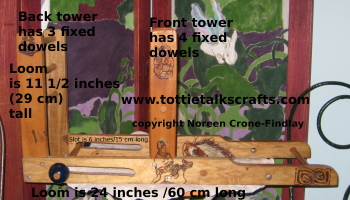
Inkle Loom Dimensions

Recently, someone asked me about the dimensions of my inkle loom.

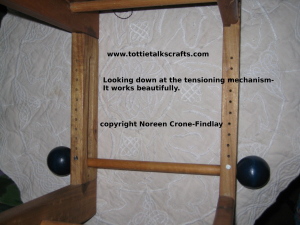
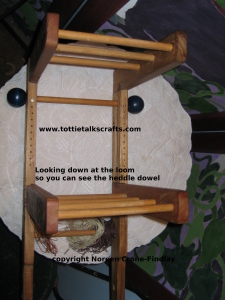
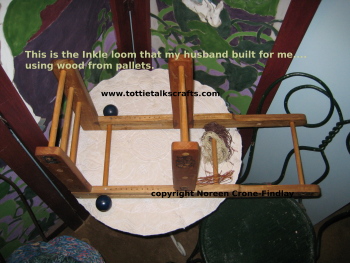
So, I’ve taken pictures of my loom and measured it, in hopes that this helps her husband in building her inkle loom.

My husband built mine from reclaimed wood from pallets, and it’s VERY hard wood.

You need hardwood for an inkle loom, as you put so much pressure on it.

I have woven everything from rugs to garments to bags to bookmarks on this loom. I love it.

inkle-loom-6

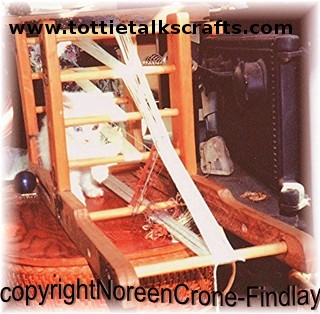
I am not alone in loving my inkle loom…. my cats LOVE to help me warp it!

inkle-loom-1

inkle-loom-2

inkle-loom-3

inkle-loom-4

inkle-loom-5

All images and content on this blog are copyright and not to be reproduced without permission.

Image source: Noreen Crone-Findlay copyright

28 Comments

Filed under Loom & looms & small loom weaving