Recently, I made a video about cutting up garments to upcycle them by weaving or knitting with the fabric strips.
In early October of 2017, my son in law’s step-dad passed away.
This was, of course, very hard on our grandson.
I talked with him about what it meant to him to have his ‘other’ grampa (not my husband) pass away.
I asked him if he needed something of his grampa’s to hold onto, and he said yes.
So, I asked for a couple of Bill’s shirts so I could make comfort critters with them.
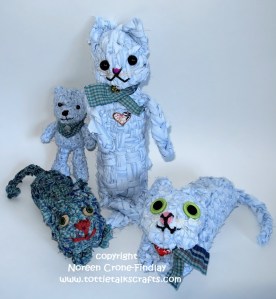
I cut them up and wove them into kittys, as that was what my grandson asked for, so he has one, and other family members have them too. (I didn’t photograph all of them).
I also knitted a teddy bear for one of our relatives, as he is definitely a teddy bear guy 🙂
The bear and kittys have been well received and they do carry the love that went into every stitch of making them.
I’ve done this before, and have found that ‘compassion critters’ made from upcycled clothing of a dear one is very comforting for people in grief.
Every little thing helps….
Here’s the video:
The woven kitties and knitted bear are made from the following patterns:
I use weaving hooks in all kinds of weaving- everything from potholder looms and frame looms to triangle looms, and a fair few looms in between.
Crochet hooks are okay for some weaving, but they can be too short and too round for some weaving.
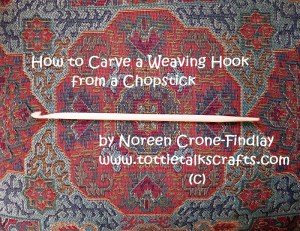
I have found that making weaving hooks from chopsticks is quick, easy and very satisfying. It’s a great way to upcycle.
Chopstick weaving hooks are longer than crochet hooks (afghan hooks can be hard to find) and are flatter, and work beautifully.
You can customize your weaving hook to be the absolute bees knees by fine tuning it with a little sanding or whittling as you work with it.
Here is a step by step ‘how to’ video tutorial that shows you how you can easily carve or whittle your own perfect weaving hook with just a few simple tools:
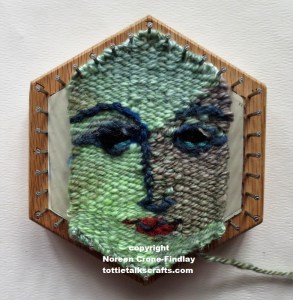
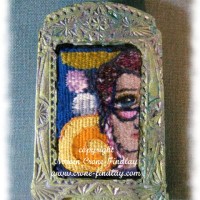
I’ve just finished weaving a new Woven Woman mixed media tapestry. LINK
Woven Woman (Essence) by Noreen Crone-Findlay (c)
I’ve made 3 video tutorials to show how I wove various aspects of her:
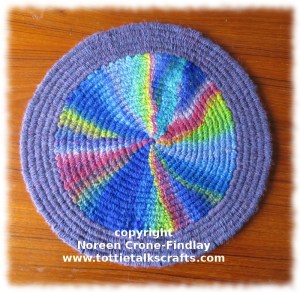
How I wove the ‘Galaxy’ circle at her heart: LINK using the Peg Loom
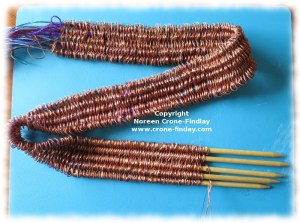
weaving with wire on weaving sticks
How I wove the narrow copper band around her face, using Weaving Sticks: LINK
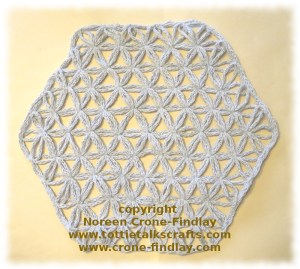
And, the third video shows how I used a Lily Speed o Weave loom to weave a hexagon, using the ‘Flower of Life’ pattern, with spool knitted cord.
I spent several days shooting a video, showing how to weave the Flower of Life with wire, but the wire just doesn’t show up in the video. Sigh.
So back to the drawing board, and several more days, but this time, using spool knitted cord, because it shows up well in the video.
Flower of Life pattern woven on the hexagon loom by Noreen Crone-Findlay
You can use all kinds of things to weave this pattern that is a celebration of geometry- Lucet cords, wire, thread, yarn, art yarn, roving (use thread or embroidery floss or yarn to tie the intersections), t shirt yarn, fabric strips…. no limits!
By the way: In my etsy shop, there’s a great eBook:
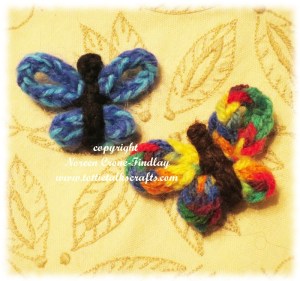
Butterflies are the symbol of transformation, and since everyone I know seems to be experiencing some kind of transformative experience or another, it seems to me to be a good time to make some little butterflies.
They are very quick and easy to make, using a Lucet – although you can also use spool knitted cord, if you prefer.
They can be used to embellish anything that you can think of, or can be stitched to a ribbon for a book mark, or have a pin sewn to the back so they can be worn on a hat, bag, scarf or lapel. They can be attached to a key ring.
They can be used in scrapbooking or card making.
It’s lovely to have one in your pocket to give to a friend who just needs a little comfort…..
Here’s the video for how to make the butterflies:
We are in deep, cold, snowy mid winter in Western Canada, so it’s lovely to have butterflies flittering about the studio, even if I had to make them myself! 🙂
That just reminded me of something that I hadn’t thought of in years….
My mother used to give us ‘Butterfly Kisses’, which were a quick little flutter of her eyelashes on our cheeks.
I unraveled the sleeves of the sweater and used the Comfort Bear pattern LINK to pattern
It’s taken awhile, because, I think that I needed to design the Comfort Bears first.
I was so pleased when I had an ‘AHA!’ that I could use the Comfort Bear pattern to make the Memory Bears for Marie’s daughter and her partner, her son and grandson and her grandson’s Mum.
They’ll be able to cuddle a little of their Mum and Grandma whenever they need a small bit of comfort…..
I am finding the Comfort Bears to be very inspiring… They have many aspects, and more keep being revealed.
I designed these wee crocheted comfort bears many years ago.
I’ve had requests for a pattern for crocheted comfort bears, and so here is my pattern for crocheters to create wee bears to give to charities and individuals who are in need.
May they bring joy to those who make them and to those who receive them.
❤ Noreen
CROCHETED COMFORT BEAR
Designed by Noreen Crone-Findlay (c) 2001
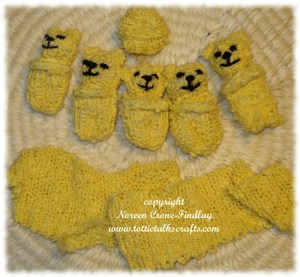
The size of your hook and weight of your yarn will determine the gauge of the crocheting, and the finished size of your bear. When made with worsted-weight yarn, the Comfort Bear is approximately 3 inches tall. When made with Embroidery Floss, it is approximately l inch tall. In order
to make this bear, you will need to know how to make a chain, slip stitch, single crochet and double
crochet.
MATERIALS:
Larger bears in photo were made with approximately half an ounce of worsted-weight yarn. Smaller bears were made with 1 skein of embroidery floss or lace weight yarn, using one strand. I experimented with copper wire. Oh ugh! I don’t recommend it!
Black embroidery floss for embroidering the features.
Crochet Hook in a size appropriate to your size of yarn
(For larger bear: “H”
For smaller bear: Steel Size 9 (l.15 mm))
Darning needle for sewing seams
Embroidery needle for embroidering features
ABBREVIATIONS:
Ch= chain
Sc= single crochet
Dc= double crochet
Sl St= Slip stitch
Turn= turn the work over and start the next row in the last st of the last row
Y0= yarn over the hook
* to *= you will repeat the instructions that appear between the two”*” signs however many times stated in the pattern. BEGIN WITH THE FIRST LEG:
Ch 5, leaving about 4 inches of yarn at beginning of ch. This tail will be used to sew the legs up later.
Row 1: Sc in 2nd ch from hook and in each ch to end. (4 sc). Ch 1 and turn.
Row 2 & 3: 4 sc, ch l, turn. Cut yarn, and draw end through last ch l.
Repeat Rows 1 – 3 for the second leg, but do not cut the yarn. Ch l and turn. BODY:
Row 4: Work l sc in each of the 4 sc of second leg, then work l sc in each of the 4 sc of the first leg. (8
sc). Ch l and turn.
Row 5 & 6: 8 sc, ch l, turn. HEAD:
Row 7: Sc in lst sc, (ch 2, sc in next sc)7 times. (7 ch 2 spaces formed) ch l, turn.
Row 8: 2 sc in each ch 2 sp (14 sc) ch l, turn.
Row 9: (l sc in first sc, sk next sc)7 times. (7 sc) ch l turn
Row 10: sc in lst 2 sc,(insert hook into next loop, yo, pull through st)3 times, yo, pull yarn through all 4
loops on hook, sc in last 2 sc. (5 sc) ch l turn.
Row ll: 5 sc, ch l. Cut yarn, leaving a tail of about 10 inches, pull yarn end through last ch l. ARMS: Make 2:
Row 1: Ch 4, sc in 2nd ch from hook, sc in each remaining ch. (3 sc) ch l, turn.
Row 2 and 3: 3 sc, ch l, turn. Cut yarn, leaving a tail of about 4 inches, pull yarn end through last ch l. FINISHING: Head: Gather upper edge of head and pull up tightly. Stitch.
-Sew center back seam of head.
-Stuff head. Neck: Wrap yarn end around neck of bear 3 or 4 times, and pull up tightly.
– Stitch over the neck wraps 2 or 3 times to lock in place. Legs: Fold the leg edges together. With the starting yarn end, sew the leg seam up to the center back. Body: Stuff body and sew shut. Arms: Sew arm seam, and sew arm to bear. Repeat for other arm. Ears: Push crochet hook into a stitch in the top of the head, yo, pull up a loop onto hook. Ch 4.
-Cut yarn, pull end through last loop on hook.
-Tie a knot with first yarn end, then thread yarn end into darning needle, and hide yarn ends inside
head.
-Repeat for other ear. Features: -Embroider features by stitching with straight stitches approximately 6 or 7 times for eyes and nose.
– Embroider mouth by making a single straight stitch at each side of the nose.
If you would like some help embroidering the features, please check out:
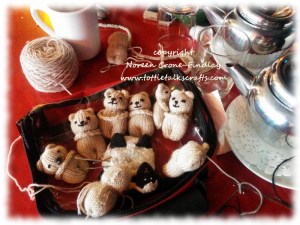
Because I offered to make the tiny knitted comfort bears LINK TO PATTERNfor the Women’s Shelter, and they responded enthusiastically by asking for 40 of them by Dec 21 (eegads), I have been taking them with me everywhere I go, making making making little comfort bears.
I’ve been so grateful that friends have offered to help me with them.
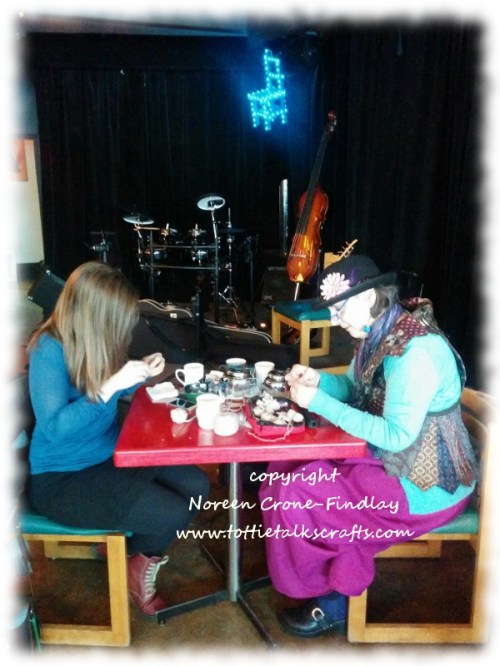
It’s such a joy to sit together making these wee ambassadors of love and connection:
Arwen & Noreen at the Blue Chair cafe making Kindness Bears
I have been hearing really touching stories from people- the tiny bears have the amazing capacity to open hearts, so people feel safe to tell their stories…. some of which are really painful to hear, but must be heard even so.
Emily Dickinson’s poem:
If I can stop one heart from breaking, I shall not live in vain; If I can ease one life the aching, Or cool one pain, Or help one fainting robin Unto his nest again, I shall not live in vain.
has taken on even deeper meaning to me as I make these tiny ‘Kindness’ bears.
I have to admit that some of the stories that I have heard have brought tears to my eyes, and sometimes cause rage to well up at the horrors some people have endured.
If these little bears can bring solace, well, then, I , and all those who join me in making them, shall not have lived in vain.
It brings me such joy to see people everywhere finding ways to create comfort and to show their love of humanity.
Recently, I went to a benefit concert for Syrian refugees, and one of the organizers said: If you want to help, don’t ask us what you can do, tell us what your strengths are, and then do that.
I thought about what she said and then asked one of the other organizers if knitting teddy bears for the Syrian children was culturally acceptable, and she said that it is indeed.
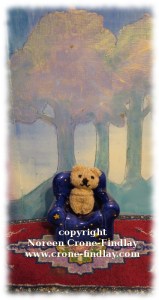
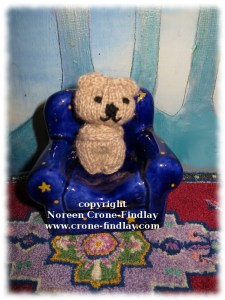
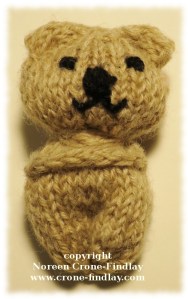
And, so, I have designed a tiny knitted teddy bear that fits in a pocket to be a perfectly portable comfort, cuddle or hug.
I decided that I also need to help out with children who are already here, and are in distress.
So I offered to knit some for the children in the Women’s Shelter as well as for the Syrian Refugee children.(The lady at the Women’s Shelter was delighted with my offer and has heartily taken me up on it 🙂 )
Also, I am going to knit a few to keep in my bag for those times when I meet someone who just needs a little extra TLC.
I invite you to knit them for whatever charity makes your heart sing.
Feel free to share the link to this page… it would be wonderful to have knitters all over the world knitting these wee ambassadors of love and comfort!
copyright Noreen Crone-Findlay
Note:the finished size of this Tiny Comfort Bear is determined by the size of knitting needles that you choose and the thickness of the yarn.
YOU WILL NEED:
EQUIPMENT: Knitting needles (the Cuddle Bear in the photos was knitted with 2.75 mm needles); scissors; darning or tapestry needle; embroidery needle; ruler or tape measure.
Note: You can also knit these Comfort bears on a knitting machine if you have one. Because I have been requested to knit so many, I have made a whole bunch of them on my knitting machine.
YARN: 1 ball of sock yarn will make 10 or more Comfort Bears.
ALSO: A small amount of stuffing; black sock yarn or embroidery floss to embroider the features.
FINISHED SIZE:
With sock yarn and 2.75mm needles, the Comfort Bear is 3 inches/ 7.5 cm tall.
With sock yarn and 2.25mm needles, the Comfort Bear is 2 1/2 inches/ 6.25 cm tall
NOTE:For a very small bear: Use smaller needles and thinner yarn, such as lace weight.
For a larger bear, use thicker needles and heavier yarn.
copyright Noreen Crone-Findlay
INSTRUCTIONS:
BODY:
Leave at least 6 inches/ 15 cm of yarn for finishingand cast on 12 stitches.
Row 1: K 12
Row 2: K 1, P 1 in each stitch. (24 stitches)
Set up your knitting: You can either work the Comfort Bear flat on 2 needles, then sew the center back seam after finishing, OR, work it in the round, using 4 dpns, OR in the round on a magic loop on 1 long circular needle OR in the round on 2 shorter circular needles.
Rows or Rounds 3 – 15: Work in st st.
NECK:
(Eyelet Row/Round): Row or Round 16: [K2tog, yo] 12 times.
HEAD:
Rows or Rounds 17 – 30: Work 24 stitches in st st.
Row or Round 31: [K2tog] 12 times. (12 st)
Cut yarn, leaving 8 inches/20 cm for finishing.
copyright Noreen Crone-Findlay
FINISHING:
(Note: If you knitted your Comfort Bear flat on 2 needles, sew up the back seam now before completing the steps.)
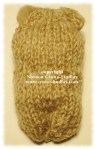
1] Thread the yarn end at then end of the last round into a darning or tapestry needle and take it through all the stitches.
copyright Noreen Crone-Findlay
2] Pull up the stitches to close the top of the head, then take the needle through all the stitches again to secure them.
3] Stuff the entire body.
4] EARS:
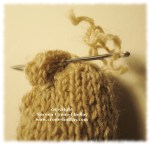
Pinch a semi-circle out at the side of the head and stitch through the base to form the ear. Stitch along the base of the ear, back and forth to define it well.
copyright Noreen Crone-Findlay
Stitch in place at the top of the head, then take the yarn inside the head and come out at the other side. Stitch in place to secure the yarn and then stitch the other ear in the same way.
copyright Noreen Crone-Findlay
Take the yarn end inside the body.
5] LEGS:
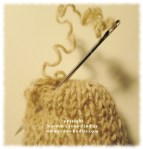
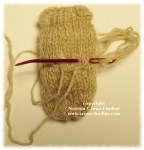
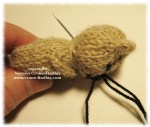
Thread the yarn end at the lower edge of the body into the needle and then pull up to gather the lower edge closed. Stitch in place to secure the gather.
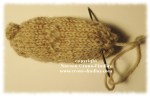
Take the needle through the body about 1/4 inch/.5 cm up from the base.
copyright Noreen Crone-Findlay
Go through the body again, slightly up from the last stitch.
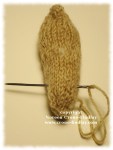
Now, stitch back down towards the feet.
Stitch through the body several more times, to create the line between the legs.
copyright Noreen Crone-Findlay
Stitch in place at the base, then take the yarn end back into the body.
copyright Noreen Crone-Findlay
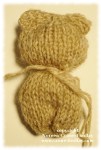
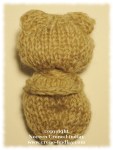
6] NECK: Cut a piece of yarn about 30 inches/75 cm long and fold it in half.
Thread the ends into the darning needle then go in and out the eyelet round at the neck.
copyright Noreen Crone-Findlay
Wrap the yarn around the neck several times and then tie a tight knot to secure the neck.
copyright Noreen Crone-Findlay
Take the ends inside the body.
ARMS:
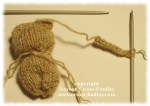
1] Leaving several inches of yarn at each end for attaching the i cord, knit a 3 stitch i cord that is 1 3/4 inches/4.5 cm long.
copyright Noreen Crone-Findlay
2] Sew the arms to the body.
copyright Noreen Crone-Findlay
FACE:
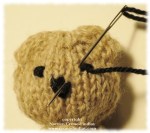
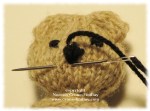
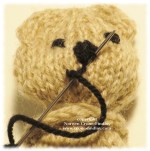
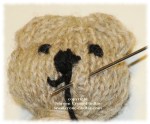
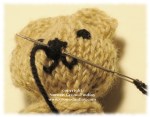
With black sock yarn or embroidery floss, embroider the face:
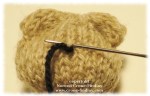
Bring the needle up through the head from the back of the neck to the center of the face.
Take a couple of tiny stitches to secure the yarn.
copyright Noreen Crone-Findlay
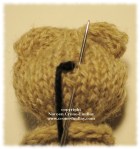
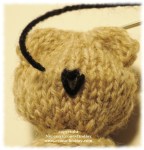
Stitch a ‘V’ for the nose, then take the needle out at the first eye.
copyright Noreen Crone-Findlay
Take a couple of tiny stitches for the first eye.
copyright Noreen Crone-Findlay
Then across to the second eye. Take a couple of tiny stitches for the second eye.
copyright Noreen Crone-Findlay
Take the needle from the top of the nose, down to the point of the V, then out to one side for the first half of the smile:
copyright Noreen Crone-Findlay
Pull the needle through the face at the point of the V and out to the end point of the smile.
copyright Noreen Crone-Findlay
The needle goes back in almost where it came out to catch the middle of the smile line, then comes out at the point of the V.
Repeat for the second half of the smile.
copyright Noreen Crone-Findlay
Take a couple of tiny stitches in the nose to secure the end.
copyright Noreen Crone-Findlay
Then, go through the body to bury the yarn end.
Snip the yarn end at the back of the neck.
copyright Noreen Crone-Findlay
And there you have it!
Here’s a video tutorial on how to embroider a teddy bear face:
I hope that you’ll enjoy the tiny comfort bear to bring joy into your life in the knitting of it, and joy into the life of whoever you give it to.









 Tottie Talks Crafts Blog