I hate wasting yarn… so I really don’t like loom waste – who wants to toss their yarn in the trash? Really 🙂
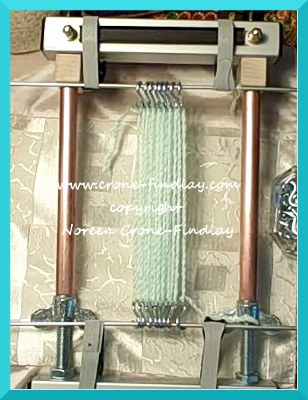
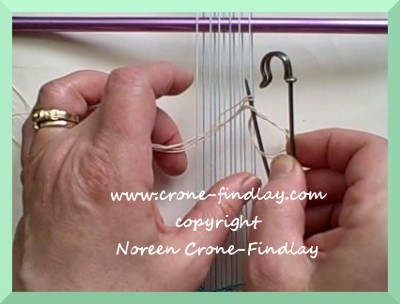
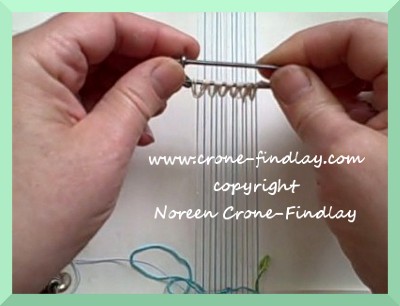
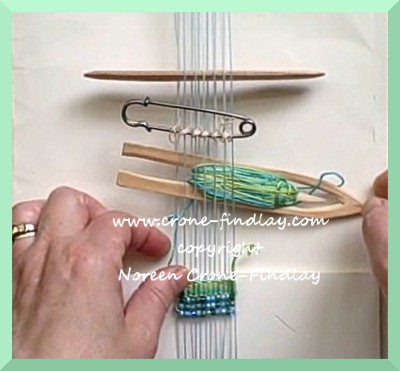
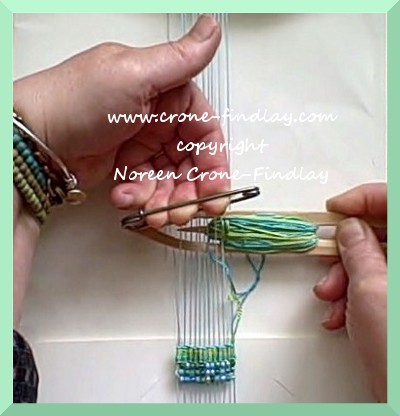
That’s why I love Claudia Chase’s ‘No Warp Ends’ technique for the Mirrix looms.
copyright Noreen Crone-Findlay
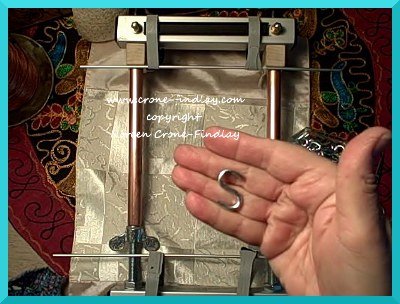
The one thing that I wasn’t keen on was using paper clips to be the holders for the yarn ends, so I thought about it and mulled it over.
Hmmmm…. I use ‘S’ hooks all the time to hang things and connect them, but I have never used them on a loom.
This called for some experimenting.
I don’t know about you…. but, I have a tendency to start with a really complicated plan, and have to do a lot of trial and errors to get to the elegant and simple final version.
I was thinking about all kinds of ways of making harnesses to hold the bars for the ‘s’ hooks…. oh my!
I also figured that I wanted to use both sides of the loom while setting up for this technique.
I had woven two affinity bracelets at the same time- one on the front of the loom, and one on the back, so this seemed to stick in my mind as ‘the way to go’.
Well… I twiddled and fiddled, and threw away the whole overly elaborate harness idea, and ended up using 4 loops of double sided velcro to hold the bars to the upper and lower edges of the loom.
That was a big breakthrough- talk about a simple way to do this! Yay!~
And, I am really pleased with the final method that I came up with- it really works for me!
copyright Noreen Crone-Findlay
Here is the video, showing how I warp the Mirrix Lani using the ‘No Warp Ends’ technique, with ‘S’ hooks:
My daughter-in-law spins gorgeous yarn. Which makes me very happy.
Because, sometimes a skein or two finds its way into my studio.
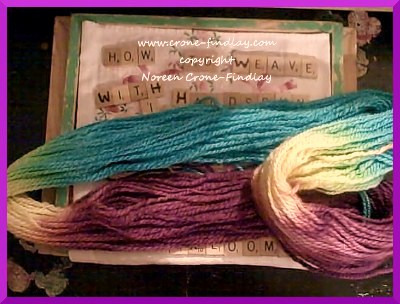
Recently, she spun Merino and silk and dyed it turquoise and purple, separated by short sneezes of sunshine yellow.
copyright Noreen Crone-Findlay
I love it, and have been puzzling over how to use it in one of my new tapestries in a way that keeps the integrity of the colorway, while working across the entire width of the tapestry. Weaving narrow bands of it in vertical columns would not be a problem with maintaining the colors as units… but… horizontally- ah, well… that’s another cup of soup entirely.
I didn’t want to have the colors end up in little splats of one color arguing with another.
That meant working in short segments, weaving small blocks of each color.
I could have woven little squares of each color, with little slits that would need to be stitched or interlocked. Myech…
I sat down with my trusty little pencil and thought about this conundrum….
and came up with this:
copyright Noreen Crone-Findlay
If I started at the left hand edge, and wove a little triangle with one length of turquoise, then, I could use the little bursts of yellow to tell me when to nip down, and start a slanting wedge of purple.
This completely worked for me! I wouldn’t have any joins to deal with, and I could work each little section of color in order, so the colorway of the yarn stays intact.
It’s a happy solution to an interesting problem!
Tapestry weaving is full of nifty little voyages of discovery 🙂
copyright Noreen Crone-Findlay
My first little purple patch was not so perfect, but by the time I had woven across to the right hand side I was pleased with it.
If you have a loom that doesn’t have a shedding device, picking up the warp strands for every row you weave can be a tedious process.
I like to use a stick, a pin and a loop of string to open the sheds. It’s a huge time saver!
I’ve made a video tutorial on how to do this for narrow bands, but this technique also works on wider pieces, too.
copyright Noreen Crone-Findlay
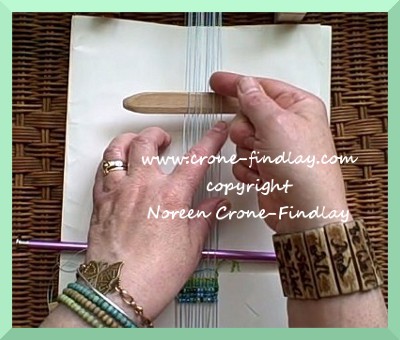
Pick up every other warp strand with a weaving stick (even a popsicle/craft stick or a paint stick will work).
Push that stick up to the top of the loom.
copyright Noreen Crone-Findlay
Now, use a knitting needle to pick up the ~remaining~ warp strands, to open the second shed.
You’ll be going over the strands that you went under in the first shed, and under the ‘overs’.
copyright Noreen Crone-Findlay
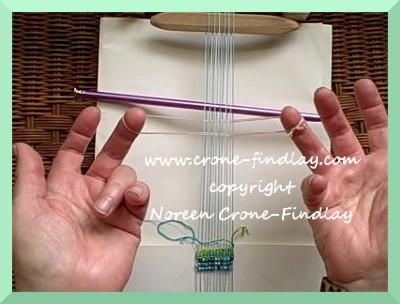
Take a loop of string (in this case, I used 2 string heddles from one of my inkle looms held together for more strength, and to make it easier to see in the video) through the open shed.
copyright Noreen Crone-Findlay
Pick up the end of the loop with a kilt pin, and then lift the loop strings between each warp strand onto the pin.
copyright Noreen Crone-Findlay
Take the second end of the loop up onto the pin, and close it.
Adjust the length of each section of the loop.
And, Voila! you now have a handy, dandy way of opening both sheds!
copyright Noreen Crone-Findlay
copyright Noreen Crone-Findlay
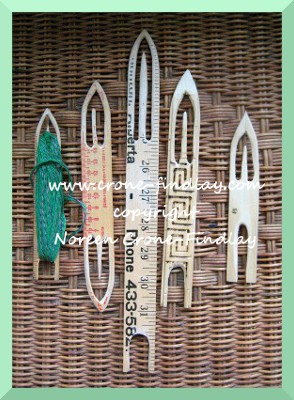
Here’s a pic of the shuttles that I make by upcycling old rulers and bits of decorative trim:
copyright Noreen Crone-Findlay
HOT TIPthat I mentioned in the video: If you use a file folder as the separator/background thingie between the front and back of your loom, you can use the pocket of the file folder to park your shuttle and beading needle when you’re not weaving.
I love buying vintage crochet cotton at the thrift shop. It speaks to me of the hands that it has passed through, and the pleasure it has brought to other thread lovers.
I like to use it in my weaving, crochet and tatting, as it gives me a sense of connection to needlewomen of the past.
BUT… storing balls of crochet cotton can be a problem. Those hollow cores take up a LOT of space!
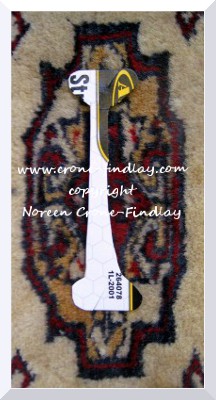
So, for many years, I have been upcycling old credit cards or pieces of cardstock to make bobbins like this:
copyright Noreen Crone-Findlay
Because, storing yarn or thread on a small flat bobbin is so much more efficient than leaving it on the cardboard tubes:
copyright Noreen Crone-Findlay
Last night, I had insomnia, and was thinking about winding off a pile of vintage crochet cotton, when I had a flash of inspiration!!
Instead of making chubby little embroidery style bobbins, if I made ‘dog bone’ shape bobbins, I could use my bobbin winder to speed up the process of winding them. AND, they’d take up less room, as it would be a longer, leaner shape.
I jumped out of bed, and started cutting the new shape bobbins:
copyright Noreen Crone-Findlay
And, winding up balls of cotton:
copyright Noreen Crone-Findlay
In a twinkling of an eye, I have compactly wound bobbins that won’t tangle with other bobbins, as the thread is taken through a slot and secured. Another bonus! No snaggles!
copyright Noreen Crone-Findlay
This shape of bobbin is great for warping the Mirrix loom, as it’s so compact. Yep – it’s a win!
And, they can be easily stored in unusual containers, like this:
copyright Noreen Crone-Findlay
I made a video to show how quickly and easily this works:
I haven’t tried using these bobbins for tapestry weaving, but I will, and will let you know how I like them.
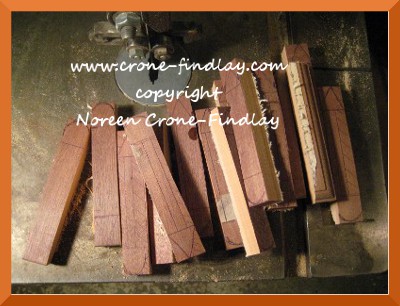
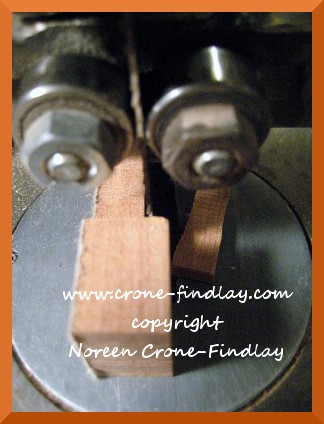
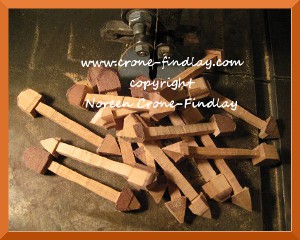
I love making tapestry bobbins from wood- especially upcycled wood, so I will be showing you how I do that in an upcoming post.
Happy weaving, and here’s to creative ways of storing yarn and thread stash! 😀
At the beginning of May, a ‘new-to-me’ loom , a large Mirrix tapestry loom, arrived in my studio. (Courtesy of my son and daughter in law who picked her up in the city 4 hours away, that used to be her home- the previous owner didn’t want to ship her).
copyright Noreen Crone-Findlay
I immediately sat down and made a whole lot of heddles for her, as she didn’t come with them.
And then, I warped her up- ooooooooohhhhhhhhhh, I love how easily she warps! Bliss!
As I was warping her up and starting to weave, I thought…. ‘Hmmmm…. there must be a group for Mirrix weavers on Ravelry’
(Ravelry= the facebook of the yarn world)
I looked, and sure enough! There is a Mirrix group…. which I joined, pronto.
And the first thing I saw was that Claudia (the inventor of the magical Mirrix looms) and Elena, her talented daughter, had posted that they were accepting applications for their annual ‘Social Networking for a Mirrix Loom’ campaign. Link
Well… I had decided within hours of starting to weave on my ‘Joni’ loom that I wanted to fill my studio with Mirrix looms.
So, I sent off an application….
Um… I wanted to fill the studio with ~Smaller~ Mirrix looms!
MEANWHILE>>>> The Joni is one big Mamma, and even though I am tall, my arms are short, so I found that I was having shoulder pain.
My clever daughter in law subtly sneaked the information out of me that I was longing for the treadle kit for the Mirrix loom. Then, she orchestrated the family buying me the treadle kit for Mother’s Day! What a sweetheart!
To say that I was thrilled was an understatement!
THEN! on the 18th of May, was just tickled pink to hear from Elena that they had picked me as one of their team for the 4 months of the ‘Social Networking’ campaign. Whee! What a couple of thrilling days!
And, now… I am starting to keep my part of the bargain, which is to chronicle my experiences with the Mirrix loom(s).
So, since I began my Mirrix adventures with making string heddles, I am going to show you my quick and easy way of making the string heddles for the Mirrix looms (or inkle or frame looms, too).
Hearts are one of my most favorite design motifs ever.
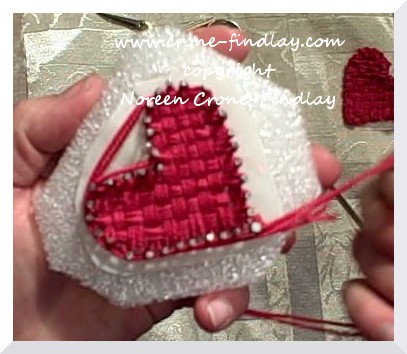
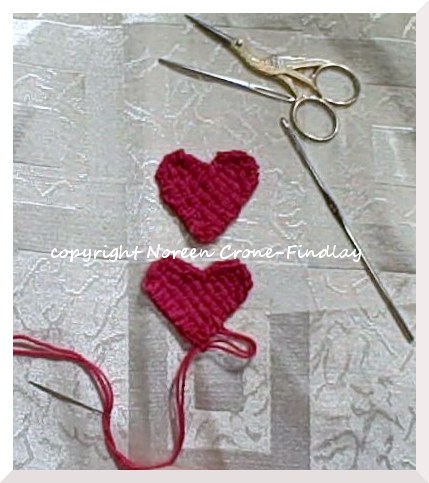
I decided that I should design a tiny little woven heart motif as a project for the ‘Stitch Red’ heart health campaign, and also work as an embellishment on a special ‘I love you’ scarf for my daughter.
Here’s the link to the previous post about using tambour crochet to embellish the scarf: Link
The yarn used in the heart motif is from Koigu, made specially for the Stitch Red campaign. Link
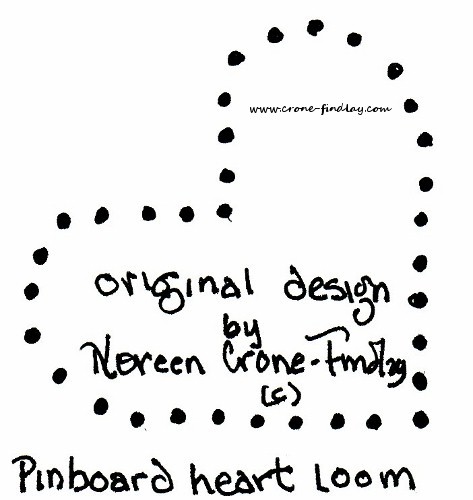
Here is the pattern to make the pin board loom to weave the heart:(Note: Print it out so the pattern is 2 inches by 2 inches)
copyright Noreen Crone-Findlay
Materials and equipment: a square of foam (I upcycled some packing material) that’s about 4 inches square by an inch or so thick.
34 pins or 1 inch fine finishing nails. (You may need a nail file to file rough edges off the tops)
A 3 or 4 inch square of clear plastic from a clamshell package or other recycled thingie.
Knife to cut the foam, scissors.
2.5 mm crochet hook
small tapestry needle
Instructions
1: Copy the pattern, and trim to fit the size of piece of foam.
2: Place the piece of clear plastic over the pattern. Push the pins into the dots.
Warping: The right hand arch of the heart is held vertical and the left hand arch is horizontal.
3: Tie 2 strands of yarn together (Note, you need to be working with fine yarn, like a sock weight) and place over the pin at the point of the heart.
4: Skip 8 pins, go around the next pin and down to the lower edge, and around the pin to the left of the pin at the point.
5: Go up and down across the 5 pins at the top and their mathcing pins on the lower edge.
6: Take the yarn up to th emifpoint pin (there are 3 empty pins above it) and down.
7: Go up and down across the next 5 sets of pins. There will be 3 vertical pins/nails left empty. Make an ‘8’ around the last set of nails to bring the yarn back down to the lower set of nails.
copyright Noreen Crone-Findlay
8: Weaving
Row 1: Weave hook from right to left: Over 4/Under 4 between the 1st and 2nd pins.
Make a loop of yarn and place it on the hook, then draw it through the warp strands. Place the loop on the 2nd nail on the right hand side.
Adjust yarn.
Rows 2 & 4: Weave Under 4/Over 4 across, pick up the loop of yarn, ease through, place loop on nail/pin.
copyright Noreen Crone-Findlay
Row 3: WEave Over 4/Under 4 across, pick up loop, ease through, place on nail on right hand side of loom.
Rows 5 & 7: Weave )ver 4/Under 4/Over 4/Under 4/Over 4… make loop, ease through, place on pin on right hand side.
Note: on Row 7, the yarn passes by 5 pins before it’s woven in.
Rows 6 & 8: U4/O4/U4/O4/U4 make loop, ease through, place on pin on right hand side.
Row 9: Working with top 3 pins only: U4/O4/U 4 make loop, ease through, place on pin on right hand side. (It already has loops on it, but not to worry).
copyright Noreen Crone-Findlay
Finishing:
Wrap the yarn around the circumference of the heart 2 1/2 ties and snip.
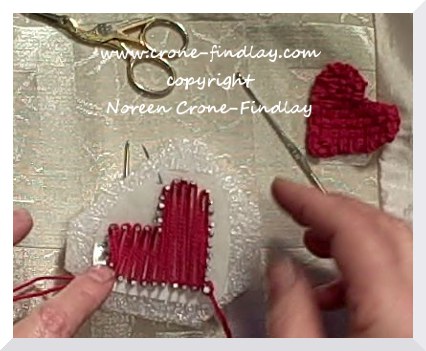
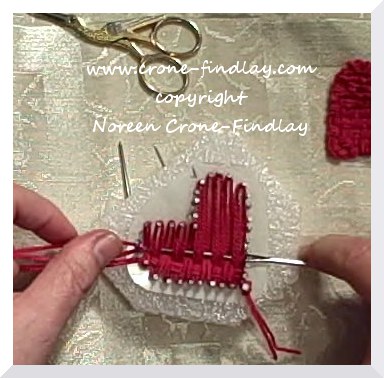
Working in a counter clockwise direction: Thread the yarn ends into a darning needle and lift the stitches off, one by one, stitching through them.
copyright Noreen Crone-Findlay
Some nails have 2 sets of threads on them, so lift the sets of yarn off one at a time.
Stitch over the long floating threads to capture them.
Stitch twice at the tip of the heart.
Untie the beginning knot and weave in the ends.
Adjust the circumference stitching to shape the heart, and stitch through the outside edge again if desired.
Weave in ends and trim.
copyright Noreen Crone-Findlay
The hearts can be used to embellish or trim scarves, hats, mittens, gloves, cowls, hair ornaments, bags, stuffies, dolls, toys, blankets, shawls, stoles, vests, coats, wall hangings, cellphone and tablet covers. The sky’s the limit!
Here’s the video tutorial on how to weave the heart motif:
I think that people might like to have a heart loom in wood, so I asked Donna and Gary McFarland of Dewberry Ridge looms Link if they would make them, and they said yes, so if you want one, drop them a note.
PLEASE NOTE: All content of this blog, including video, audio, written and photographed is the sole work and property of Noreen Crone-Findlay, and MAY NOT be used without my permission. Thanks so much!
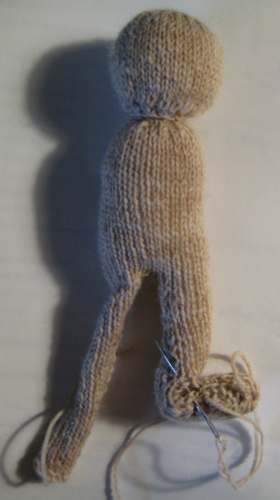
A lady on Ravelry is having trouble making Edward Bear’s foot, so I am going to show some step by steps on how to do it:
copyright Noreen Crone-Findlay
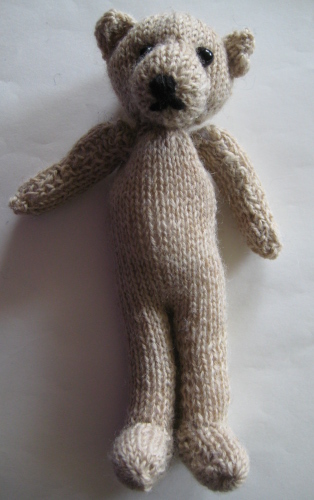
Here is Edward Bear with his head and one leg stuffed.
His foot is turned up and the stitching is started along one side of the foot.
copyright Noreen Crone-Findlay
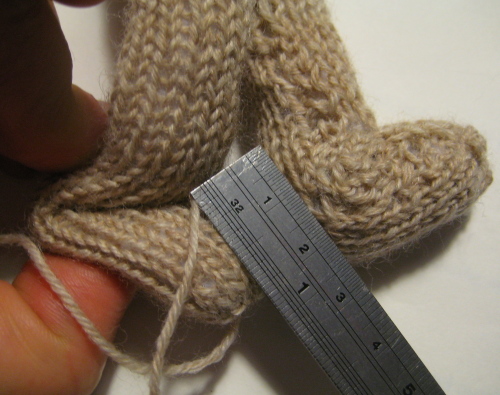
Here’s a closeup of measuring the foot- Stitch the edges together around the fold to stitch the foot to the leg- around the sides of the foot and across the top of the foot.